Full text
He doesn’t remember me, but I know who he is. The biographer and I met at a party Nathaniel took me to about a year after I arrived in New York, a literary fundraiser at one of those apartments where the elevator opens right into the living room. “Wilhelmina, this good man wants to write about me,” Nathaniel said. “Your assignment tonight is to persuade him of a better idea.”
A tray of miniature hamburgers floated by, and the biographer grabbed one and ate it looking down at my feet. He was squarely middle-aged, with a saddish face and damp-looking skin that suggested an indoor life. He followed us from the bar to the bookshelves and back again as Nathaniel drifted through the crowd greeting people. Nathaniel, as I recall, was kind but distracted, and probably irritated by how I hovered at his elbow, laughing a beat late at every joke. I was too new to that scene to talk to anyone without them addressing me first. And who would? I was, what, twenty-four, conspicuously younger than every other guest. For months, I’d wanted Nathaniel to bring me along to one of his obligations, as he called them—but when I got there, I found it sterile and frightening. All those long-haired women with their stylish glasses, the men, like the biographer, looking at me in that furtive, knowing way, like I was something—a dollar bill, or a pen—Nathaniel might drop for them to pick up.
“I’m going to do it, you know,” the biographer said, grabbing another tiny hamburger. “Write that book.” On the mantel above the fireplace—a fireplace, in a penthouse!—the hosts grinned from a photo, bookended by Bill and Hillary Clinton.
“The definitive biography! Get in line,” I said, taking a sip of wine. I’d never heard anything from anyone about a biography, but amplifying Nathaniel’s importance seemed a key task in my vague job description, along with maintaining the orderliness of his sock drawer and always being available for a daytime trip to the movie theater.
“To think he wanted to be an actor,” the biographer said. “Can you imagine?” Nathaniel was already a few steps away, making a quarter he kept in his suit pocket for this purpose appear and disappear behind an elderly woman’s ear.
“Nathaniel as an actor?” I said. “Of course I can.” “I mean a world where he never wrote his books.”
In those early days I could be disarmed by the performative fandom of Nathaniel’s readers. They were contributing to a different conversation, a secret one about influence and loyalty and status that underpinned the one happening on the surface. I hadn’t learned to hear it yet. “No, I can’t,” I agreed. And wasn’t it true? Nathaniel’s books had made this world for me. They’d been the doorway, and now here I was, on the inside.
At the time of the party, the biographer had not yet written a single biography. I had written many poems, but not yet anything Nathaniel liked. Nathaniel had written six collections of poetry, two screenplays, four literary novels, one essay collection. A book of food writing; a pocket-sized collection of aphoristic wisdoms about the weather that sold better than all the poetry books combined. A best-selling memoir that had been adapted into a movie; a gritty, out-of-character romance that had been adapted into an even more famous movie.
Lili had not yet written the piece that would change all our lives.
I took a hamburger, too, and ate it looking into the biographer’s eyes. A piece of bun fell straight out of my mouth. The biographer watched it fall and then stepped on it, as if to hide my bad manners from both of us. In Nathaniel’s settings, I was mostly quiet and accommodating. But sometimes an urge to be distasteful would overtake me. I didn’t know how to explain these urges to myself—or to Nathaniel, when he noticed—and they were always followed by an effervescent, almost pleasurable burst of shame. After I finished the burger, I wiped my fingers on my thigh, blushing.
The biographer got to talking about his apartment in Williamsburg, a neighborhood being gentrified into oblivion. In five, six years, he said, living on Graham Avenue would be like living in a juice bar. 2017 seemed as far away to me as Michigan. When he asked, I said I was living in Manhattan, and then I changed the subject. I was living in Nathaniel’s spare room. I was Nathaniel’s spare girl. Assistant, I told him, in response to the biographer’s precisely executed question about my relationship to Nathaniel. Literary assistant.
The sun had set. The cityscape through the windows was like a starry night from the future, galactic and buzzing. Over by the bar, Nathaniel gave me the signal for let’s split, the one we’d planned on the walk over—a finger gun raised to his head. But then a woman in a long dress grabbed his arm and he turned toward her, taking the drink she offered. I tried not to look disappointed.
“Stop touching your hair,” the biographer said. We’d been trapped together all evening, two shy losers.
“What?”
“When you talk, you touch your hair over and over.” He made an effeminate swooping motion; it took a beat to recognize he was showing me myself. “It makes you seem insecure.” He reached out and paused my hand. I was startled to find he was right—his hand and mine were in my hair now, almost cupping my face. There was something funny about this intimacy and I laughed without meaning to, but when the biographer didn’t join, I stopped, a bit afraid. He brought my hand down slowly, as if I couldn’t be trusted to do it myself. When my arm was safely by my side, he wrapped his fingers around my wrist, measuring its perimeter, and then squeezed my hand.
“That’s it,” he said. “Relax.” I tried not to move my arm. Adjusting my hair would prove a point, but I couldn’t guarantee he would interpret the action as rebellion, instead of more involuntary female idiocy. So I pretended I had no arm, no hand at all. When my hair drifted into my face, I blew it away, wishing I were a different sort of woman.
Oh, the relief when Nathaniel appeared beside the biographer with my purse. The thing about living in New York City was that no matter how bad an event was, when you left, you were still in New York City. Down on the street, I skipped, I was so happy, and that made Nathaniel laugh. “Never take me to another party again,” I said, and we shook on it.
“Shall we run back?” he asked. I didn’t think he was serious, but he took off, his jacket winging as he weaved between clusters of people on the sidewalk. They cursed at him, jumped aside, stared in wonder at the gray-haired man galloping in his dress shoes. Within a minute he had a block on me, but then—I was just drunk enough for this—I kicked my kitten heels off and held them in one hand as I ran. The city under my feet had an animal’s warm, breathing give, scaled with glass and bottle caps and still-burning cigarettes. I caught Nathaniel by the coat and only then did he slow. I was sweating; he was not. We got dollar slices a block from Nathaniel’s apartment, licking oil off our fingers as we made fun of the way the biographer stuck to my side, afraid to be seen in that room standing alone. “I can only imagine the questions he’d ask,” Nathaniel said. “What was your mother like?” He started in on his crust. My heels were bleeding, but I couldn’t feel it yet. I loved him very much.
Now, the first line of the biographer’s email: I don’t think we’ve met.
Outside the window of my temporary office, everything is gray—gray leaves, gray sky, gray sidewalk, the students walking in pairs and trios toward the cafeteria, which hulks grayly on the horizon. It’s been five years since that awful party; Nathaniel is due to arrive in Rosendale in a matter of days, for a reading I couldn’t manage to get canceled. I am writing the authorized biography of Nathaniel Fellow, writes the biographer. Authorized! Was it possible Nathaniel had agreed? Worry churns in my gut at the thought, and I try to ignore it. Not my problem anymore. I was told you knew him well, the biographer writes. Would you be open to a brief interview?
Maybe he’s just being polite, but the email is worded stiffly, a modification of a form. This happens to me often. I was a pretty girl in a city full of pretty girls. Easy to forget.
*
If you want to write fiction, Nathaniel said, start with as many real details as possible. His women were mostly based on women he’d known. His men were mostly based on him. Versions of him, he said. One can sort of throw one’s voice. The writer’s job, first and foremost, is to make what they are lying about feel true. We were on a blanket in Sheep Meadow when he told me this, finding shapes in the clouds, a game I’d never played, not even in childhood. And then, once the thing is written, change it up just enough so the person you’ve stolen from doesn’t recognize themselves. Elephant, he said. The Mackinac Bridge! The clouds floated into new shapes. A strawberry burst in my mouth.
The biographer probably wouldn’t think to ask me about Nathaniel as a teacher—he’d ask his verifiable former students, if he could get any of them to answer.
Another one of Nathaniel’s rules: If you need the past to tell a story, you’re telling the wrong story. When I started writing fiction, he handed all my stories back with the first three or four pages cut. I learned he did this to most of his students. He’d skim the first few pages, scanning for something interesting, and then write: Start here. Almost always, the second drafts were improvements.
I know where he’d start our story. His office, late August, New York City. A woman, opening the door. I’d read scenes like it so many times; when he called for me to come in, looked up from his desk, it wasn’t him I saw, not exactly, but him seeing me. The moment, as I lived it, played through his eyes: the girl with her long hair down, lip-stick an endearing bid to look older, bare legs shiny with lotion. A heavy bag of books, the pretense for this meeting, slipping off her shoulder, tugging the strap of her cheap dress with it.
I’ll begin our story much earlier than he would, and with a fact.
Nathaniel didn’t know I existed until I made him learn my name.
__________________________________
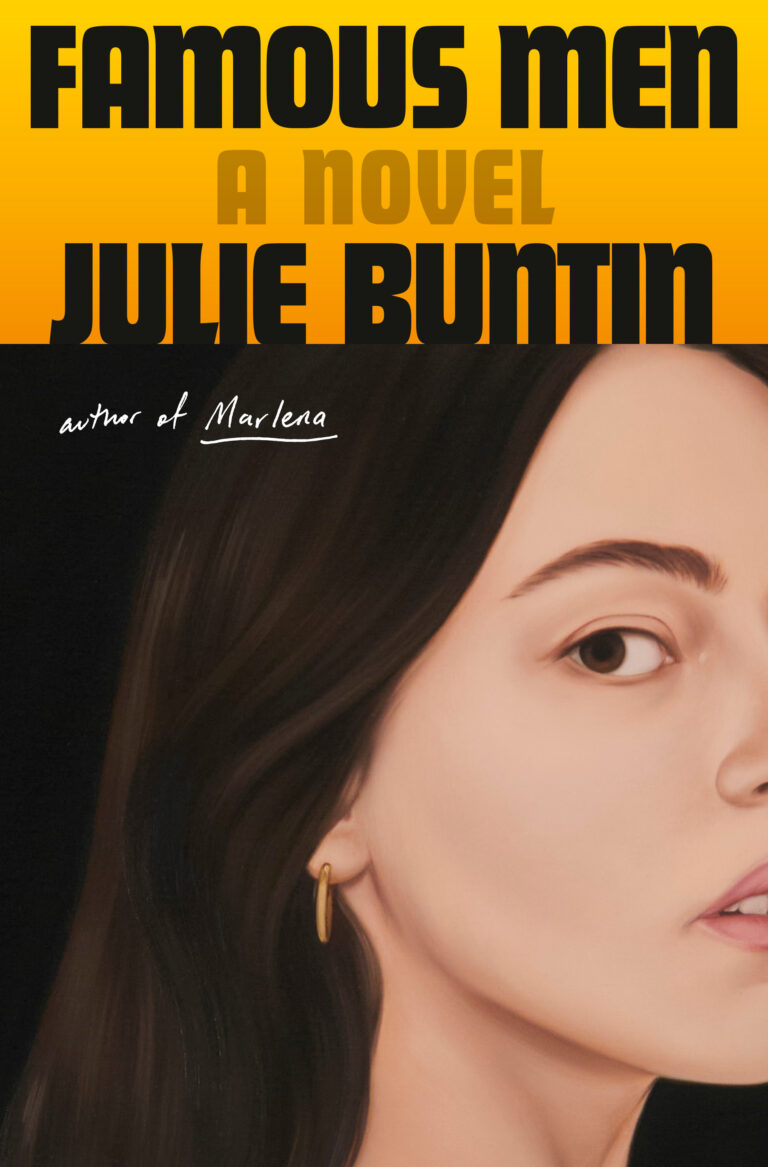
From Famous Men by Julie Buntin. Copyright © 2026 by Julie Buntin. Published by Random House, an imprint and division of Penguin Random House LLC. All rights reserved.










Comments
No comments yet — be the first to weigh in 👇
No comments yet. Be the first!