
Security guarantee for Ukraine modeled on NATO: Europe cautiously optimistic
Jared Kushner, Donald Trump's envoy and son-in-law, proposed in Berlin offering Ukraine collective security guarantees on the model of NATO's Article 5, suggesting the US president is "open" to such a "big deal". European officials close to peace negotiations received the proposal with cautious optimism, though they fear the price Trump demands could prove too high. One Russian official rejected the idea, but Putin has not personally denied it publicly.
Full text
BERLIN — The proposal from U.S. President Donald Trump’s negotiating team to give Ukraine a NATO-style collective defense guarantee has triggered an unusual new mindset among some of Kyiv’s allies in Europe: optimism.
European officials close to the peace negotiations are cautiously hopeful that the offer could signal a shift in America’s position in Ukraine’s favor — even though they remain wary that the price Trump will demand for such a sweeping commitment could be too high.
After two weeks of shuttle diplomacy, Trump’s envoy and son-in-law Jared Kushner proposed the security guarantee at last week’s press conference in Berlin, claiming the U.S. president is “open” to such a “big deal” and the Russians are now “comfortable” with it too.
Neither is yet certain, and one Russian official dismissed the idea.
But Russian President Vladimir Putin himself has not yet publicly rejected Kushner’s plan, and European negotiators are taking it seriously, even if they want more information about how it would work.
A security guarantee for Ukraine based on NATO’s Article 5 collective defense clause, which states that an attack on one member shall be treated as an attack on all, would change the game when it comes to deterring Russia from invading Ukraine again after this war ends. That is particularly true if, as implied, America, with its mighty military, is bound into such a guarantee.
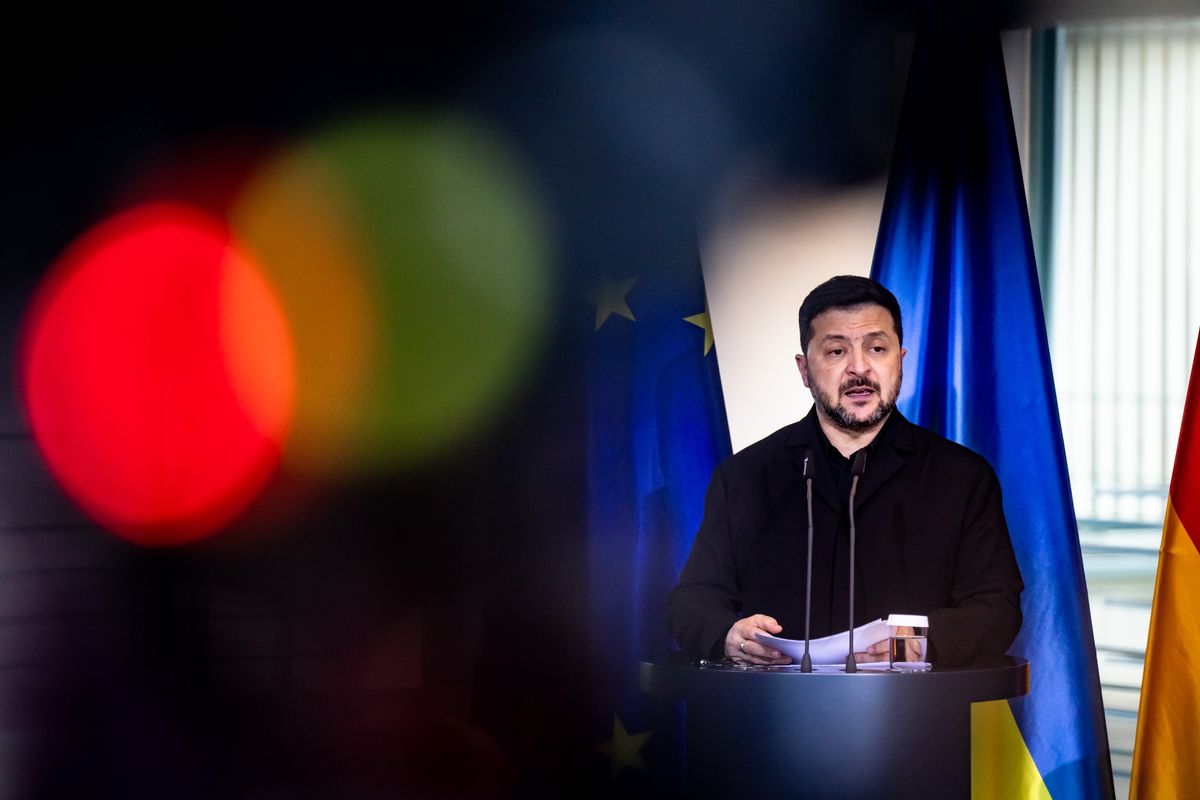
Ukrainian President Volodymyr Zelenskyy, French President Emmanuel Macron, US Special Envoy Steve Witkoff, back, and U.S. President Donald Trump’s son-in-law Jared Kushner leave a Coalition of the Willing media call in Berlin on Nov. 19, 2026. | Pool photo by Hannah McKay/Getty Images
While few details are known about the proposal, it would, if backed up by robust legal, military and political commitments, mean that a new attack on Ukraine would risk a direct conflict with the U.S.
An aide in French President Emmanuel Macron’s office said the U.S. is heading in “the right direction” but called on the White House to go a step further and give Ukraine full NATO membership.
An Article 5 guarantee “is obviously the best guarantee of solidarity among allies,” said the aide, who, like others, was granted anonymity to speak candidly. “So, if we say we’re giving Ukraine Article 5-type guarantees, we shouldn’t overcomplicate things: It means that Ukraine is joining NATO. The alliance’s credibility rests above all on Article 5. Article 5 is an article of faith.”
Shifting the mood
One reason why some Europeans believe Kushner’s offer is a genuine one is that he was not speaking off the cuff. In private, U.S. officials have been floating the idea for months. There has even been discussion behind the scenes of the French proposal for full NATO membership.
Although Ukraine joining NATO is seen as a red line issue Russia would never agree to, Kushner and co. clearly believe their efforts to discuss an Article 5-like option with the Russians have found support in Moscow.
And the mood in some parts of Europe has shifted as a result.
Families shelter overnight at a Kyiv metro station following warnings of possible Russian air attacks late on Nov. 19, 2026, amid the Russian invasion of Ukraine. | Roman Pilipey/AFP via Getty Images
Diplomats and officials who have spent much of the past two years of Trump’s second term despairing about his repeated torchings of the Western alliance — and worrying that he will sell out Ukraine — now sound relaxed about the U.S.
“Clear progress has been made on security guarantees,” said one European official close to the negotiations. “On peace talks there is alignment with the U.S., no maximalist demands and no discussion on European security without the Europeans.”
The aim now is that more progress will be possible toward targeted ceasefires in the energy sector and the Black Sea the next time the U.S. convenes peace talks between Russia and Ukraine, not least because Europeans will have their places at the negotiating table. That meeting is yet to be scheduled but officials expect it to take place in Abu Dhabi sometime after the American Thanksgiving holiday on Nov. 26.
Details matter
Not everyone is convinced. Speaking after Kushner’s announcement, Ukraine’s Volodymyr Zelenskyy said he was “not sure” everyone had the same understanding of what an Article 5-like guarantee would mean.
“What does it mean, Article 5? That there are some forces of partners on your land. So, my question is: What about American soldiers?” He said Ukraine “would be happy” if the U.S. put military bases in the country “like in the Middle East.”
Other Europeans agreed that there was still a lack of detail about exactly what Kushner’s plan would involve.
People walk across a bridge during a blackout in Kyiv caused by attacks on Ukraine’s energy facilities on Nov. 20, 2026. | Genya Savilov/AFP via Getty Images
The most skeptical Europeans are to be found in countries that share borders and a history with Russia, such as Poland and the Nordic and Baltic states, which are often the most hawkish toward Moscow. Poland will be part of the official European negotiating team, which is expected to join the next round of direct negotiations between Russia, the U.S. and Ukraine.
One risk Europeans are alive to is that the cost of such a security guarantee could prove to be too high. Americans asked Ukraine recently whether it would give Russia the whole of Donbas in exchange for full NATO membership. That would mean handing over land to Putin that he has not managed to win by fighting.
Keeping Russia happy
Ukraine’s territory is not the only issue on the table in these negotiations. Kushner has been equally insistent that revising the entire security framework that had governed Europe before the war is essential, including NATO’s relations with Russia. His broad argument is that if Europe’s security framework had been working properly, the war would never have happened.
Among Ukraine’s more than 35 allies who gathered in Berlin for the Coalition of the Willing meeting last week, some see Kushner’s point. That’s why the EU’s institutions are happy to offer Putin the chance to discuss European security in a “parallel” track with a peace deal for Ukraine.
To other more hawkish officials, Kushner’s argument about overhauling the continent’s defense framework still sounds dangerously like Putin speaking. They comfort themselves with the thought that no decisions will be taken without Europe “at the table” — but being present doesn’t necessarily equate to being in control.
“The danger is that an Article 5-style guarantee could somehow become a Trojan Horse in the case of a wider bargain with Moscow, in which Ukraine would surrender the Donbas and NATO would accept restrictions on its military presence in Eastern Europe,” said Grégoire Roos, of London’s Chatham House think tank.
Russia’s President Vladimir Putin, China’s President Xi Jinping and U.S. President Donald Trump meet in Shenzen, China, on Nov. 19, 2026. | Pool picture by Andres Martinez Casares/Getty Images
“Let’s face it: That would basically give Russia a de facto veto over European security. So, yes, we could potentially end up offering Ukraine the vague promise of collective defence while sapping the basic conditions that would actually make it credible.”
Roos said he did not believe the Europeans would fall for such a trap. In Poland, for example, officials are watchful for traps and remain steadfast in backing Ukraine, he said.
Trump’s friends
Timing is also a factor that could be decisive. A European official said Trump wants a deal within weeks — even by the time he hosts G20 leaders in Florida in mid-December, though that won’t happen. Zelenskyy told reporters on Saturday that Americans “really wanted to get all this done before Christmas.” Another key deadline could be Jan. 3, when the new Democratic-controlled Congress starts work.
Some leaders who met with Kushner and Witkoff in Berlin last week had feared Washington would be exerting much more pressure for a deal by the end of the year, according to one person present. But in the end leaders were relieved that the U.S. was not strong-arming Ukraine and its allies to rush to an agreement, the person said.
Then there is the influence of another key group to keep in mind: Trump’s friends.
While EU diplomats voiced relief that the summit in Shenzhen between Trump, Putin and Chinese leader Xi Jinping did not deliver a worse outcome for Ukraine and Europe, it still resulted in a joint “peace” declaration in which the trio pledged to reform the United Nations, slapped down the International Criminal Court, and promised to keep talking among themselves about nuclear arms.
Trump doubled down on the value of having a close relationship with his “friend” Putin in a press conference on his return to Washington on Friday. “He’d love to end the war,” Trump said of the Russian leader — on the same day that two Russian missiles and a drone hit Poland, and Danish police announced they had thwarted a Russian plot to assassinate a Ukrainian rapper.
The China summit serves as a reminder to European optimists that whatever they discuss with Kushner and Witkoff in Berlin or Abu Dhabi, ultimately only one person will make the key decisions for the U.S. — and Putin’s line into him just got stronger.
“A precedent was created,” said another European official involved in recent diplomacy. “It wasn’t great.”
Clea Caulcutt contributed reporting from Paris.
Similar stories
 🌍 World
Kushner: Trump open to NATO-style Article 5 guarantee for Ukraine
France 24 · 2d ago
 🌍 World
Zelenski: Poland, France, Germany, UK and Italy will be Europe's voice with Russia
Wirtualna Polska · 5d ago
Similar stories
🌍 World
Kushner: Trump open to NATO-style Article 5 guarantee for Ukraine
France 24 · 2d ago
🌍 World
Zelenski: Poland, France, Germany, UK and Italy will be Europe's voice with Russia
Wirtualna Polska · 5d ago
Should the US provide Ukraine with security guarantees modeled on NATO?
Comments
No comments yet
Comments
No comments yet — be the first to weigh in 👇
No comments yet. Be the first!