Full text
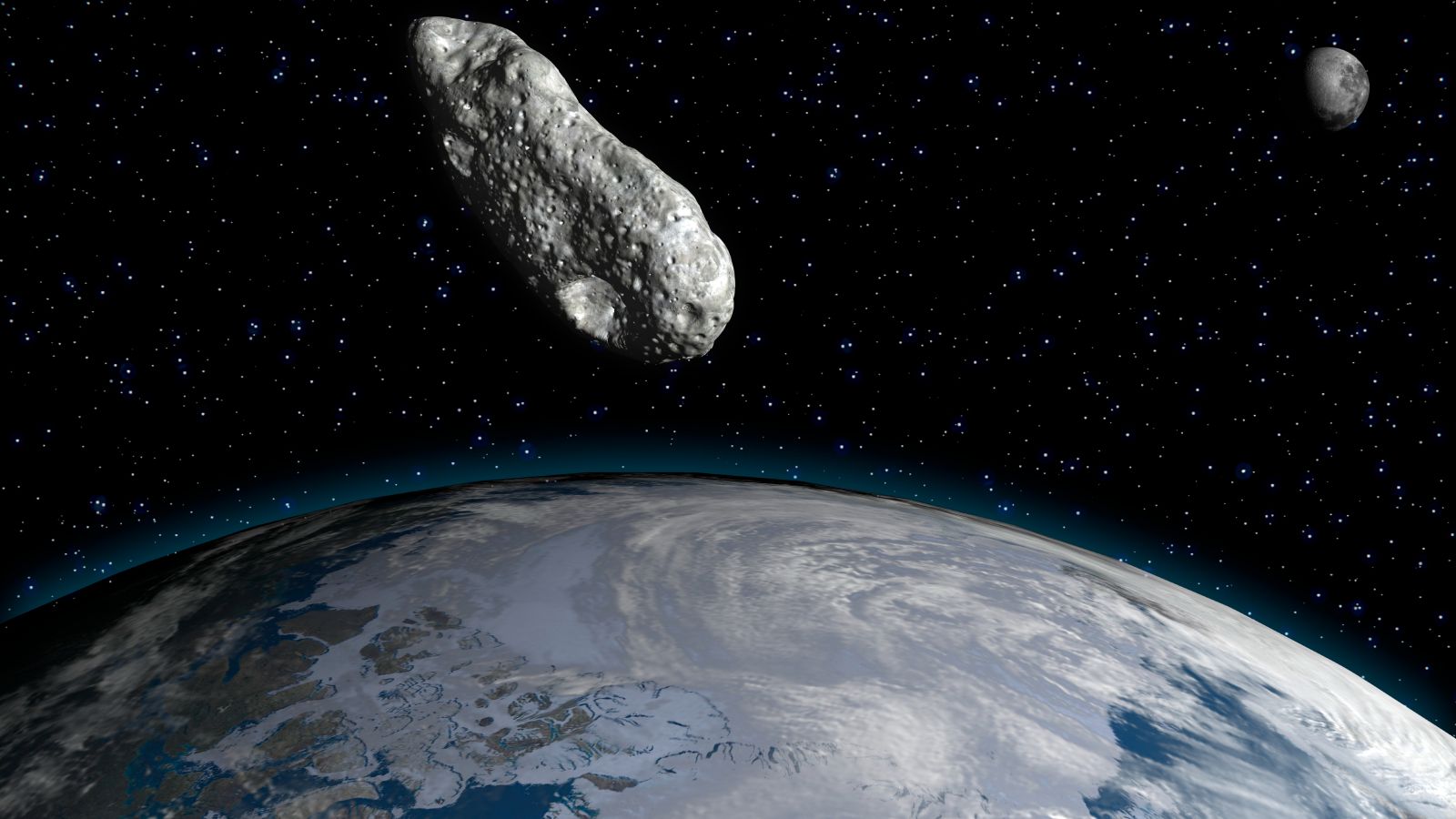
Earth and its moon will have company this holiday season. In April, our planet picked up a passing "minimoon," pulling the space rock into a temporary orbit, astronomers have confirmed.
The object, dubbed 2026 QQ8, was first observed by Hungarian researcher Krisztián Sárneczky in August. It was officially reported by the International Astronomical Union's (IAU) Minor Planet Center — the body that logs and confirms new solar system objects — on Oct. 29. This extraterrestrial traveler is expected to stick around until January 2027, extending its stay through the holidays before breaking free of our planet's influence.
2026 QQ8 is tiny — only about 6 feet (2 meters) across, according to the IAU. If it got too close to Earth, it would likely burn up in our planet's atmosphere . However, researchers don't think there is much chance of that happening, since 2026 QQ8 is currently orbiting at around 1.5 times the average distance of the moon.
2026 QQ8 takes 359 days — almost a full Earth year — to orbit the sun. It comes close to our planet every 10 years or so. This minimoon is classified as an Aten asteroid; this population of space rocks occasionally cross into Earth's orbit and have semimajor axes smaller than Earth's, meaning they typically orbit closer to the sun than our planet does. Large Aten asteroids are considered the most dangerous type of asteroid , as they can easily get lost in the sun's glare before speeding toward Earth — but, again, our new mini companion is far too small to pose a threat.
related stories
An 'invisible threat': Swarm of hidden 'city killer' asteroids around Venus could one day collide with Earth, simulations show
'City killer' asteroid 2024 YR4 could shower Earth with 'bullet-like' meteors if it hits the moon in 2032
Fallout from NASA's asteroid-smashing DART mission could hit Earth — potentially triggering 1st human-caused meteor shower
2026 QQ8 is not the first minimoon discovered circling Earth. That distinction belongs to 1991 VG , which was around 30 feet (10 meters) in diameter when it was detected in November 1991. Astronomers now think Earth grabs minimoons pretty frequently; we are likely to have at least one at any given time . Most of the space rocks stay around for less than a year, although a handful may remain in Earth's gravitational pull for decades.
New telescopes are expected to help researchers spot more minimoons as they enter and leave Earth's orbit. These include the Vera C. Rubin Observatory in Chile, which began operation earlier this year . The Rubin observatory, which takes a full scan of the entire Southern Hemisphere sky every few days, has already spotted what may be a new dwarf planet lurking in the outer solar system, as well as a new satellite galaxy of the Milky Way . Over its planned 10-year mission, the observatory is expected to detect millions of previously unknown moving objects in space.

Comments
No comments yet — be the first to weigh in 👇
No comments yet. Be the first!