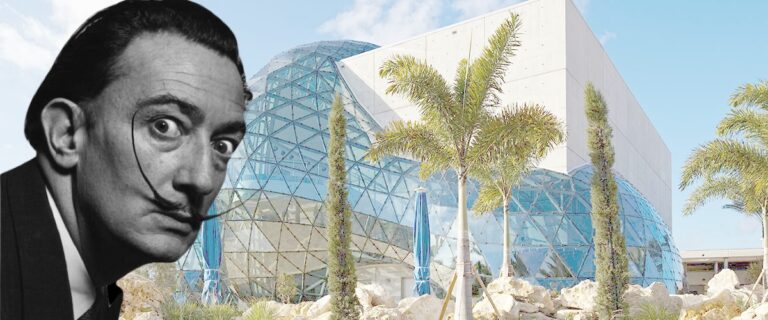
Dead Dalí greets museum visitors via AI: what is digital revival of an artist?
At the Salvador Dalí museum in St. Pete, Florida, the "Dalí Lives" exhibition has been running since 2019 — an interactive digital animation of the surrealist master who died in 1989. Visitors can "speak" with Dalí: an AI app recreates his voice and image, answers questions and tells anecdotes. Essay author David Bering-Porter analyzes this phenomenon as an example of "undead labor" — when AI allows a person's brand, image and voice to function after their death, blurring the line between artist and product.
Full text
When you walk into the Salvador Dalí Museum in St. Petersburg, Florida, Dalí himself will greet you. He appears on a life-sized screen, mustache waxed, and talks about his life and his work. He tells anecdotes. He answers questions in his own voice. The museum promises visitors an “opportunity to learn more about Salvador Dalí’s life from the person who knew him best: the artist himself.” Yet, Dalí died in 1989.
Many museums and galleries claim that visitors will “meet” the artist through the work, the idea being that close attention to a work of art leads, inevitably, to an encounter with the person who made it. The Dalí Museum (or “The Dalí,” as it calls itself) has something more literal in mind. In its ongoing exhibition Dalí Lives (via Artificial Intelligence) , which opened in 2019, the meeting takes place not through text or image, history or biography, but through a digital reanimation of the man. There is some sleight of hand in the promise, of course, and not only the obvious kind. Dalí, following a rigorous surrealist method, did not claim to understand his own paintings. “The fact that I myself, at the moment of painting, do not understand my own pictures,” he wrote, “does not mean that these pictures have no meaning; on the contrary, their meaning is so profound, complex, coherent and involuntary that it escapes the most simple analysis of logical intuition.” The person who knew him best was not, by his own account, especially forthcoming.
The claim that this digital Dalí actually is Dalí is as important as it is strange, and it signals a shift both in what our machines can do and in our relationship to them.
What is it that greets visitors at The Dalí, wearing Dalí’s face and speaking in his voice? The digital Dalí is an application of artificial intelligence, built with the machine learning and digital animation techniques used to make deepfakes and other forms of generative media. When the museum says that “Dalí lives via artificial intelligence,” it means it quite literally. The system was trained for over a thousand hours on roughly six thousand images and frames of film and other media in order to replicate Dalí’s facial expressions, body movements, speech patterns, and mannerisms. The promotional materials are keen to point out that this is more than a cheap fake, no mere actor or illusion but, in some important way, Dalí. The suggestion is that the algorithms responsible for animating his uncanny likeness have also managed to bring him back from the dead, reassembling him piece by piece.
The claim that this digital Dalí actually is Dalí is as important as it is strange, and it signals a shift both in what our machines can do and in our relationship to them. Rather than dismiss the claim as salesmanship, I want to take it seriously and consider how it might be possible for this digital revenant to be Dalí, at least in part. The claim can only be made because of how this version of him was made. It is not a relationship based simply on resemblance. It is a reanimation of the physical traces Dalí left behind in the media archive that survived him: the wealth of photographs, audio recordings, appearances and interviews on film and television, and other remains through which the artificial neural networks behind Dalí Lives were able to reconstruct him and bring him back towards some semblance of life. These recorded remains served as the raw materials from which the AI learned the particulars of the artist. His gestures, his mannerisms, his face, his intonations were reworked into a new kind of life. Salvador Dalí was brought back as a digital zombie.
This is different from other media reanimations of the dead that we have seen in the last few decades. The hologram of Tupac Shakur that performed with Snoop Dogg and Dr. Dre at Coachella in 2012 was a trick of the light, a projected image of a likeness. When Peter Cushing returned as Grand Moff Tarkin in Rogue One (2016), twenty-two years after his death, and when Carrie Fisher appeared in The Rise of Skywalker (2019) three years after hers, a living actor performed the role and the dead actor’s face was painted on and fleshed out with software. In each case a body stood in for the body that was gone. The digital Dalí has no actor underneath. The archive itself was the training data, and from it the system generated entirely new footage of Dalí doing things Dalí never did. These new images are no longer limited by the traces of the past. They can be set to perform almost any task, in any setting.
What can this digital Dalí do? The museum states that it has 45 minutes of “new” Dalí footage distributed across 125 interactive videos. These in turn parse into approximately 190,512 possible combinations of speech and action, so that individual museumgoers can have relatively unique encounters with the artist-as-revenant. Those were the numbers in 2019. In April 2024 the museum added a sequel, Ask Dalí , in which visitors pick up a replica of Dalí’s lobster telephone and put any question they like to a Dalí voiced by GPT-4 and ElevenLabs, built from “a variety of the artist’s writings and archival audio.” The combinations are no longer finite and Dalí now takes questions. Goodby Silverstein & Partners, the advertising firm whose in-house production team built both versions of the artificial Dalí, has a name for this phenomenon: “mass intimacy.”
The phrase is counterintuitive and revealing, as it names one of the paradoxes of digital life: the simultaneous targeting of the individual and the masses. Not so long ago it was considered paranoid to think that our machines were talking to us, but now it is an everyday experience under what Shoshana Zuboff has called “surveillance capitalism,” an economy that maintains a real and ongoing investment in the life, biography, and behavior of each individual. Social media and generative media alike aim to provide an intimate experience that is generalizable enough to engage the masses and customizable enough to appear individualized: a form of intimacy that is as statistically significant as it is personally significant.
Why call the result a zombie, rather than a ghost or a clone or a puppet? Because the zombie has always been a monster of labor. It first appears on the colonial plantations of Haiti, where it gave the enslaved a way to understand and reckon with their own condition. The zombie is slavery taken to its logical extreme: a body stripped of mind, soul, and will, leaving behind a mechanical semblance of life that has been reduced to pure instrument. This version of the zombie is no longer productive for itself but only for the benefit of another, a biological machine for the generation of labor power. It is the clearest example of what I call undead labor : value extracted from a laboring body beyond what it is built to produce.
It might seem odd, then, to describe a talking, charming, life-sized screen as a zombie. It has no body, it is incapable of any physical act, let alone hard labor, and it is hardly dumb or brutish in its interactions. But the zombie was never defined solely by its stupidity. From its origins in Haiti, it was defined by work without consent. Marx described capital as “dead labor that acts like a vampire; it comes to life only when it drinks living labor, and the more living labor it drinks, the more it comes to life.” For Marx, capital was dead labor: the work of the past, stored up in machines and money, feeding on the living. Undead labor takes this one step further. It is not the past feeding on the living; it is the body itself kept at work past its own death, so that dying is no longer the point at which a worker stops producing.
Dalí’s body has not been dragged from the grave, but a version of him has been put to work, his likeness shaped and molded to fit the desires of another. Like the zombie on the plantation, the digital zombie displays many of the abilities of an ideal worker, now in the information age, not the least of which is the ability to work unceasingly and without end, well beyond the limits of any living worker. The digital Dalí rises not from a corpse but from a corpus, a body of recorded work used as the training data for the machine learning systems that let this Dalí speak to audiences from beyond the grave.
Dalí’s body has not been dragged from the grave, but a version of him has been put to work, his likeness shaped and molded to fit the desires of another.
What the museum has built, then, is a pliable, predictable, and programmable worker, one that offers all the benefits of Dalí’s celebrity and personality with none of the drawbacks of a worker who might disagree or disobey. And Dalí is only the famous case. The media archive we create while we are alive does not disappear when we die. The growing record of photographs, text messages, emails, voice memos, and videos we leave behind on the servers of a handful of companies is a corpus of the same kind. In 2022, Amazon demonstrated that Alexa could speak in the voice of a dead relative from less than a minute of recorded audio; the promotional video showed a child asking whether “Grandma” could finish reading a bedtime story. Most people found it creepy. But it was also a preview. In 2024, researchers at Google DeepMind and the University of Colorado published a paper anticipating that “within our lifetimes it may become common practice for people to create a custom AI agent to interact with loved ones and/or the broader world after death.” They call these agents generative ghosts. But ghosts are not put to work. Zombies are.
Back at the museum, among the many things the digital Dalí does, one set of interactions stands out. When I visited in the spring of 2023, the last life-sized screen, at the end of the exhibition in the museum gift shop, offered to take a selfie with me. The Dalí zombie holds up a smartphone, mimes taking the picture, examines the result and exclaims, “Oh là là!” before showing it to the amused onlookers. The entire interaction is a charade, but an instructive one. The smartphone is computer-generated, and the “selfie” is a digital construct, layers of images mapped onto one another to produce a realistic picture of the visitor with Dalí, which can then be sent to the visitor’s own phone.
In one of the short promotional videos for the exhibition, the first glimpse we get of Dalí is at his easel, the master at his brushes, before he “notices” the viewer, gets up, and walks over to speak to us directly. Here the digital Dalí performs the maestro, an oversized persona speaking with authority about the art on the walls. As the visitor moves through the museum, she encounters him on a series of screens, windows into the strange digital space this revenant occupies, a supplement to the galleries themselves, and the journey ends with a selfie in the gift shop. It is the perfect encapsulation of Dalí’s own development from classical painter to surrealist sensation to pop-culture icon, replayed through machine learning: from maestro to meme.
The selfie is also where the illusion cracks. The likeness remains strikingly photo-realistic, but the anachronism of Dalí taking a selfie sinks the interaction into the uncanny valley. Something in the movement of his hands, too fast, too smooth, too precise, and something in the play of the light and shadow across his knuckles, reveals that something strange is at work. It is lighting from a different era. Dalí’s hands are borrowed from another time, and they do not match the phone he “holds,” which has been carefully layered into the image, and which comes from no particular time at all. Light from the 1970s casts harsh shadows on a smartphone case. There is something startling and vulgar about it. Dalí was certainly not above hawking his own fame while he was alive, but here it becomes clear that his image has been used and put to work in what might be a fitting hell for Dalí: to serve as an eternal docent in his own museum.
_______________________________
Adapted from Undead Labor: Capitalism’s Zombie Worker by David Bering-Porter. Published by the University of Minnesota Press. Copyright © 2026 by the Regents of the University of Minnesota. All rights reserved; used by permission.

Should museums use AI to digitally revive deceased artists?
Comments
No comments yet
Comments
No comments yet — be the first to weigh in 👇
No comments yet. Be the first!