Full text
Archaeologists have unearthed an 11th-century wooden kitchen gadget with an ancient board game carved into the back. Medieval bakers may have used the wooden paddle not just to transfer bread into an oven but also to pass the time while they waited for the food to cook, the researchers said.
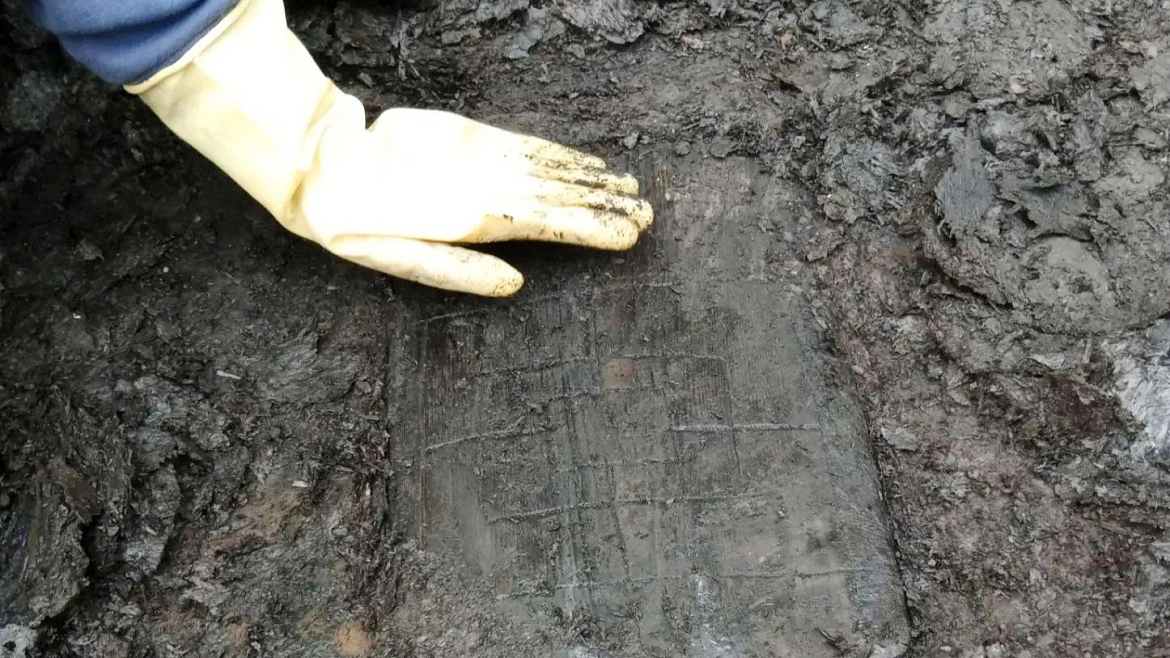
"We discovered a fragment of a fairly large shovel," Sergey Toropov , director of Novgorod State University's Center for Archaeological Research, said in a translated statement . "Most likely, it was a bread shovel, which was used to bake bread in an oven. On the reverse side, however, three squares have been carved, one inside the other."
The "bread shovel" — also known to contemporary home bakers as a wooden bread peel, a pizza paddle or a pizza peel — was found at the archaeological site of Pyatnitsky in the center of Staraya Russa, a medieval town between Moscow and St. Petersburg where last month, archaeologists reported their discovery of a " snake amulet ."
Archaeologists discovered a wooden baking implement — likely a pizza-paddle-like tool — dating back to medieval times. (Image credit: Novgorod State University) The preserved portion of the bread peel measures about 12 by 16 inches (30 by 40 centimeters), and it was likely crafted from oak. While one side is flat, likely for baking tasty treats, the other side had been carved with a board for the ancient game known as merels , merrelles, mills, nine-men's morris or cowboy checkers.
The origin of the game is unknown, but historical records and archaeological artifacts suggest a similar two-person logic game was played by the ancient Romans two millennia ago — and the game may be even older than that. In the Middle Ages, merels became particularly popular across Europe and Asia , possibly because it requires little equipment and can be set up quickly.
A typical merels (also known as nine-men's morris, mills or merrelles) board and pieces. (Image credit: Alamy) A typical merels board has three nested squares connected by horizontal and vertical lines. Each player has nine pieces of the same color. The goal is to arrange the pieces into columns of three along the lines. When a player forms a line, they can remove any one of their opponent's pieces. In this way, merels is a mixture of tic-tac-toe and checkers. A player wins when their opponent has only two pieces left or is completely blocked. (You can play an online version here.)
RELATED STORIES
Decorated wild-boar tusk found in Russia may have been medieval warrior's good-luck charm
Archaeologists unearth a medieval nobleman buried with his horse and dog in a rare wooden tomb in Russia
2,000-year-old 'not a pizza' fresco discovered in Pompeii
"Perhaps special boards for playing merels existed in antiquity," Toropov said, "but more often, one finds playing boards scratched or carved into the flat surfaces of household objects."
The archaeologists are not sure whether the wooden bread peel served two functions or whether it was repurposed as a game board after it broke and was no longer useful.
"At any moment, one could mark out a board on a flat surface, find suitable pieces — for example, small stones lying underfoot, and while away some time," Toropov said.
Merel boards and playing pieces have been recovered from ninth-century archaeological sites in the kingdom of the Rus', whose ancestors were Vikings who arrived in what is now Russia in the eighth century , according to the statement, but "a find as well-preserved as the one from Staraya Russa is practically unique."


Comments
No comments yet — be the first to weigh in 👇
No comments yet. Be the first!