
Sulfur deposits on Mars could enable sulfur concrete construction
Pure sulfur deposits have been discovered on Mars, which may serve as a binder for producing sulfur concrete — a building material based on local resources. Mars is sand-rich, and sand can function as aggregate. Sulfur concrete hardens quickly and requires no water, making it an attractive alternative to conventional cement in Martian conditions.
Full text
If we ever hope to build a base, a city, or a full-fledged colony on another world, the first steps are to build structures that can support human existence. The Moon is the closest option, but has many limitations: its gravity is greatly reduced, it has practically no atmosphere at all, and nearly all of the resources humans would need must be brought from Earth. Mars is a little more interesting, with substantial reserves of (solid and gaseous) water, a different mineralogy from Earth, and a thin but meaningful atmosphere: the eighth thickest in the Solar System , just one spot behind Earth. Importantly, Mars is a sand-rich world, and with sand, an interesting possibility arises as far as construction materials go: concrete, with sand serving as an aggregate .
In the past, studies have shown that the type of sand found on Mars is made of a very different composition than sand on Earth, and with a different grain size as well. If one were to try to make concrete using conventional means out of Martian sand, a problem arises: it winds up with large numbers of porous voids within it, making the concrete structurally weak. Back about a decade ago, a new method was devised for making Martian concrete , but a novel key ingredient was required: sulfur, in its pure form and in large quantities.
With NASA’s Curiosity rover recently finding pure, elemental sulfur on Mars for the first time, the prospect of building, cities, and even larger structures on Mars suddenly falls into the realm of possibility. All of the necessary ingredients are now known to copiously exist on the red planet.
The Sphinx of Giza next to the Pyramids in Egypt, as photographed in 2006. The oldest surviving Pyramids date back nearly 5,000 years, and are the largest, oldest surviving human-created monuments. The Pyramids are an early example of the use of concrete: the oldest building material and the most commonly used building material on Earth, even after more than 8000 years of history.
Credit : Ian Robertson/flickr
Here on Earth, concrete is one of the most ancient building materials that’s still in widespread use today. In what is now the middle east, people discovered that by mixing lime with sand, stone, and water, a hard, sturdy, and naturally waterproof material would be created. When it dried and cured, it was useful for creating underground water storage systems (cisterns) and foundational structures (floors) for homes and communities. Concrete was an essential material used in construction throughout history, including in the building of Egypt’s famed pyramids .
Advances in which materials were mixed in with the concrete led to harder, sturdier versions of concrete , which in turn led to the ability to construct larger, more complex structure that could bear more weight. Today, more than 8000 years after the earliest version of it was first developed, concrete remains the most widely-used building material on planet Earth. Modern concrete performs exceptionally well from a materials science perspective and is cementitious , where a powder-like binder gets mixed with water, and then an aggregate (or set of aggregate) material, like sand, stone, or gravel.
However, the raw ingredients for the type of concrete which is used on Earth — including the binder and the liquid water — does not exist on other worlds like the Moon or Mars. If we wanted to use terrestrial concrete there, we’d have to bring the ingredients with us.
A specimen of concrete, no matter what it’s made from or what process by which its made, has a maximum pressure it can withstand in one direction before failing completely and shattering. Once that pressure is exceeded, the concrete can no longer bear weight and will crumble. For excellent modern concrete, this pressure can be as great as 35-50 MPa (megapascals), or over 500 times the atmospheric pressure, but older or inferior concrete will fail at much lower pressures.
Credit : Lin Wan, R. Wendner, & G. Cusatis, Construction and Building Materials, 2016
In order to serve as a good building material, perhaps the main metric that concrete is rated on is known as unconfined compressive strength . If you took a material that was in the shape of a rod or cylinder and compressed it, how hard could you compress it — how much pressure could you apply — before the material failed, and cracked, crumbled, or otherwise gave way before the pressure? The vaunted Roman concrete , which represented a huge advance over all previous forms of concrete, could withstand pressures of up to 12-15 Mpa (megapascals), or more than 100 times greater than the pressure due to Earth’s atmosphere, while modern concrete typically is much stronger: of between 35 and 50 Mpa.
The main component of concrete, by weight, is the aggregate used. People have speculated that the surface material found on the Moon or Mars, which is made of fine, particulate matter similar to the sand or crushed rock that often serves as the fine aggregate within concrete here on Earth, could be used as the aggregate in concrete. But when material similar to the surface material found on the Moon or Mars is used in direct, one-to-one replacement of the aggregate for concrete that we make on Earth, the concrete winds up relatively weak and prone to failure. Microscopy reveals that such concrete fails for good reason: the physical properties are different enough that substantial voids, or large gaps between aggregate segments, frequently appear.
The method of making sulfur concrete does not work well with terrestrial, Earth-based sand, as the microscopy image on the right shows. Instead, large voids ensue, leading to structurally weak concrete. However, using sand with the composition of a Mars-analogue chemistry leads to extremely small gaps and a very strong type of concrete, capable of withstanding pressures of over 500 times that found at sea level here on Earth, as shown at left.
Credit : Lin Wan, R. Wendner, & G. Cusatis, Construction and Building Materials, 2016
Back in 2015, a research group at Northwestern University set out to create various mixtures of concrete made with Mars-analog material , testing them for a number of physical properties on both macroscopic and microscopic scale, including void size and frequency on microscopic scales and unconfined compressive strength on macroscopic scales. Because it’s long been known that Mars is a sulfur-rich planet, with various landers and rovers having discovered yellow deposits that are indicative of sulfur (which have been since verified chemically), the team chose, rather than using conventional binders that require liquid water, to simply use molten sulfur , which becomes completely liquid at the relatively low temperature of 116 °C (240 °F).
The idea is that, by heating sulfur to these modest temperatures and then mixing them with Martian sand — one of the easiest-to-find and most ubiquitous types of material found on the surface of Mars — a type of concrete could be created. The team began by first recreating the type of material found on Mars by reproducing the composition of Martian sand, which is made of various oxides in the following percentages:
silicon dioxide (34-44%),
aluminum oxide (18-24%),
ferric oxide (9-12%),
calcium oxide (5-6%),
then a mix of 2-4% of each of titanium dioxide, iron oxide, magnesium oxide, and sodium oxide,
plus a sub-percent contribution of each of potassium oxide, manganese oxide, and diphosphorous pentoxide.
This graph shows the phase diagram of sulfur, with the native pressures and temperatures typically found on the Moon and Mars illustrated as well. In order to reach the molten (liquid) phase of sulfur on the planet Mars, sulfur would only need to be heated to modest temperatures of around 116 C (240 F), which is easily achievable with a simple oven or heat pump. Then, a mixture of that molten sulfur and Martian aggregate (sand) of the appropriate size could produce Martian concrete: an extraterrestrial alternative to the conventional modern concrete used here on Earth.
Credit : Lin Wan, R. Wendner, & G. Cusatis, Construction and Building Materials, 2016
That mixture served as a simulant of the composition of the sand that would be naturally found on Mars, informed by generations of landers, rovers, and orbiters. They then took this Mars-like material and used it as aggregate, mixing it with molten sulfur, and used it to create concrete-like rods of a specific, standard length. They tested the rods in various ways for material strength, including the key test of an unconfined compression test. But they didn’t just choose one mixture to test. In order to optimize the process, they varied two separate properties of the aggregate-and-binder that was used in the making of the concrete.
First, they varied the grain size of the aggregate that was used. Even though the material used for the aggregate, the simulated Martian sand, was the same throughout all of the tests, sand itself consists of a mixture of grain sizes, but sifting can remove grains above a particular size. Sand on Earth often consists of grain sizes not only larger than 1 millimeter (mm) but even larger than a full centimeter at times, and sand on Mars can routinely be found with grain sizes up to between 4-5 mm. By removing the larger grain sizes, finer aggregates can be produced.
And second, they varied the aggregate-to-binder (i.e., sand-to-sulfur) ratio, in an attempt to find out which ratio, or which set of ratios, led to the greatest unconfined compressive strength and also to the presence of the smallest, fewest voids within the concrete at a microscopic level.
These diagrams show the compressive strength of the concrete produced from a Mars-analogue aggregate of a variety of grain sizes and a variety of aggregate-to-cement ratios, when molten sulfur is used as the cementing agent instead of a terrestrial mixture of water and some type of lime agent. As you can see from all three graphs, there is both a grain size (of under 1 mm) and a sand-to-sulfur ration (of 50/50) that is optimal for producing the greatest compression strength concrete.
Credit : Lin Wan, R. Wendner, & G. Cusatis, Construction and Building Materials, 2016
The results of the study, published in 2016 , were remarkable. They found that, if you left the large-sized grains in, the concrete became quite weak and brittle: cracking easily and with a relatively poor performance when compressed in the long direction. Grains of 4-5 mm, in particular, were catastrophic for the concrete, leaving large voids within it when examined on a microscopic level. But if you sifted the aggregate so that only grains of a maximum of 1 mm in size were included, the concrete became much stronger: as strong, in fact, as terrestrial modern concrete, with unconfined compressive strengths reaching 50 Mpa.
They also found that if you put either too much or too little sulfur into the mixture, relative to the aggregate, the concrete that is produced has a much smaller unconfined compressive strength than if it has just the right amount. Interestingly enough — and this was not necessarily foreseeable beforehand — the optimal mixture is right about 50/50 as far as the aggregate-to-sulfur ratio goes. This turns out to be very different than terrestrial concrete, where aggregate makes up the majority of the concrete : about 60-80% by volume and even more, about 70-85%, by mass.
These two side-by-side microscopy images show high-quality Martian concrete, made with a mix of Mars-analogue aggregate of small diameter grains only and a 50% mixture of molten sulfur, at left, and lower-quality concrete that contains large voids and is structurally significantly weaker, as shown on the right. Both large grain sizes or the wrong ratio of sulfur can lead to weakened concrete.
Credit : Lin Wan, R. Wendner, & G. Cusatis, Construction and Building Materials, 2016
With all of that in mind, the formula for Martian concrete is now known. Sifting sand on Mars would be an easy enough task, as would be heating sulfur. All one would need is an energy source, a mechanical vibration device, and an oven or heat pump of some variety. However, one major obstacle still remained: the sulfur that had been found on Mars, at least up through 2023, was only in the form of a complex chemical compound: with sulfur bonded to other elements. The concrete that was built using Martian-analogue aggregate relied on pure, isolated, elemental sulfur: something that had never been found on Mars before.
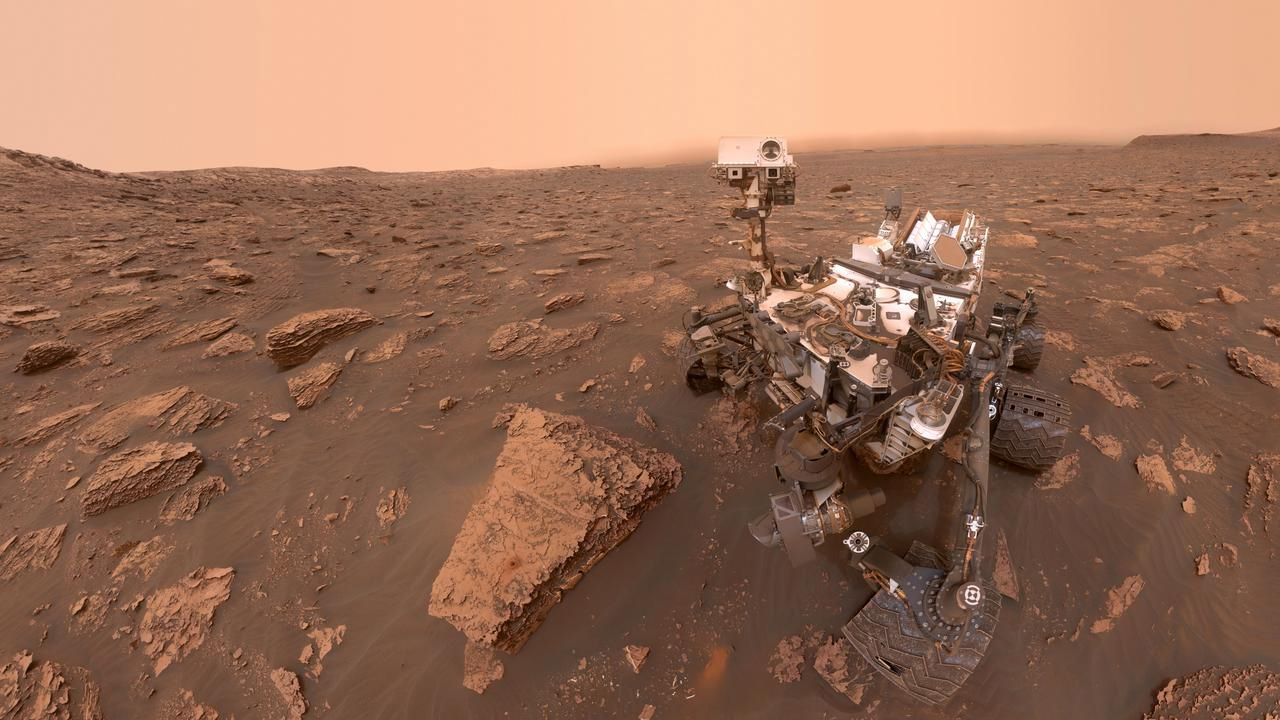
People have often questioned the value of continuing to maintain and explore Mars with an older generation of Mars rover when newer generations were available and operational. Spirit and Opportunity were launched almost simultaneously and both landed on Mars in 2004; Spirit ran until 2010 and Opportunity ran until 2018. The succeeding, next-generation mission, Curiosity, began when that rover touched down in 2012, and still continues today, despite the degradation to its wheels. However, the largest and most advanced Mars rover, Perseverance, began its mission on Mars in 2021, and since then, many have questioned Curiosity’s continuing value, despite their complementary natures and the vastly different terrains they’re exploring .
NASA’s Curiosity Mars rover captured this view of Gediz Vallis channel on March 31. This area was likely formed by large floods of water and debris that piled jumbles of rocks into mounds within the channel. Some of the rocks are white in color with dimpled depressions on them. One of them, when rolled over by one of the Curiosity rover’s wheels, collapsed, revealing yellow sulfur crystals inside.
Credit : NASA/JPL-Caltech/MSSS
And then, in 2024, something unexpected happened. While driving along through what was very likely long ago an ancient, water-rich area, the Curiosity rover drove over a rock in a sulfate-rich region : like many of the rocks it had seen before. But on May 30th, 2024, the rock that was beneath its wheel simply gave way and was crushed by the rover, revealing something scientists had never seen before inside : a sample of pure, elemental sulfur. This scientific discovery was unprecedented , as pure sulfur samples on Earth are normally produced by volcanic or hydrothermal systems: active conditions that haven’t been present on Mars, as far as we know, for billions of years.
What Mars does have lots of is sulfate minerals: sulfur atoms bonded to other atoms. However, on the interior of the rock crushed by Curiosity’s wheels, the rover’s robotic arm was capable of performing X-ray spectroscopy, which showed that beneath the surface sand-and-dust that covered them, the yellow-colored stones were indeed composed of pure, elemental sulfur alone. Both volcanic and hydrothermal processes are disfavored in the production of this elemental sulfur, which led scientists to propose a novel mechanism for their creation: the decompression of clathrates (where atoms or molecules get protected by a cage-like structure that forms around them) that had been previously buried in the Martian soil.
The yellow crystals visible here were exposed when the Curiosity rover’s wheels rolled over a rock on Mars and crushed it, revealing these yellow crystals inside. After examination by an X-ray instrument aboard Curiosity’s robotic arm, scientists were able to confirm that these crystals are composed of pure elemental sulfur: the first such discovery on Mars.
Credit : NASA/JPL-Caltech/MSSS
This suggests something quite remarkable: that lying on Mars, in select locations at least and perhaps even ubiquitously, are significant stores of pure, elemental sulfur. This indicates that sulfur doesn’t need to be refined or extracted from complex compounds on Mars in order to produce pure sulfur, but that it already exists on the surface, and merely need to be located. Because Martian sand is ubiquitous, all one then needs to do is:
collect the sulfur,
collect Martian sand,
sift the sand until no particles within it larger than 1 mm remain,
heat the sulfur until it becomes liquid (above 240 °F/116 °C),
mix the sulfur and sand in a 50/50 ratio,
and you’ve got it: Martian concrete, that will cure and harden to be just as strong, sturdy, and resilient, even in the complete absence of liquid water, as terrestrial, modern concrete is here on Earth.
Even better is this: because it’s on Mars instead of on Earth, where the surface gravity is only about 38% of what it is on Earth, you can load it up with more than 2.5 times as much mass on Mars and still achieve the same pressures acting on the concrete as you do on Earth. Martian concrete, we now know, can be constructed solely with materials that are already found on Mars, taking us one step closer to the dream of an off-world building, city, or colony fit for human habitation.
Humans have often dreamed of colonizing other worlds: both within our Solar System and beyond. While we may be a long way from a Martian colony involving skyscrapers, as illustrated here, many contend that a small, domed structure on another world, such as Mars or the Moon, could represent a key step toward that ultimate goal. For the first time, the ability to make Martian concrete using only materials known to be native to Mars, in an already-usable form, has arrived.
Credit : Corepics VOF/Shutterstock
As recently as 20 years ago, we didn’t know whether it would even be possible to create any off-world structure without having to source the entire suite of materials we’d need to build them from Earth itself. Concrete, the most common building material on Earth, was known to require several conditions that are unique to Earth in order to make it strong and durable: the right mix of chemical compounds and reactions, and with liquid water as a requirement. While both Mars and the Moon have fine-grained material on their surface, that alone was insufficient for the creation of high-quality concrete.
On account of this recently-discovered procedure for creating Martian concrete using the type of sandy soil found on the red planet, hopes rose that buildings could be constructed on Mars using material that was found in situ on Mars itself. With Curiosity’s serendipitous discovery of significant deposits of pure, elemental sulfur on Mars , this now brings up the possibility that 100% of the ingredients that we need to create and use Martian concrete are already on Mars: all we need is a sifter, a heater, and equipment designed to shape and pour this new form of concrete on Mars.
The specifics for how we’ll build our first habitat on the red planet remain open for design and debate. Thanks to these two recent advances, however, the foundation for the science of Martian construction has already been laid.
This article Pure sulfur discovered on Mars, making Martian concrete possible is featured on Big Think .
Similar stories

Similar stories
Should building a colony on Mars be a priority for humanity?
Comments
No comments yet
Comments
No comments yet — be the first to weigh in 👇
No comments yet. Be the first!