Full text
Saturn is about to reach its annual opposition this week, when it appears at its brightest and biggest all year and becomes the only planet visible all night.
The short, exciting period for skywatchers has more to do with where Earth is in its orbit than with Saturn 's journey around the sun. Opposition occurs when Earth moves directly between a planet and the sun, placing the two planets on the same side of the solar system. For observers on Earth, that means Saturn appears opposite the sun in the sky, just like a full moon (hence the name "opposition"). Saturn therefore rises in the east around sunset, 100% illuminated, before reaching its highest point around midnight and finally sinking toward the western horizon around sunrise.
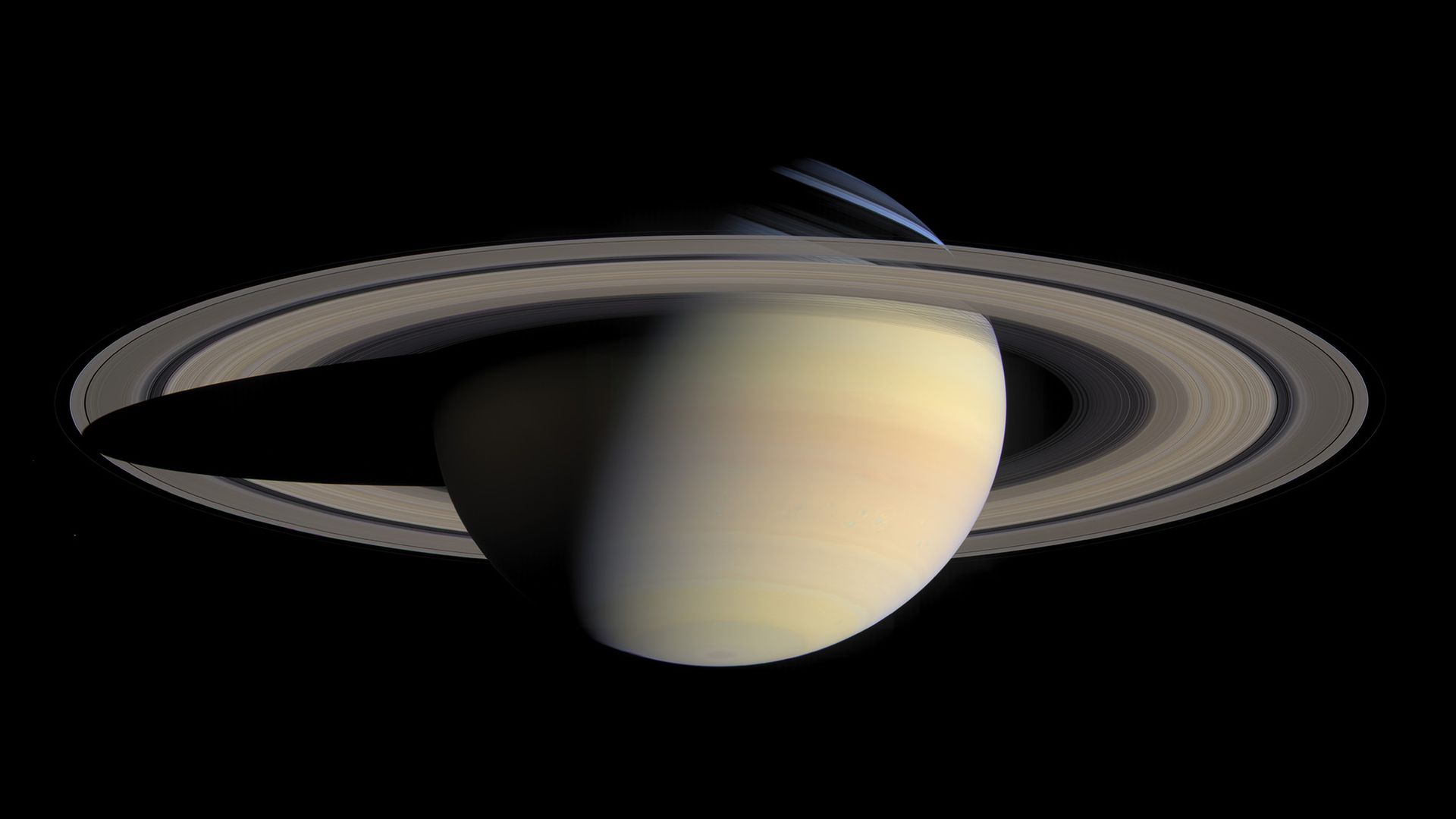
This year's opposition occurs Sunday (Oct. 4), making the few weeks on each side an excellent time to start looking. At 784 million miles (1.26 billion kilometers) away, Saturn will be relatively close to Earth, causing its disk to appear about as large as it gets through a telescope and making its pale-yellow light shine more brightly than at other times of the year. You won't need any equipment to find it; under a clear sky, Saturn will be easily visible to the naked eye as a bright, steady point of light, between the constellations Pisces and Cetus.
Once you've located Saturn, the best way to view it is in a backyard telescope so you can see the planet's rings in sharp relief. Try it yourself — observing Saturn's rings for the first time is one of the most memorable sights available to amateur astronomers. Larger apertures and higher magnifications may also reveal some of Saturn's moons, including Titan, the planet's largest satellite, but even a relatively modest backyard telescope can reveal Saturn's rings.
Related stories
What are Saturn's rings made of?
How Old Are Saturn's Rings? The Debate Rages On.
Hubble confirms mysterious, 10-sided cloud is growing over Saturn's south pole
The rings themselves are particularly interesting this year. Saturn's axial tilt means our viewing angle of the planet's rings changes throughout its roughly 29-year journey around the sun. After the rings appeared almost edge-on from Earth in 2025, they're gradually opening up again, giving observers an increasingly clear view.
You don't need to restrict your observing to the night of opposition; Saturn will remain a prominent evening target throughout October. However, the nights of Sept. 30 to Oct. 4 offer an ideal combination of brightness, visibility and all-night observing. There are also plenty of other great stargazing sights to look for this fall .
If you've been waiting for an excuse to point a telescope at Saturn, this is your moment. The next time Saturn will be at opposition will be Oct. 18, 2027.

Comments
No comments yet — be the first to weigh in 👇
No comments yet. Be the first!