Full text
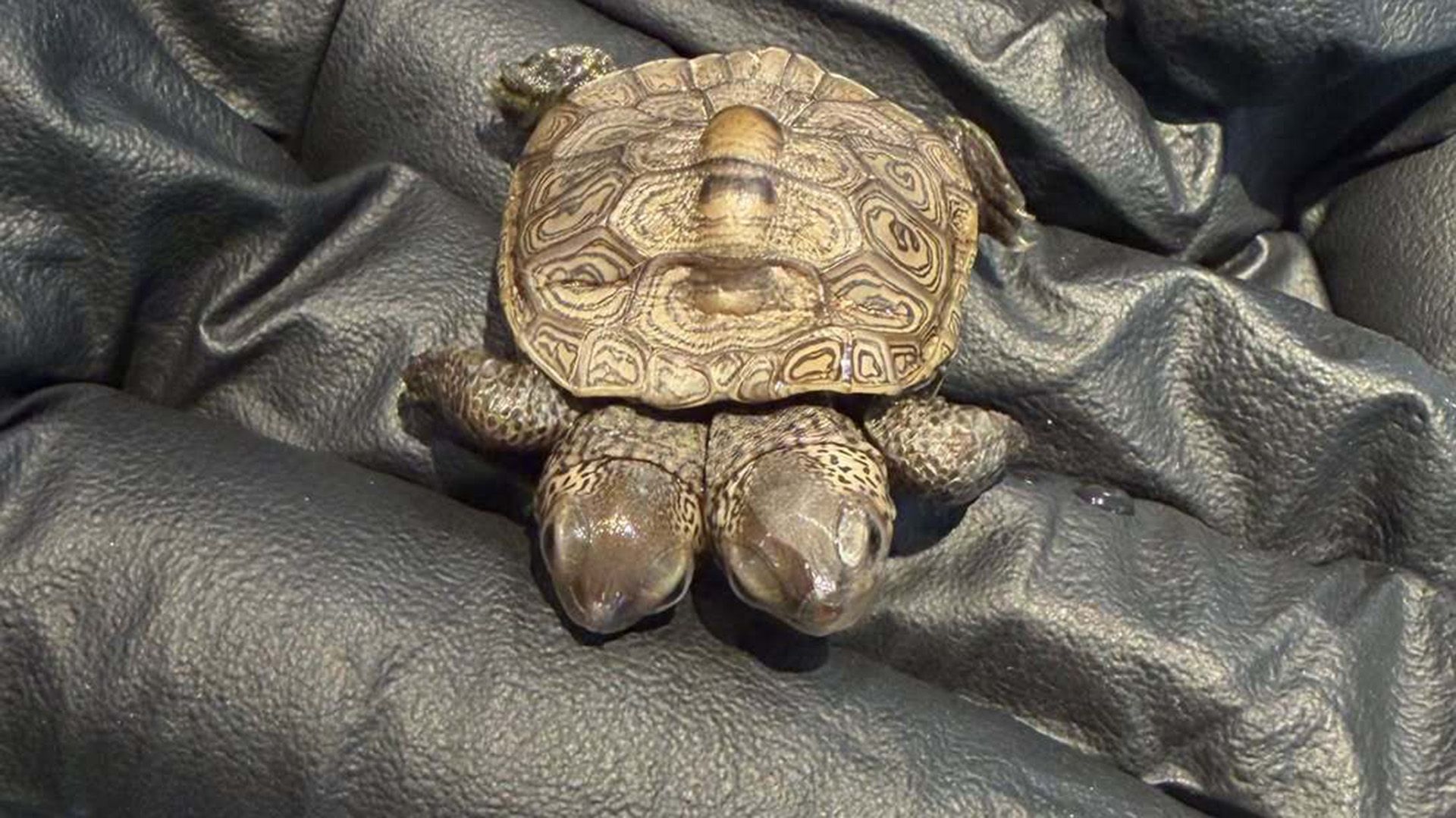
Cape Cod is known for its lobsters and its growing great white shark population , but now the holiday hotspot has another extraordinary animal to showcase: A rare two-headed diamondback terrapin that is surviving against the odds.
The baby turtle, which weighed just 0.18 ounces (5.2 grams), was brought to the Cape Wildlife Center in Barnstable, Massachusetts, on Sept. 17, according to a Facebook post from the wildlife center. It was originally found by representatives of the Mass Audubon Wellfleet Bay Wildlife Sanctuary at a protected nesting site in the town of Wellfleet.
The turtle's condition, known as bicephaly , is a rare developmental disorder that's typically caused by the incomplete splitting of a single embryo during the formation of identical twins. It results in conjoined twins that share one body but have two fully formed, independent heads.
Two-headed turtles face survival challenges, as their abnormal anatomy can impair coordinated movement, feeding, and other functions essential for survival. (Image credit: New England Wildlife Centers Staff) Zak Mertz , CEO of New England Wildlife Centers, which includes the Cape Wildlife Center, said the recently discovered diamondback terrapin ( Malaclemys terrapin ) is an uncommon example of bicephaly in turtles. Both genetics and epigenetics — the study of how genes and environment can interact — are thought to play a role in the condition's development.
"Our understanding based on the available research is that bicephaly is caused by both genetic and epigenetic factors," Mertz told Live Science in an email.
"It may have to do with the relatively long lifespan of the turtles , their preference for returning to the same nesting sites, and a limited gene pool due to their conservation status," he said."It may also be influenced by environmental factors, such as the temperature, humidity during incubation, physical characteristics of the nesting sites, or potentially even things the parents are exposed to in the environment."
Having two heads is rare but not unprecedented. According to the center , this is the third bicephalic terrapin found in the area in the past five years, providing another opportunity to learn more about the animals. Other wild animals with bicephaly have been found in recent years, including a two-headed porpoise found off the coast of the Netherlands and a two-headed dolphin that was found on a Turkish beach.
Related stories
Rare, 2-headed snake discovered by Florida house cat
Rare, Two-Headed Rattlesnake Named 'Double Dave' Rescued from Certain Doom in New Jersey
Rare conjoined turtles hatched in Massachusetts
A 2021 study found that rare two-headed and partially duplicated sea turtle embryos and hatchlings showed significant craniofacial and spinal abnormalities and were generally smaller than typical hatchlings. The research found bicephalic turtles faced survival challenges because their abnormal anatomy could impair coordinated movement, feeding, and other functions essential for survival, highlighting the importance of monitoring such deformities as potential indicators of population and environmental health.
Diamondback terrapins are found in brackish marshlands along the Atlantic and Gulf coasts of the United States. Brackish waters have more salt than fresh water but less salt than seawater, and often occur where the freshwater of a lake or river meets the salty sea. These terrapins are classified as threatened by the Massachusetts Endangered Species Act, and their broader conservation status at the federal level is currently under review .
Veterinarians are monitoring the rare terrapin's health closely. "It is fascinating and an area that certainly merits more study," Mertz said. "We are excited to care for these two and learn as much as we can to inform future study in the process."

Comments
No comments yet — be the first to weigh in 👇
No comments yet. Be the first!