Full text
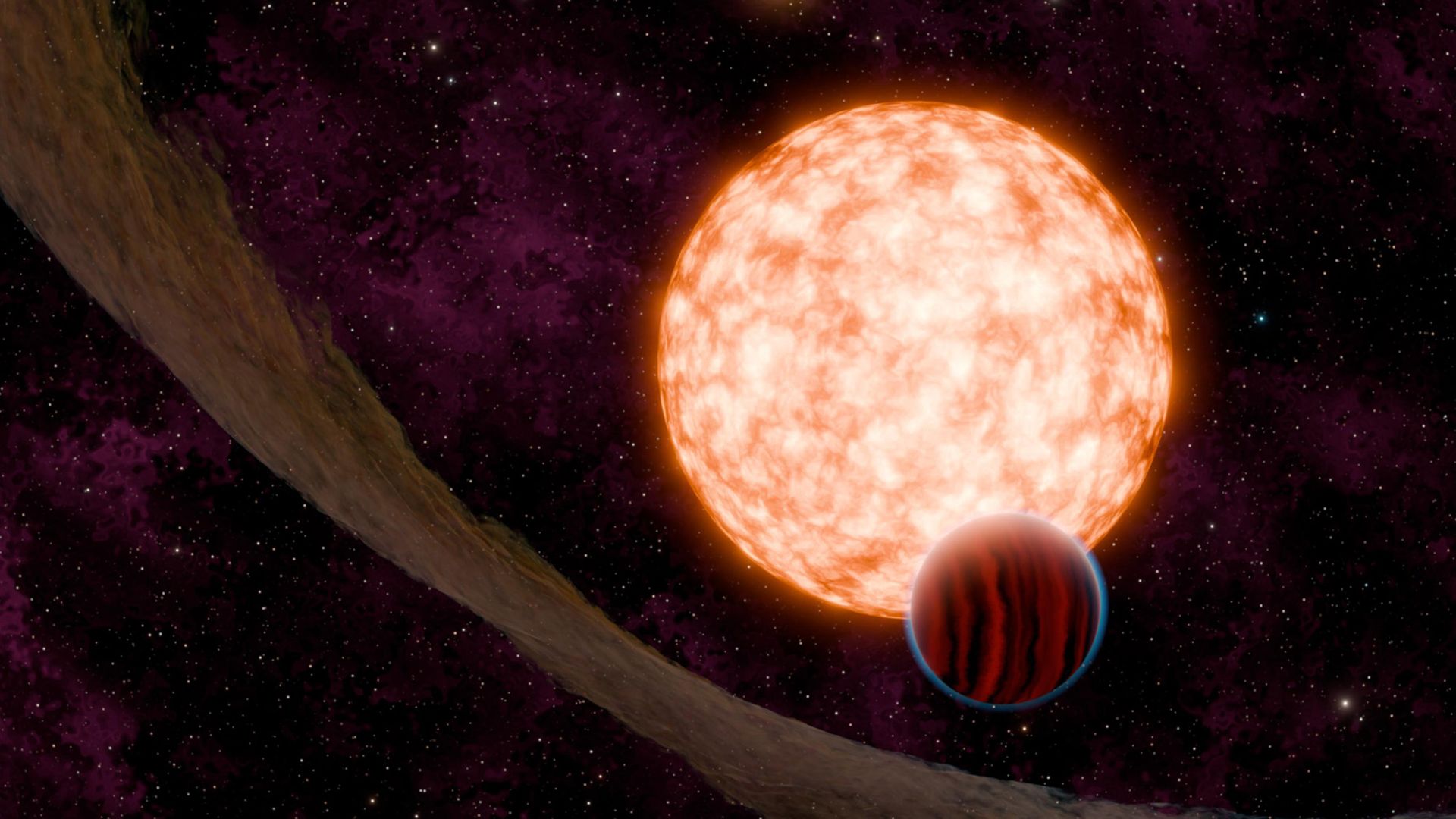
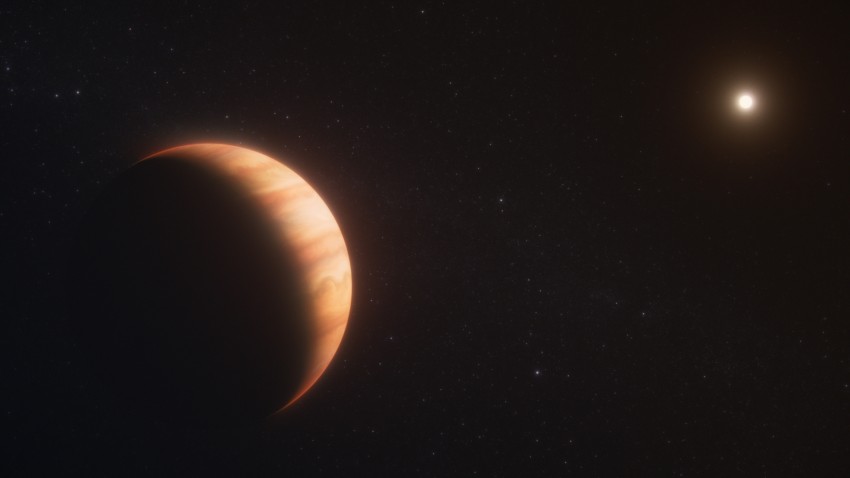
Researchers have discovered an exoplanet that travels around its small, red star backward, much like a rubber duck spinning against the current in a whirlpool. The discovery could give insight about how exoplanets form around the most common types of stars in our galaxy.
It's a mystery why the alien world, called GJ 3090 b, orbits its star backward (also called a retrograde orbit). Stars and planets usually form from the same rotating disk of gas and dust, called a protoplanetary disk. Newly formed celestial objects normally rotate in the same direction as the protoplanetary disk, because changing the rotational direction requires a lot of energy applied in the right way.
Astronomers have discovered a few exoplanets with retrograde orbits before; these orbits often happen when the gravitational attraction of other massive objects in their star systems scrambles the planets' orbits. However, this newly discovered planetary system doesn't seem to have any massive objects that could have changed the retrograde planet's orbit, researchers reported in a study published Sept. 21 in the journal Astronomy and Astrophysics .
"We looked for the kind of massive companion that could have forced the planet into such an extreme orbit," study co-author Yann Carteret , an astronomer at the University of Geneva, said in a statement . "We may need to think differently about how this system acquired its unusual architecture."
A planetary mystery
For their new study, the researchers analyzed 23 hours of observations from two exoplanet-hunting instruments installed on a 12-foot-wide (3.6 meters) telescope at La Silla Observatory in Chile. They saw the retrograde planet cross in front of its star 10 times. Each time it passed in front of the star, the starlight reaching Earth dimmed a little. Measuring the extent and duration of that dimming revealed the planet's size and information about its orbit.
An illustration of a star surrounded by a protoplanetary disk. Material leftover from the star's creation may coalesce into planets. (Image credit: NASA/JPL-Caltech) What made this detection particularly difficult was the type of star: an M dwarf. These stars are small, relatively cool and so dim that even the closest M dwarf stars to Earth can't be seen with the naked eye. About three-quarters of the stars in the Milky Way are M dwarfs, so studying them is particularly important for understanding our galaxy's exoplanets.
The star system in question is made of two, or possibly three, planets smaller than Neptune, each of which takes less than 16 days to orbit the star. GJ 3090 b is the innermost planet, completing an orbit about once every 2.9 days. Its orbit is one of the most misaligned ones scientists have detected so far, at a whopping 136 degrees out of alignment with the star's spin, making the planet nearly upside down — similar to Venus in our solar system.
Related stories
A doomed exoplanet is caught in a 'death spiral' around its star. Can it survive?
'A completely new phenomenon': Astronomers spot a planet causing its star to constantly explode
JWST spies frigid alien world on bizarre orbit: 'One of the coldest, oldest and faintest planets that we've imaged to date'
Because GJ 3090 b is the planet closest to the star, it's unlikely that its orbit was disturbed by a massive planet or a hidden binary star; the other planets in the system are not upside down. And because they're farther from the star, a large gravitational disruption would probably affect them more, not less.
Instead, the researchers suggested that the unusual planet may have simply been born upside down. If a lot of gas and dust from outside the star system got sucked into the system, it might have replaced the protoplanetary disk with a second, newer disk at a different angle to the original, which could have formed the retrograde planet. The amount of material making up the inner planets (formed from the dusty, gaseous disk) is less than the amount that would pull on the star's spin enough to make the star change its rotational direction, keeping the system in a balanced misalignment, the researchers explained.
"The idea that a planetary system could be rebuilt from a second, differently oriented disk is particularly exciting," Vincent Bourrier , an astronomer at the University of Geneva and co-author of the study, said in the statement. "It suggests that the environment around a young star can play a much bigger role in determining the architecture of its planets than we might have expected."

Comments
No comments yet — be the first to weigh in 👇
No comments yet. Be the first!