Full text
Archaeologists excavating a medieval settlement in northwestern Russia have unearthed an unusual 11th-century pendant that combines Christian and pagan imagery. It is the oldest amulet of its kind discovered in the region.
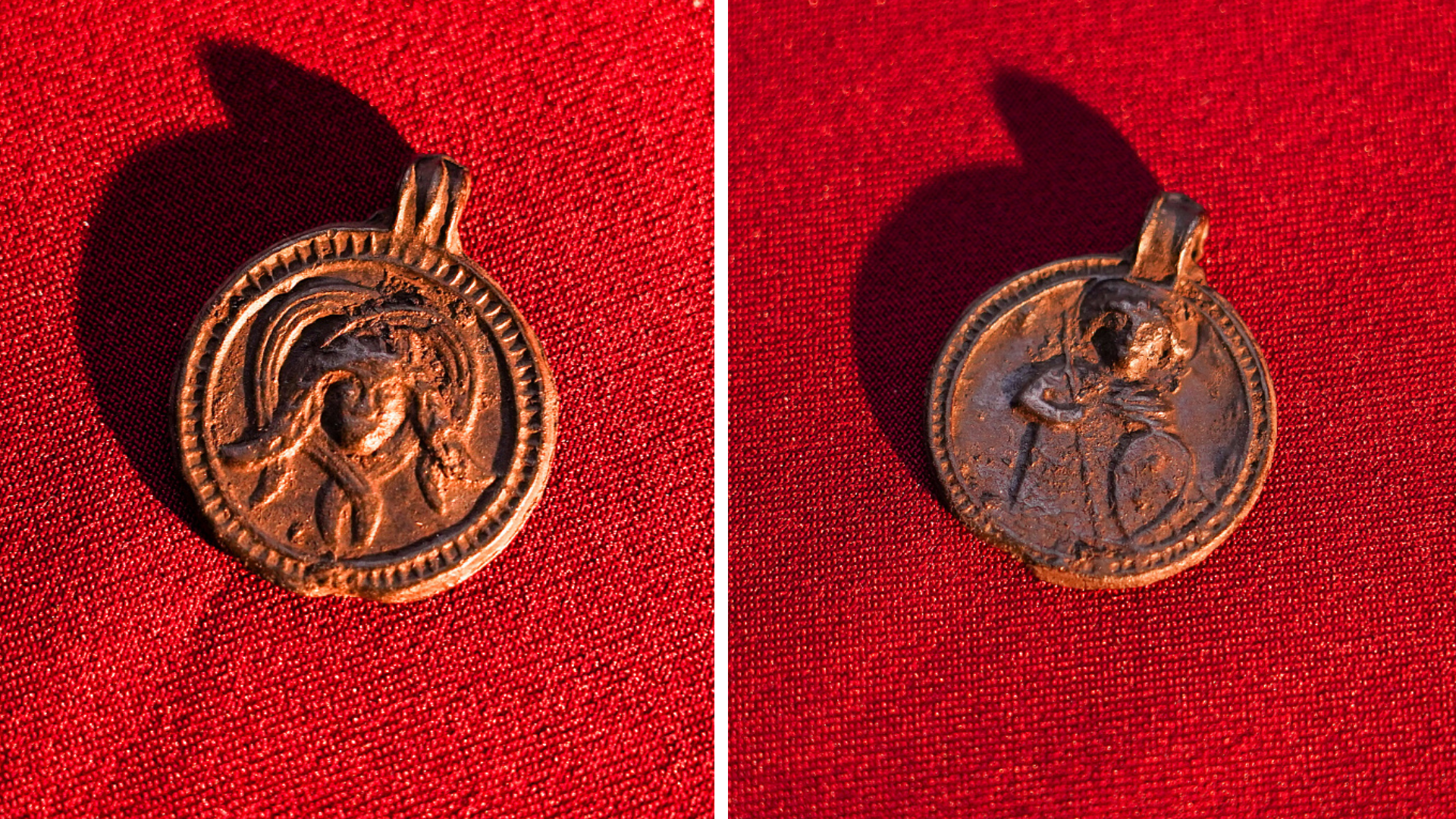
The double-sided copper-alloy pendant was found during a summer excavation in Staraya Russa, a historic town between Moscow and St. Petersburg, according to a translated statement from Novgorod State University. One side depicts a Christian saint, while the other side has a Medusa-like figure.
The artifact is known in Russian as a "snake amulet" or "serpentine pendant." Four other examples of this jewelry type are known from Christian sites in the area, but those have been dated between the 12th to 14th centuries. The newly discovered pendant was found in layers dated to the 11th century, suggesting an early Christian community lived in the area earlier than thought.
"The main characteristic of the serpentine pendant is its combination of images that are incompatible, from a strictly dogmatic standpoint," Sergey Toropov , director of the Novgorod State University Center for Archaeological Research, said in the statement. One side always features a Christian image, such as Jesus , the Virgin Mary, or a saint, while the other side prominently features snakes.
RELATED STORIES
Archaeologists unearth a medieval nobleman buried with his horse and dog in a rare wooden tomb in Russia
Complete skin of an adult horse found with 10th-century woman and newborn in rare Siberian burial
2,600 silver coins found in the outskirts of Moscow may have been buried by a medieval plague victim
In this case, the front of the pendant depicts a warrior-saint with a spear and shield, which Toropov linked to St. Theodore Stratelates . According to ecclesiastical texts, he was also known as Theodore of Heraclea and was famous for bravely killing a giant serpent terrorizing his home town in Asia Minor. On the back of the pendant is the image of a woman's head with snake-like hair, but it is unclear if it is specifically a depiction of the gorgon Medusa from Greek mythology.
"The 'incompatible' images in this case could symbolize the victory of the forces of light over the forces of darkness," Toropov said.
The tradition of serpentine pendants likely came to Russia from the Byzantine Empire . Because the piece of jewelry is made from copper and not more valuable silver or gold , it likely belonged to a member of the middle class living on the medieval estate at Staraya Russa, Toropov said.
The pendant's combination of a Christian saint and a pagan mythological figure shows that Russia had a complicated religious landscape a millennium ago, according to the statement. Christianity had taken hold in the region, but some people clearly preserved their pagan traditions and symbols.

Comments
No comments yet — be the first to weigh in 👇
No comments yet. Be the first!