Full text
In an extraordinary first-of-its-kind video, researchers have documented a humpback whale mom grieving her stillborn calf.
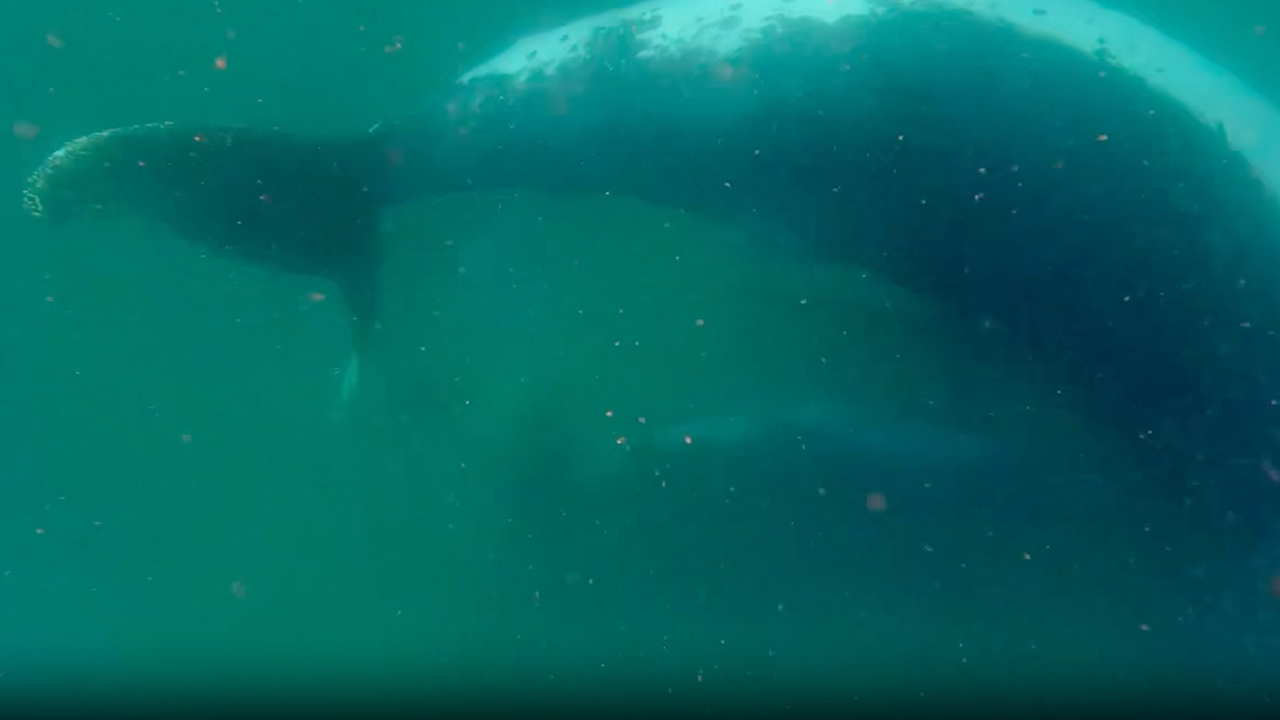
The footage was recorded off the coast of southeastern Australia in July 2025, according to a study published Wednesday (Sept. 16) in the journal Discover Animals . In the clip, a female humpback whale ( Megaptera novaeangliae ) hovers above her baby's motionless body on the seafloor and tries to make eye contact with the newborn, as if to check for signs of life.
"It is extremely rare to witness," study first author Olaf Meynecke , a marine ecologist at Griffith University in Australia, told Live Science in an email. "Only about 20 births of humpback whales have been observed to date and described in literature," none of which involved a stillborn calf.
Unlike the babies of toothed whales and porpoises, newborn humpback whales don't have enough blubber to float, so they sink without the help of an adult whale. This might partly explain why scientists had not witnessed a stillbirth in this species until now, Meynecke said, as the lifeless body sinks to the seabed immediately after birth and is almost impossible to spot from a distance.
The whale mom repeatedly tried to make eye contact with her calf, even though researchers think she was aware it died during birth. (Image credit: Andy Mulville) The video was taken after study co-author Andrew Mulville, who was on a private boat that morning, noticed two adult humpback whales milling about at the surface of the water. One of the whales adopted a vertical position with its tail pointing up. Moments later, Mulville saw the remains of an amniotic membrane, the inner layer of the placental bag that envelops a fetus, floating on the water.
The whale had obviously just given birth, but there was no sign of the calf. So Mulville and others on the boat followed the female underwater with a GoPro camera. They found the calf dead on the seafloor, while the mother displayed what the study authors interpreted as "postmortem attentive behavior," or grieving.
"She was repeatedly diving down for short times and swimming next to the calf, then resting next to it on the floor for about a minute, even moving the pectoral fin over the calf, then diving up again," Meynecke said. This behavior lasted for at least 90 minutes and possibly days, although the researchers left the scene after about two hours of observation.
The mother did not try to bring the calf's body to the surface, possibly because she realized that it had died during birth. This is different from the postmortem attentive behavior of toothed whales, which researchers have previously seen pushing stillborn babies above the water, according to the study.
The other adult whale on the scene was an "escort" supporting the pregnant female as she prepared to give birth, Meynecke said. Based on the escort's size and appearance, it was likely a female of a similar age to the mom, but the researchers did not confirm this. Male and female escorts are common in humpback whales; they usually travel with females and their calves during migration and assist females during pregnancy.
RELATED STORIES
'It's incredibly rare to see a moment like this in the ocean': Camera drone captures moment humpback whale gives birth off Australian coast
'I thought I was dead': Terrifying video of humpback whale gobbling up kayaker explained
Kelping is a 'global phenomenon' sweeping the world of humpback whales, scientists say
Grieving behavior suggests that humpback whales have an inherent, strong maternal attachment to their calves. Grief is difficult to demonstrate due to the lack of physiological or neurological measurements. However, the whale mom sought close proximity with her calf during the observation time, and the adult whales were spotted swimming in the area for the next two days, suggesting they were emotionally invested in the death, according to the study.
"It provides a rare window into the behavioural response of baleen [filter-feeding] whales toward a deceased member of their species but also in this case of a mother toward her calf," Meynecke said. "It provides important insight into the complex behaviours of the species and aligns with other observations of care taking, assisting distressed whales or even protecting other species from predators."
 Greenland shark lives 400 years with eyes that barely age: scientists study the secret
Science Daily · 24d ago
Greenland shark lives 400 years with eyes that barely age: scientists study the secret
Science Daily · 24d ago
/https://tf-cmsv2-smithsonianmag-media.s3.amazonaws.com/filer_public/0d/b6/0db6a183-3e35-4b2e-9ad6-2489249044f4/narwhal-group.jpeg) Narwhal tusk mystery solved: opposing inner and outer spirals give it strength
Smithsonian Magazine · 27d ago
Narwhal tusk mystery solved: opposing inner and outer spirals give it strength
Smithsonian Magazine · 27d ago
 Nurse shark films a great white: a world first in ocean footage
National Geographic PL · 27d ago
Nurse shark films a great white: a world first in ocean footage
National Geographic PL · 27d ago
Comments
No comments yet — be the first to weigh in 👇
No comments yet. Be the first!