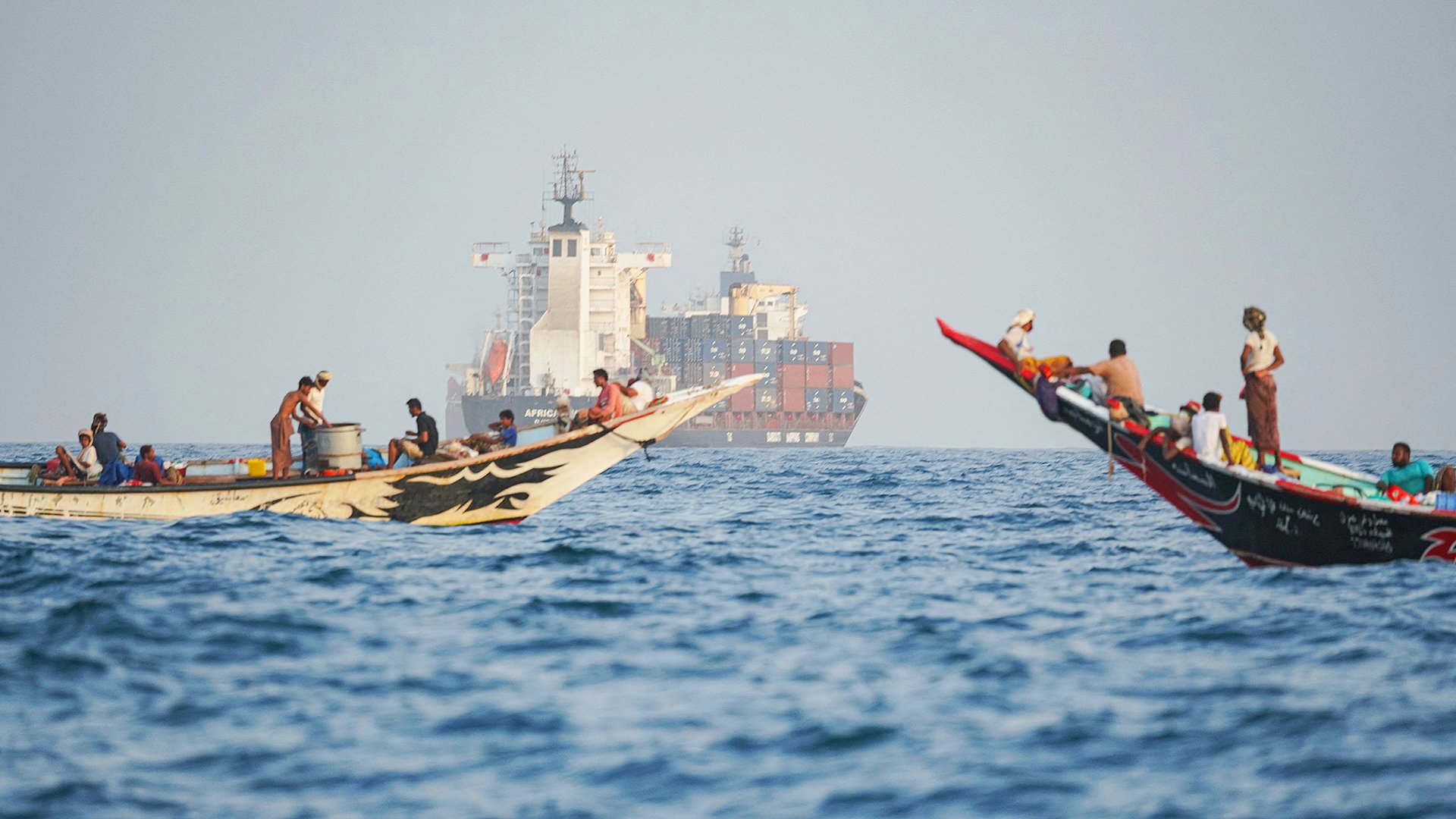
Houthis seize Mocha port and islands; control Bab al-Mandab strait
Iran-backed Houthi rebels have captured the strategic port of Mocha in southwestern Yemen and two islands on Red Sea shipping lanes. The seizure strengthens their control over the narrow Bab al-Mandab strait and the entrance to the Gulf of Aden, where Houthis have already imposed a blockade on Saudi oil exports. Combined with Iranian control of the Strait of Hormuz, this threatens global oil flows from the Middle East.
Full text
The Iranian-backed Houthi rebels have captured Mokha – a key Red Sea port in southwestern Yemen near the Bab al-Mandab (BAM) Strait. There are also reports they seized two islands located in the Red Sea shipping lanes . These moves against the Saudi Arabian-backed forces that previously held these areas could further cement the Houthi’s control over the narrow chokepoint to the Gulf of Aden, where the group has already imposed a blockade on Saudi oil exports .
The Houthi’s drive to control the BAM has been emboldened by the U.S. being stretched thin in its ongoing fight against Iran . Combined with Tehran’s control of the Strait of Hormuz , this threatens to add to the Islamic Republic’s command over the flow of oil from the Middle East. It is a maximum pressure campaign on the U.S. and global markets, something we have predicted for years. Amid all this activity, the per-barrel price of Brent Crude is well over the $100 mark now .
The port of Mokha. (Google Earth)
The rapid advance on Mokha was planned and backed by Iran, according to the leader of Saudi-backed forces that retreated from Mokha, which is about 50 miles north of the BAM. It took place as Tehran has taken a more belligerent stance in the region that has seen it reportedly damage U.S. aircraft in a recent attack on Jordan earlier this week and get closer to striking U.S. Navy warships with ballistic missiles.
“The Joint Forces have formed a command center south of the city of Mokha, following Houthi breakthroughs across various combat axes under heavy fire, in which the Houthis used various types of weapons,” Deputy Chairman of the Presidential Leadership Council (PLC), Lt. Gen. Tareq Saleh, said in his acknowledgment that his forces lost the port. The PLC was created in 2022 to represent the internationally recognized government of Yemen.
“The armed forces on the West Coast — the National Resistance, the Giants [Brigades], and the Homeland Shield — in addition to units of the Taiz axis west of the governorate, have paid a heavy price, martyrs and wounded, over the past days as they confronted the Houthi attack, which was planned by Iran, supported by it, and carried out with the participation of its various proxies/tools.”
“Thanks to God, our armed forces were able to repel an enemy combat formation a short time ago in the province of Taiz, forcing it to withdraw,” Houthi spokesman Brig. Gen. Yahya Saree proclaimed . “This was achieved by targeting it with a number of locally manufactured surface-to-air missiles.”
(Houthi Telegram channel)
Videos have emerged showing Houthi forces inside Mokha and its airport and a large amount of equipment being seized.
The people of the port city of Al-Mokha gave a warm reception to Yemeni armed forces fighters following the city's strategic liberation. pic.twitter.com/0XDrveJPxU
— IRNA News Agency ☫ (@IrnaEnglish) September 10, 2026
BREAKING: The Houthis have announced a Cessation of Combat Operations along the Coast of Bab al-Mandab Strait following the Collapse of Pro-Saudi Forces
The Core Military of the Houthis has entered the City of Mokha
Additionally, all Islands Key to Controlling the Bab… pic.twitter.com/95HI4TJ6Bm
— Iran Observer (@IranObserver0) September 10, 2026
Houthi forces captured the key coastal city of Mokha overnight after Saudi/UAE backed forces retreated.
Seen here, Houthi fighters pose with an abandoned M-ATV MRAP at the city’s critical seaport. pic.twitter.com/1WD6l08MVc
— OSINTtechnical (@Osinttechnical) September 10, 2026
Houthi fighters were filmed on the runway of Mokha international airport after capturing the city. pic.twitter.com/56Rc4BwsNf
— Open Source Intel (@Osint613) September 10, 2026
Holy score. This footage from Al Jazeera shows some of the equipment that was left behind for the Yemeni to capture in Mokha. https://t.co/yc0nwRlIse pic.twitter.com/Jn8VT571LY
— Reno (@theRenoNara) September 10, 2026
Even before the capture of Mokha, the rebel group held the BAM under threat with its array of drones and missiles, some of which it launch from deeper in Yemen. In fact, the group became the first to fire anti-ship ballistic missiles (ASBM) at vessels during its campaign against Red Sea shipping.
©2023, The International Institute for Strategic Studies, originally published on https://iiss.org/online-analysis/military-balance/2024/01/houthi-anti-ship-missile-systems-getting-better-all-the-time/(reproduced with permission) (International Institute of Strategic Studies)
Mokha, however, provides a potential new surveillance and launching point for the Houthis to deploy mines as well as aerial drones and uncrewed surface vessels (USVs) they can use to attack shipping. As we have reported previously , the rebel group pioneered the operational use of some of these weapons.
The Houthis “are determined to control the ports in order to use booby-trapped boats from areas close to shipping lanes,” Col. Abdul Basit Al-Baher, a Yemeni army officer and military analyst, told Arab News last month as the rebels were pushing closer to the port.
You can see video and images of a Houthi USV that struck the Greek-owned ship Tutor in the Red Sea in 2024 below.
Photos of Houthi kamikaze USV right before it struck Greek-owned cargo ship Tutor.
The ship's guard were totally confused as to what they were observing.
They couldn't even react before it hit the ship. https://t.co/ZwFlWnsFAR pic.twitter.com/8ORRrvZWH6
— Clash Report (@clashreport) June 17, 2024
In addition to Mokha, the Houthis also reportedly captured two important islands that could also add to its control over shipping through the strait. However, TWZ cannot independently confirm this.
There are claims that the Houthis seized Perim Island , which sits right in the middle of the BAM. In 2021, satellite images we obtained showed completion of a new, approximately 6,150-foot-long runway on the island as well as hangars and other facilities. The installation was supposedly meant primarily to support drone operations and was built by the United Arab Emirates.
This strategically located island sits in the narrowest part of the BAM, less than two miles west of Yemen and about 13 miles east of Djibouti, giving the Houthis a commanding presence at the mouth of the Red Sea.
PHOTO © 2025 PLANET LABS INC. ALL RIGHTS RESERVED. REPRINTED BY PERMISSION)
(PHOTO © 2025 PLANET LABS INC. ALL RIGHTS RESERVED. REPRINTED BY PERMISSION)
Zuqar Island, which was also reportedly captured , sits in the middle of the Red Sea about 80 miles north of Perim Island. In the custody of the Yemeni government since 1998, it was being “used by government forces to track shipping traffic, monitor movements by Houthi rebels and stop weapons smuggling in the Red Sea,” according to The National .
Last year, images emerged of construction of a runway on the island.
(PHOTO © 2025 PLANET LABS INC. ALL RIGHTS RESERVED. REPRINTED BY PERMISSION)
This satellite image from 2025 shows the runway on Perim Island. (PHOTO © 2025 PLANET LABS INC. ALL RIGHTS RESERVED. REPRINTED BY PERMISSION)
It is unclear who built these island runway, though there have been indications that it could have been the United Arab Emirates once again.
A closer look at the new 2.1 km runway on Yemen’s Jabal Zuqar Island in the southern Red Sea shows a small apron with one completed aircraft hangar and another likely under construction, plus a taxiway leading to two military emplacements, likely to shelter aircraft or UAVs. https://t.co/cnphe6yCeO pic.twitter.com/iOwr7C6I91
— Rich Tedd (@AfriMEOSINT) October 20, 2025
Zuqar Island sits about 7 km east of the northbound shipping lane in the Red Sea. Control over these two islands could allow the Houthis to mirror the pattern Iran established in the Strait of Hormuz by directing traffic to pass through a narrow passage between Qeshm and Larak islands.
The Iranian transit scheme for the Strait of Hormuz. (Iranian government)
The conflict between Saudi Arabia and the Houthis grew out of a civil war in Yemen that erupted in 2014. It expanded a year later when a Saudi-led coalition joined forces with the government ousted by the Houthis and raged on until the parties reached a tenuous ceasefire in 2022. The Saudis held off on getting involved in the recent Red Sea conflict which saw the U.S. and coalition warships duking it out with the Houthis, and eventually led to a U.S.-led air campaign over Yemen. Tensions, however, reignited after that conflict ended when the Houthis joined the U.S.-Iran conflict on the side of their major supporter. In addition to the aforementioned blockade, the Houthis began striking Saudi refineries.
The Houthis already control the port of Hodeidah, about 100 miles to the north. Capturing Mokha and the two islands extends their reach even closer to the BAM.
In the wake of the Houthi blockade imposed in July, traffic in the BAM fell by 15% , according to Lloyd’s List Intelligence .
“ On average, 273 ships sailed through the chokepoint each week between 27 July and 23 August,” the organization reported. “The naval ban on Saudi Arabia came into effect on 20 July, and the weekly average in the run up date was 319. Still, traffic remains above volumes seen before the crisis in the Middle East Gulf that led to a flurry of activity in the Red Sea as Saudi oil was redirected to Yanbu.”
As we have explained in the past , Saudi Arabia has diverted millions of barrels of oil per day through pipelines to its Yanbu port on the Red Sea in an effort to minimize the energy shortages due to the hostilities near the Persian Gulf.
Saudi Arabia has increasingly sent oil to its port of Yanbu on the Red Sea. (Photo by Yasin Demirci/Anadolu via Getty Images) Anadolu
The biggest impact of the blockade, Lloyd’s List Intelligence notes, is that it is driving up the cost to deliver oil by forcing traffic north through the Suez Canal, “extending voyage times and tying up capacity. In the Middle East, rising use of Hormuz shuttle tankers and multiple STS transfers is creating delays and increasing vessel utilization. Combined, these rising inefficiencies have led to the third VLCC spot-rate spike since the beginning of the crisis in the Middle East Gulf.”
The Houthi strikes on Saudi’s oil infrastructure, including a Houthi missile and drone attack against the Saudi Aramco refinery at Jazan on the Red Sea earlier this week , add a further dilemma for Riyadh, making it harder to get its product to points of shipment.
Video of of the aftermath of those strikes, which you can see below, emerged on social media.
Following Houthi strikes, fires can be seen raging at the Jizan oil refinery in Saudi Arabia. pic.twitter.com/tAqOPlsmvS
— OSINTdefender (@sentdefender) September 8, 2026
All this is raising the specter of the U.S. having to get as involved as it did during the previous Houthi campaign against shipping that ended last September, which could pull resources away from Iranian-focused operations, if supporting such an operation is even possible at all at this point. The Navy, and other key elements of the U.S. military, is overstretched and worn down by continuous deployments for many months leading up to Venezuela and then Iran, and now six months after Operation Epic Fury.
U.S. forces in the Persian Gulf are under increasing pressure as tensions with Iran continue to simmer. On Tuesday, several U.S. Air Force jets were damaged in an Iranian missile barrage on Muwaffaq Salti Air Base in Jordan, according to CBS News . An A-10 Thunderbolt II close support jet lost a wing and about eight F-15E Strike Eagle multi-role fighters were slightly damaged and returned to service, the network noted.
There is also a report that Acting Navy Secretary Hung Cao said Iranian forces “blew the hell out of Bahrain” where the U.S. military has a number of key facilities, including the headquarters of the U.S. Fifth Fleet. The country has been the subject of frequent Iranian barrages since the U.S. and Israel first attacked on Feb. 28 .
Cao’s assessment matches what we have seen and heard prior to his comments and raises anew the question of whether the U.S. will return to Bahrain and other bases in the region heavily attacked by Iran.
In an exclusive interview, Acting Navy Secretary Hung Cao told me that Iranian forces "blew the hell out of Bahrain."
While open-source analyses have long indicated that the U.S. Fifth Fleet Headquarters at Naval Support Activity Bahrain sustained extensive damage in the early…
— Ryan Morgan (@R_S_Morgan) September 10, 2026
On the sea, Iranian missiles are getting closer to hitting U.S. Navy warships, the Wall Street Journal reported .
“At least three times in the past week, Iranian forces have launched missiles at American warships, including an aircraft carrier, taking direct aim at the U.S. Navy in a way it hasn’t done since the start of the war,” the newspaper noted. “The attempted strikes on warships have led to much closer calls than previous attempts, with Iran using maneuverable warheads, people familiar with the attacks said.”
Amid this activity, traffic through the Strait remains suppressed.
“Vessel transits via the Strait of Hormuz fell on Wednesday to seven from 12 the previous day, preliminary ship-tracking data showed on Thursday, with levels also below the 10-day average of 14,” Reuters reported . “Out of these seven ships, four vessels exited and three entered, according to the data.”
However, an exact figure is hard to come by. Some vessels could be sailing through the waterway with their transponders turned off and would not be counted toward the totals, the outlet added.
Vessels transit the Hormuz Strait off the coast of Iran’s southern port city of Bandar Abbas on September 7, 2026. (Photo by ATTA KENARE / AFP) ATTA KENARE
As it is, oil prices are skyrocketing. As of noon Thursday, the per barrel price of Brent Crude exceeded $107, the highest price since July when it fell to just over $77 per barrel, according to OilPrice.com .
It will take some time before we get a better picture of how the Houthi seizure of the port of Mokha, and possibly Perim and Zuqar islands, will affect the global economy due to rising oil prices, either through reduced supply, increased cost of delivery or some combination of the two. With no end in sight to the U.S. conflict with Iran that helped to drive these actions, the Yemeni rebel group has incentives to inflict economic pain wherever it can.
Contact the author: howard@twz.com
The post Houthi’s Stranglehold On Strategic Bab Al-Mandab Strait Grows Stronger appeared first on TWZ .
Similar stories


Similar stories
Does the Houthi seizure of Mocha pose a serious threat to global oil supplies?
Comments
No comments yet
Comments
No comments yet — be the first to weigh in 👇
No comments yet. Be the first!