Full text
Astronomers just dropped a video 27 years in the making: the highest-definition animation of a gargantuan black hole jet blasting out of a distant galaxy and twisting off into space.
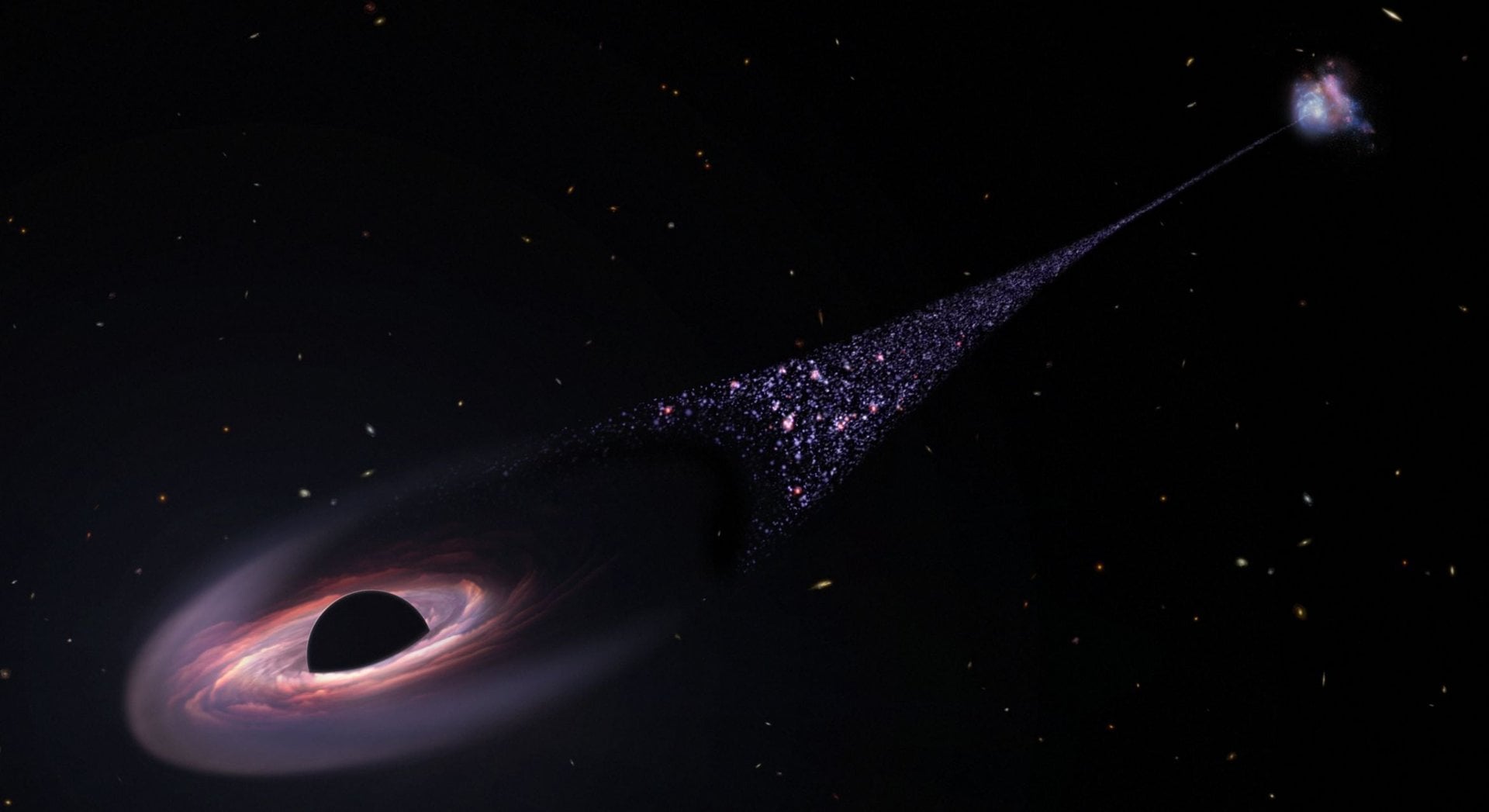
The video, made from 116 images taken between 1995 and 2022, captured a blazar known as 3C 345, in the constellation Hercules. A blazar is a sort of quasar — a bright, feeding supermassive black hole embedded in the center of a faraway galaxy — that emits huge jets of gas into its environment. The jets blaze at nearly the speed of light and are charged with highly concentrated X-rays and gamma rays.
As described in an Aug. 26 study in the journal Nature , scientists gathered the images of 3C 345 using decades of observations by the Very Long Baseline Array (VLBA), a network of 10 telescopes spread across the U.S. (VLBA had two programs that caught views of the jet, called BEAM-ME and MOJAVE, which collectively followed hundreds of blazar sources.)
To turn those hundred-or-so images into an animated movie, the team used an AI neural network named Kine, achieving a resolution four times higher than that of any individual image. By doing so, the researchers mapped the speed of the black hole jet to the highest precision yet. (Several study co-authors had previous experience boosting the resolution of distant black hole images while working at the Event Horizon Telescope Collaboration, the team behind the first image of a black hole .)
"The higher quality of our video reconstruction enabled a detailed measurement of the plasma velocity in the jet," study first author Marianna Foschi , a postdoctoral researcher at Caltech, told Live Science in an email.
A big, bright surprise
The researchers were surprised to see that the mighty jet's brightest components were flying at 10 to 13 times the speed of light while the gas surrounding it was zooming at about nine to 12 times the speed of light.
Still images of the black hole jet taken over 27 years. The bottom images (a-c) show the direction of polarization in the plasma jet. (Image credit: Foschi et al / Nature) "This is unexpected because the general consensus is that these bright components are shock perturbations moving through the plasma, and as such they should have a higher velocity compared to the surrounding fluid," Foschi said. "Our work does not invalidate the shock model in general, but it puts it into question, at least in the case of this specific source."
VLBA uses radio antennae across the continental U.S. to map the sky, providing a wide view of the universe. But while VLBA has a comprehensive view of the sky, it lacks very fine details. The array is designed to generate a two-dimensional image with elements based on a measurement between two of the array's telescopes. Because the array has only 10 telescopes to do those measurements, however, its pixel resolution is limited.
Related stories
Giant, cosmic 'Eye of Sauron' snapped staring directly at us in stunning 15-year time-lapse photo
Supermassive black hole spotted 12.9 billion light-years from Earth — and it's shooting a beam of energy right at us
2 supermassive black holes may collide 100 years from now — and Earth would feel it
That's where the Kine AI model makes a difference. The goal of Kine's work, Foschi said, is to develop an imaging algorithm that can create videos of observations at different times, focused on astronomical sources with variable brightness.
Kine is a neural network — a type of machine learning model that uses layers of "neurons" (computing nodes) to learn from a dataset, similar to the way a human brain learns. Kine can "process observations at different times, while learning and leveraging the spatio-temporal correlations present in the data," the research team wrote in the paper, referring to time and the three dimensions of space.
Foschi said the team is eager to apply Kine to other astronomical observations. "We believe this method will drastically change the way jet dynamics is studied from observations," she said. "In fact, our method enables a precise measurement of the projected velocity at any point in the jet."
See how much you know about black holes with our black hole quiz!
Comments
No comments yet — be the first to weigh in 👇
No comments yet. Be the first!