Full text
The patient: A 55-year-old man in Bangladesh
The symptoms: The man went to the emergency room with severe abdominal pain that he said began five hours prior to his visit.
What happened next: During a physical examination, doctors noted that the patient's temperature and blood pressure were normal. His heartbeat was slightly elevated, at 110 beats per minute (bpm). (A typical resting heart rate for adults is 60 to 100 bpm.)
The man explained that one day earlier, an eel had "entered through his rectum accidentally," his doctors wrote in a report of the case . At the time of the encounter, the man was wearing a lungi — a type of long skirt often worn by Bangladeshi men — and he explained that the eel entered his lungi through the opening at the bottom and then wriggled into his anal canal.
He did not seek medical attention immediately after this happened, as he had hoped the fish would exit on its own.
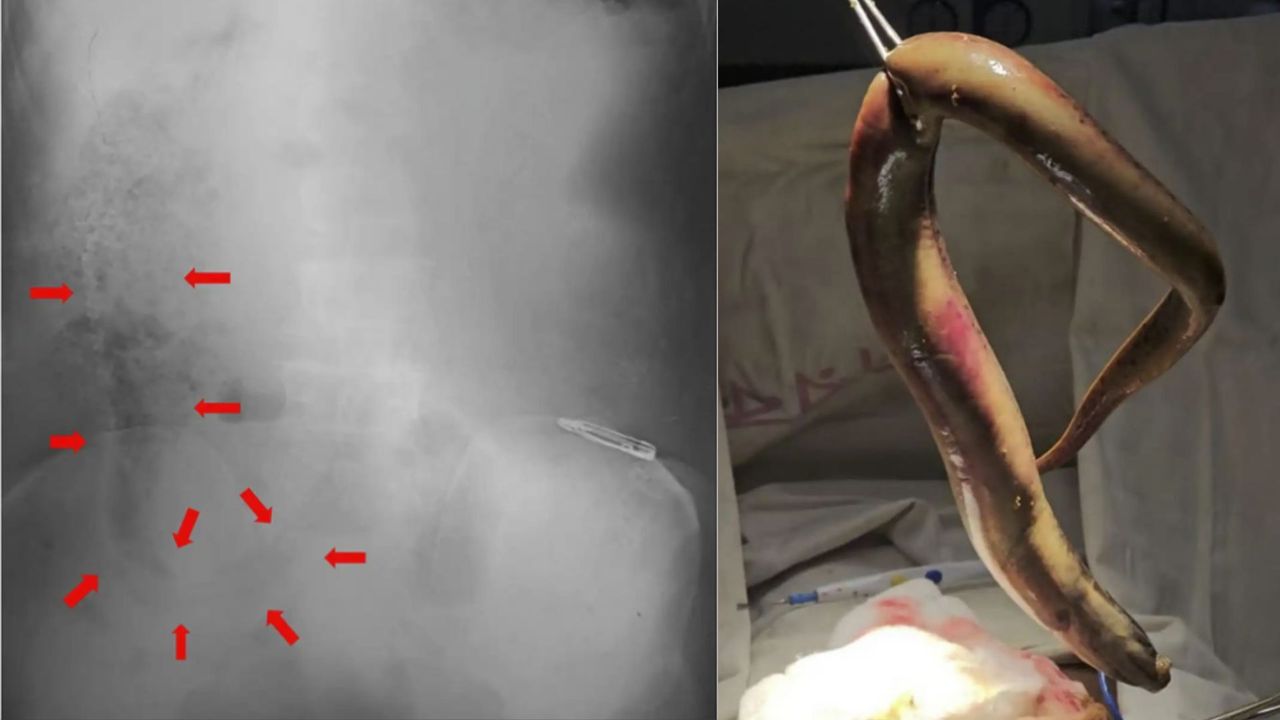
When the doctors kneaded the patient's abdomen, it was rigid and tender. They ordered an X-ray, which revealed a dark, eel-shaped shadow on the right side of the abdomen.
The diagnosis: The X-ray showed a crescent-shaped gas shadow under the right part of the man's diaphragm and hinted that he had developed peritonitis — inflammation of a membrane called the peritoneum, which covers the abdominal organs. Peritonitis is usually caused by a bacterial or fungal infection, but it can also develop if fluids from other organs leak into the peritoneum.
If the condition is not treated quickly, it can lead to a life-threatening infection that can spread rapidly through the body.
The treatment: Doctors administered IV antibiotics, as well as fluids and anti-ulcer medications, which help repair injuries to organs' outer mucosal layers and prevent deeper tissue damage.
Due to the peritonitis, the doctors determined that the patient was at risk of septicemia , or "blood poisoning," in which pathogens invade the bloodstream. They decided to operate on the patient immediately and remove the eel via a laparotomy, a surgical technique that creates an opening in the abdominal wall and provides access to the pelvic organs.
After making an incision in the man's sigmoid colon — the S-shaped section of the large intestine adjacent to the rectum — the surgeons extracted the eel from the peritoneal cavity , the space surrounding the abdominal organs and encased by the peritoneum.
Other dilemmas
A woman got a lung transplant — and ended up with a peanut allergy, too
A man tried to self-treat his incontinence by gluing his urethra shut
A joyful wedding nearly broke a woman's heart in a rare case of 'happy heart syndrome'
The eel measured nearly 2.2 feet (0.6 meters) long and was still alive. Perhaps, the doctors hypothesized, the eel was able to continue breathing by punching through the wall of the man's colon and squeezing into the peritoneal cavity, which contains a pale-yellow fluid that reduces friction between organs. This peritoneal fluid is mostly water , but it also contains glucose, electrolytes, proteins, enzymes, white blood cells and urea, a compound found in urine.
The surgeons then performed a sigmoid colostomy, creating an opening in the abdomen as an exit point for contents of the man's large intestine. In this way, they bypassed the damaged section of sigmoid colon to prevent leakage of fecal matter that could lead to further infection. Four days later, the man was symptom-free and was discharged from the hospital. The report did not document any follow-up visits.
What makes the case unique: Traumatic perforation of the intestine by foreign objects is uncommon, and cases involving live animals are "exceedingly rare," the authors wrote in the report. However, foreign objects often find their way into the human body through accidental ingestion or deliberate insertion into the rectum. Some deliberately inserted objects, such as vibrators, are designed for this purpose. Others are not; these have included chicken bones, light bulbs, metal rods, glass bottles and kitchen whisks .
Penetration of the colon by a live fish is an "unusual and scarcely documented event," the man's doctors added in the report. They noted one reference to such a case that appeared previously in scientific literature and involved a 50-year-old male patient in Hong Kong. In that case, the man knowingly inserted the eel — which measured more than 1.6 feet (0.5 m) long — into his rectum, allegedly in an attempt to relieve his constipation.
This article is for informational purposes only and is not meant to offer medical advice.
Can you guess the diagnosis in these strange medical cases? Find out with our diagnostic dilemma quiz!


Comments
No comments yet — be the first to weigh in 👇
No comments yet. Be the first!