Full text
Nissan AI cameras monitor workers’ movements and flag potentially unsafe body positions.
System compares factory employees against preferred movements while helping improve efficiency.
Nissan says technology has contributed to $34 million in health-related savings already.
Ever had a yoga instructor wander over and tell you to straighten that arm, bend a little less and stop twisting like that? Nissan workers in Mississippi are getting something similar, except their instructor is an AI-powered camera system and they’re building Frontiers and Altimas rather than attempting downward dog.
var adpushup = window.adpushup = window.adpushup || {que:[]};
adpushup.que.push(function() {
if (adpushup.config.platform !== "DESKTOP"){
adpushup.triggerAd("0f7e3106-c4d6-4db4-8135-c508879a76f8");
} else {
adpushup.triggerAd("82503191-e1d1-435a-874f-9c78a2a54a2f");
}
});
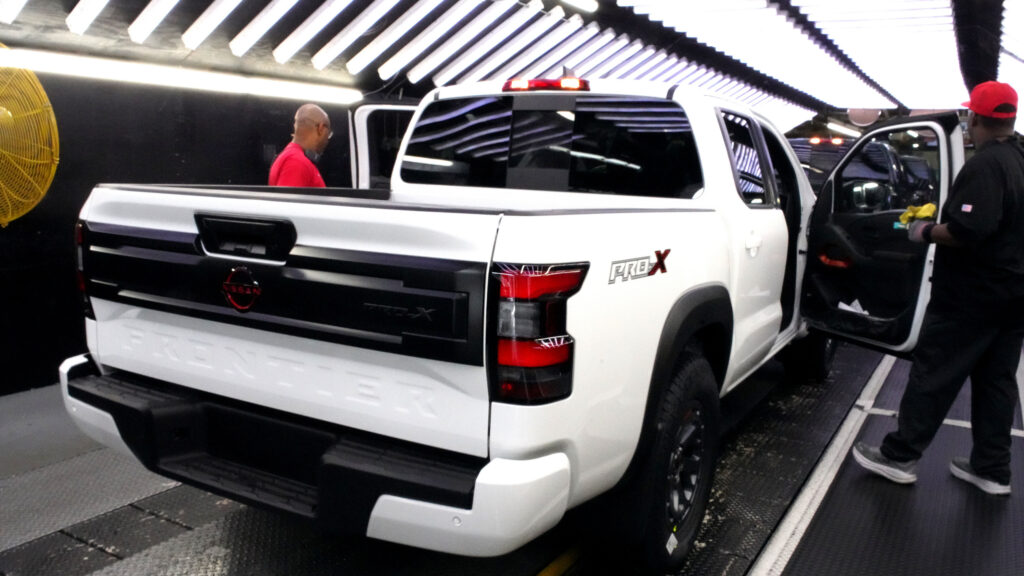
Nissan has installed cameras at its Canton, Mississippi, factory that analyze how employees move while performing assembly jobs. According to Business Insider, the system can recognize joints and body angles, spotting when someone bends too far, maintains an awkward position too long, or performs a task differently from the preferred sequence.
Related: Nissan Built The Next Skyline In Half The Time By Copying China And Using AI
There’s a benchmark for all this. Nissan calls its ideal method for completing each job the “golden cycle,” covering everything from the order in which components are fitted to how long the operation should take and how the worker moves while doing it.
var adpushup = window.adpushup = window.adpushup || {que:[]};
adpushup.que.push(function() {
if (adpushup.config.platform === "DESKTOP"){
adpushup.triggerAd("ea4d4b5a-f8e5-4d5d-9d9a-53a3b956b6cd");
} else{
adpushup.triggerAd("44c0a4dc-e25b-4ba5-ac64-2c510461b92a");
}
});
When the AI spots something potentially problematic, managers and engineers can investigate. That might mean coaching an employee on a safer technique, changing which jobs they’re doing, or modifying the workstation itself. So the camera isn’t just saying you’re doing it wrong. Nissan can use the information to figure out whether the job itself needs fixing.
That distinction matters at a time when factory workers could reasonably be nervous about AI and automation. Automakers across the industry are investing heavily in robots and other technology that can reduce their reliance on humans, while Nissan itself is cutting jobs and manufacturing capacity as part of its turnaround plan.
Helping Workers, Not Replacing Them
But Nissan insists this particular application isn’t about replacing people. “We’re not talking about job elimination,” manufacturing executive Victor Taylor told Business Insider . Instead, the company says it’s using AI to improve training, eliminate inefficient practices and, increasingly, reduce injuries.
Ergonomics wasn’t even the original priority. Nissan process engineer Chi Amaechi said the company initially investigated the system for training and manufacturing efficiency before discovering its ability to identify potentially harmful movements.
var adpushup = window.adpushup = window.adpushup || {que:[]};
adpushup.que.push(function() {
if (adpushup.config.platform !== "DESKTOP"){
adpushup.triggerAd("bb7964e9-07de-4b06-a83e-ead35079d53c");
} else {
adpushup.triggerAd("9b1169d9-7a89-4971-a77f-1397f7588751");
}
});
Nissan says the technology has contributed to around $34 million in safety and health-related savings at Canton, whose future is now focused on trucks and electrified SUVs after Nissan scrapped its EV plans. It’s particularly useful as experienced employees retire because their decades of manufacturing knowledge can’t simply be replaced overnight.
For now, Canton is the only Nissan plant using the AI system, though the automaker intends to finish deploying it there before expanding to Smyrna, Tennessee, and potentially its powertrain operations.
var adpushup = window.adpushup = window.adpushup || {que:[]};
adpushup.que.push(function() {
if (adpushup.config.platform !== "DESKTOP"){
adpushup.triggerAd("bb7964e9-07de-4b06-a83e-ead35079d53c");
} else {
adpushup.triggerAd("9b1169d9-7a89-4971-a77f-1397f7588751");
}
});
Nissan’s Canton vehicle assembly plant (Photos Nissan)


Comments
No comments yet — be the first to weigh in 👇
No comments yet. Be the first!