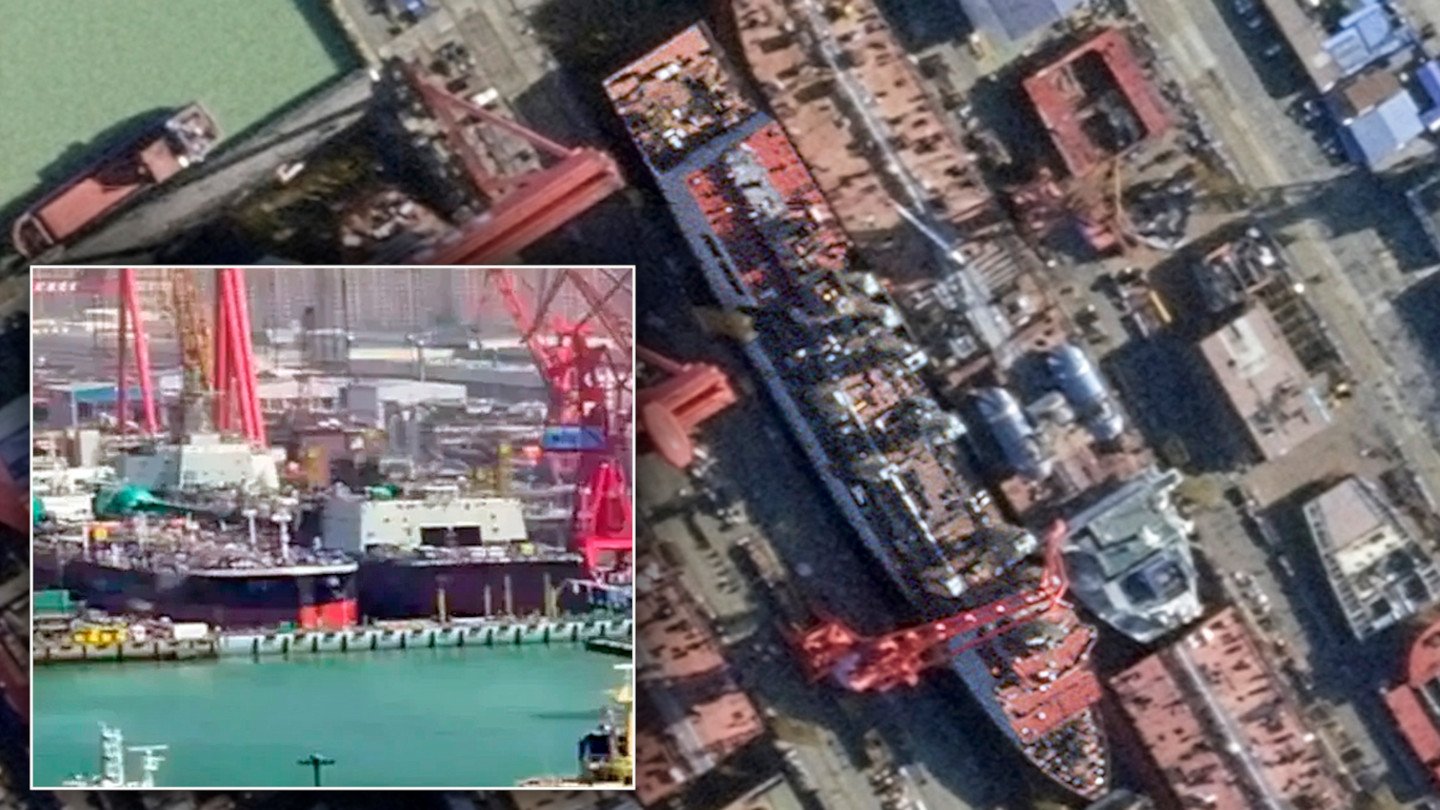
China is building the world's largest naval resupply ship for its carrier groups
China is constructing a massive naval resupply ship at a shipyard on Longxue Island near Guangzhou, operated by a subsidiary of the China State Shipbuilding Corporation (CSSC). Satellite imagery from Planet Labs shows construction has been underway since at least February 2025. The vessel is expected to be the largest naval resupply ship in the world, greatly extending the ability of the People's Liberation Army Navy's conventionally-powered carriers and their escorts to operate far from Chinese shores for sustained periods.
Full text
A very large and interesting-looking vessel is taking shape at a shipyard in southeastern China. What can be seen of it so far points strongly to it being the largest naval resupply ship anywhere in the world. A vessel like this would be valuable for supporting the Chinese People’s Liberation Army Navy’s (PLAN) growing blue water ambitions . It would be particularly important for enabling the PLAN’s conventionally-powered aircraft carriers , their air wings, and their escorts, to operate for sustained periods of time far from Chinese shores and friendly ports.
The ship is being built at a yard on Longxue Island, which is situated just southeast of the city of Guangzhou. A review of satellite imagery from Planet Labs indicates that it has been under construction since at least Febraury. A subsidiary of the China State Shipbuilding Corporation (CSSC) operates this facility. That firm is currently known as the CSSC Offshore and Marine Engineering Company (COMEC). It was previously called Guangzhou Shipyard International (GSI).
A satellite image offering a general overview of the COMEC/GSI yard. Google Earth
COMEC/GSI’s public portfolio is focused on large commercial vessels, including oil and liquid natural gas (LNG) tankers and cargo ships. It also builds specialized civilian designs, such as semi-submersible heavy lift ships and platforms designed to support offshore wind turbine construction.
In recent years, the yard has become well known for the construction of unique and unusual vessels with clear military or at least dual-purpose applications. This includes what may be a one-of-a-kind ostensibly civilian ‘research carrier,’ jack-up barges designed to connect together to support amphibious operations, and a stealthy trimaran drone ship . Soviet-designed Zubr class heavy hovercraft , which China has built examples of domestically under license , are also regularly seen there.
PLAN Amphibious Ambition: China’s Dual Paths to Cross-Strait Dominance Visible
PLAN Power Check: Imagery (Sept 29) from Longxue Island's COMEC Shipyard shows two strategic tracks for amphibious lift: continued production of logistics assets and high-tech combat… pic.twitter.com/VUUH96OTkO
— MT Anderson (@MT_Anderson) October 10, 2025
The ship being built on Longxue Island that is now drawing attention is approximately 885 feet (270 meters) long and is 121 feet (37 meters) across its widest (also known as the beam), based on available satellite imagery. There is a superstructure at the bow end with clear wings for a large bridge and a mast on top. There is also a separate superstructure at the stern end with exhaust stacks situated in front of it.
The ship in question (at bottom) is seen here in a satellite image of the COMEC/GSI yard taken on July 2, 2026. PHOTO © 2026 PLANET LABS INC. ALL RIGHTS RESERVED. REPRINTED BY PERMISSION
In May, CSSC also released a picture of the COMEC/GSI yard showing the ship from the stern as viewed from near ground level. The image, which was reportedly included in a social media post marking the change in solar terms in the traditional Chinese calendar, shows a large hangar with two at the rear of the stern superstructure. A large flight deck and hangar are also taking shape at the stern.
A close-up look at the ship in question as seen in the picture CSSC released in May. CSSC
A Planet Labs satellite image taken on July 2, seen at the top of this story and in parts throughout, also shows two large openings on the right side of the superstructure at the stern. These might be for launching and/or recovering small boats, including lifeboats. These could also just be apertures for crew walkways or other workspaces.
A closer look at the superstructure at the stern end with the openings visible in the side. PHOTO © 2026 PLANET LABS INC. ALL RIGHTS RESERVED. REPRINTED BY PERMISSION
However, it is what is seen in between the two superstructures that may be the most notable aspect of the ship. There are several pillar-like vertical structures positioned relatively close to both sides of the hull. This is in line with what is typically seen on naval vessels configured to conduct at-sea refueling and replenishment of other stores. The flight deck and hangar at the stern would also allow for vertical replenishment via helicopters.
A look at the pillar-like structures in the middle of the ship. PHOTO © 2026 PLANET LABS INC. ALL RIGHTS RESERVED. REPRINTED BY PERMISSION
“The hull form is broad and slab-sided, with a full midsection optimised for volume rather than speed alone. This is a characteristic associated with large fleet auxiliaries designed to carry fuel, dry stores, and ammunition for carrier strike groups,” according to a report on this ship from Jane’s back in April.
The ship’s design language also follows modern PLAN standards. Its layout, in broad strokes, is very similar to that of the Type 901 replenishment ship in PLAN service now. The PLAN also operates smaller Type 903 replenishment ships that have a roughly similar configuration, as well.
A Type 901 replenishment ship. Japanese Ministry of Defense
One of China’s smaller Type 903 replenishment ships. Chinese state media
Overall, the new ship under construction at the COMEC/GSI yard looks very much like a Type 901, but substantially scaled up. The Type 901 is quite large already, with a length of around 787 feet (240 meters) and a beam measuring just under 102 feet (31 meters). It also said to displace some 45,000 tons with a full load. As another point of comparison, the U.S. Navy’s newest John Lewis class replenishment oilers are just under 746 feet (227.3 meters) long and have roughly a 105-foot (32.2-meter) wide beam, according to the official fact sheet .
The new AOE design under construction at COMEC, Guangzhou. As already indicated by satellite imagery, this seems a very substantial hull, fa larger than the ca 45k ton Type 901 AOE (second image). Note the dual hangar doors for comparison.
Via Tomboy/SDF (edited for clarity). pic.twitter.com/mW8HubdQLA
— Alex Luck (@AlexLuck9) May 25, 2026
This is how of a monster is the new Replenishment ship building in Guangzhou
Compared from Left To Right
1. Type 903
2. Type 901 (Current Biggest)
3. Monster
4. Type 076 (50,000 tons)
5. Type 075 (40,000 tons)
6. Type 071 (25,000 tons)
This monster is probably for the Type 004 pic.twitter.com/FDtNphr9Y2
— PLA Military Updates (@PLA_MilitaryUpd) April 10, 2026
What other, more specific features and capabilities the new ship might have remains to be seen. What kind of armament it might have, even just for localized self-defense, is unknown. The Type 901 has four 30mm H/PJ-13 Gatling-type guns in turrets to provide close-in defense.
At-sea replenishment, in general, is a critical capability for any major navy that desires to conduct sustained blue water operations without having to rely on friendly ports. Even during peacetime in the broad expanses of the Pacific, port facilities of any kind, let alone ones capable of supporting large warships, can be few and far between and under direct threat.
For the PLAN, there is the added demand for at-sea replenishment support that comes from operating a growing fleet of so-far conventionally-powered aircraft carriers . Those carriers require steady streams of gas for their air wings on top of the fuel and other support needed to keep them sailing at all.
The Chinese aircraft carriers Liaoning and Shandong sail together, along with their escorts, as aircraft from their air wings fly overhead. Chinese government
The PLAN is also conducting more regular operations involving full carrier strike groups with conventionally-powered escorts that also need refueling and other support to keep up. During combat operations, replenishment ships also bring vital additional supplies of munitions to forward-deployed vessels.
A Type 901 replenishment ship, center, together with the aircraft carrier Liaoning , at top, and escorting surface combatants. Chinese government
It really cannot be overstressed how important at-sea replenishment is to modern blue water naval operations. This was underscored just earlier this year by challenges the U.S. Navy faced in keeping its conventionally-powered warships in the Middle East fueled amid Iranian attacks on friendly ports.
“So traditionally, for 25 years, we’ve been at war in the Middle East and that war was effectively fought in the parking lot of a giant gas station,” Robert Hein, Director of Maritime Operations for the U.S. Navy’s Military Sealift Command (MSC), said during the Navy League’s annual Sea-Air-Space exposition in April. “Iran has effectively shut down that gas station. So we’ve had to come up with really creative ways of, ‘how do we replenish the fleet?’”
You can read more about the “tanker treadmills” the Navy instituted in response, as well as other steps the service is taking now to bolster its at-sea replenishment capabilities and capacity, here .
It is worth noting here that America’s aircraft carriers are now all nuclear-powered , which eliminates their need to be refueled at sea. However, they still need gas for their air wings and other support to conduct sustained forward operations. Their escorts are all conventionally-powered, as well. As an aside, China may now be in the process of building its first nuclear-powered aircraft carrier .
Other fighting in the Middle East in recent years has also rammed home the vital importance of at-sea rearming capabilities for the U.S. Navy, especially methods for reloading vertical launch system cells on warships that it currently does not possess. Last year, in the midst of operations against Yemen’s Houthis , the service acknowledged that its warships were having to leave their stations in and around the Red Sea for weeks at a time to rearm in ports.
There may be a possibility that the ship under construction at the COMEC/GSI yard could be something other than a huge new at-sea replenishment ship, but this seems extremely unlikely. As noted, the ship has an array of distinct features that are exactly what one would expect to see on a replenishment vessel, and an overall configuration in line with that of the Type 901.
The new ship’s large size, both in terms of length and width, will offer far more internal volume for fuel, munitions, spare parts, food, and everything else needed to keep a carrier strike group operating far out to sea. China has a growing number of other ships that will require blue water support, too. This includes its massive Type 076 amphibious assault ship , which is expected to carry a substantial air wing , as well as a growing number of smaller Type 075 types .
The appearance of this ship at the COMEC/GSI also comes as the PLAN continues to modernize and expand its fleets across the board, in scale and scope, with a clear eye toward more regular and sustained blue water operations. China has been investing heavily in establishing a network of naval port facilities around the Pacific and elsewhere globally to help support these activities, as well. As noted, having to rely on friendly ports is not always desirable or even possible, especially during a conflict when the countries in question may be neutral parties .
The steady flow of warships and other naval vessels, many of them very large, from shipyards across China underscores the PLAN’s broader ambitions. As TWZ regularly points out, this has created an increasingly worrisome disparity between Chinese and U.S. naval shipbuilding capacity, or lack thereof in the latter case. The U.S. government has been trying to reverse this trend , including by leveraging foreign shipbuilders , but significant challenges remain.
An unclassified Office of Naval Intelligence briefing slide from circa 2023 underscoring the disparity between U.S. and Chinese naval shipbuilding capacity. ONI
Satellite imagery shows significant progress on the new ship of interest at the COMEC/GSI yard since the start of this year. More insights into the design and capabilities of what is likely to be the world’s largest dedicated naval replenishment vessel should emerge as that work wraps up.
Contact the author: joe@twz.com
The post China Is Building A Monster Supply Ship For Its Carrier Groups appeared first on TWZ .
Does this resupply ship pose a real threat to the balance of power in the Pacific?
Comments
No comments yet











Comments
No comments yet — be the first to weigh in 👇
No comments yet. Be the first!