Full text
BRUSSELS — Volkswagen’s growing crisis — with the company proposing factory closures and thousands of layoffs — is turning into political rocket fuel for the far-right Alternative for Germany party ahead of Sunday’s state election in Saxony-Anhalt.
“The end of traditional German car plants is the result of a failed economic and energy policy,” Tino Chrupalla, AfD’s federal spokesperson, said in a statement, putting the blame on the coalition government led by Chancellor Friedrich Merz.
Volkswagen CEO Oliver Blume is going before the automaker’s board on Friday in his latest bid to push through a sweeping cost-cutting plan that would slash 100,000 jobs, along with closing four German factories — action the company has never before taken.
The deepening crisis at Germany’s largest company comes at a terrible time for Merz, who promised to reform the economy and revitalize the country’s industrial base when he took power in 2025.
Instead, automotive suppliers, chemical companies and other manufacturing firms are bleeding jobs, energy prices are high and the country is facing a growing wave of Chinese exports that threaten to gut important industries.
All of those worries are coalescing around VW, an industrial powerhouse that employs over 280,000 people in Germany.
“The crisis at VW is affecting the mood across the whole country. VW embodies German social capitalism like no other company,” said Klaus Dörre, a German sociologist specializing in right-wing populism and industrial transitions.
Unions and politicians are threatening resistance in case Blume goes through with his promised cuts.
“We will not agree to any strategy that presents plant closures and the reduction of industrial jobs as a supposedly easy solution,” said a spokesperson for Olaf Lies, the Social Democratic Party premier of Lower Saxony, where Volkswagen is headquartered.
Politicians from Lower Saxony, including Lies, sit on the supervisory board along with members of the powerful IG Metall union, making any restructuring difficult to push through.
The union is threatening a fight.
“The factory floor will burn at all locations — I tell you that. We will oppose it with all our might. We will not allow our sites to bleed out,” Thorsten Gröger, IG Metall’s district manager for Lower Saxony and Saxony-Anhalt, said at a meeting between union representatives and German politicians on Aug. 31.
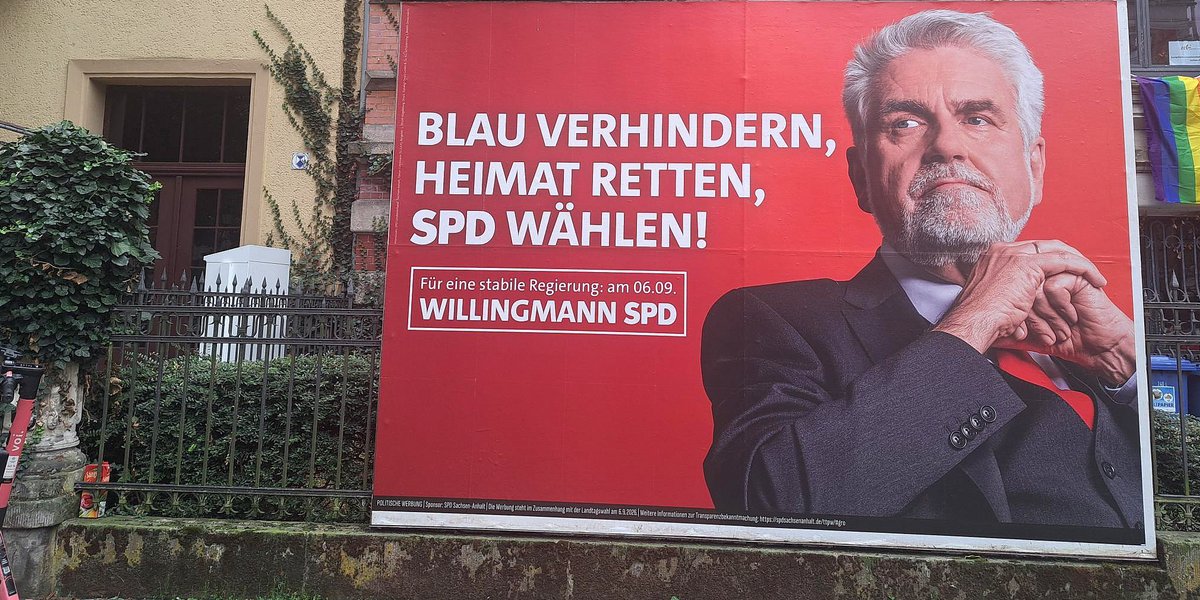
That mood is helping the AfD, which is within striking distance of winning an outright majority in the eastern state of Saxony-Anhalt on Sunday. Such a win would give a far-right party governing power in a German state for the first time since World War II.
The AfD is similarly on the rise in Berlin and Mecklenburg-Vorpommern — both holding elections this month.
“No chancellor has driven the economic misery and deindustrialization of our country as much as Friedrich Merz,” said AfD co-chair Alice Weidel in a statement .
Political gain from business pain
While there is no VW plant in Saxony-Anhalt, the far-right party is seeking to capitalize on a growing national panic about the automaker’s fate and the decline of German industrial might.
The AfD blames the auto sector’s decline on Merz and on the EU’s climate agenda, which initially proposed banning new combustion-engine vehicles starting in 2035. The European Commission walked back the measure in December, but negotiations are continuing in Brussels over what emission-reduction targets automakers must reach or face fines.
The EU plan has been unpopular with German voters since it was first proposed — and Merz also opposes it — but the AfD is leaning heavily into the 2035 legislation to show Brussels as being hostile to German industry and Merz as too feckless to block the measure.
“The one-sided and premature fixation on electromobility has led Germany’s key industry into a dead end,” Chrupalla said.
However, any changes to the EU’s rules will not fix Volkswagen’s real problem: China.
The country was once VW’s biggest and most profitable market, helping subsidize factories back home. The shift to electric vehicles and competition from Chinese automakers making very good cars at low prices have flipped the scales. VW’s China sales dropped 26 percent year-over-year in the first six months of this year.
The shift to electric cars is also endangering VW’s traditional dominance in combustion engines. VW and other European carmakers are scrambling to catch up to Chinese companies that have better EV technology and dominate the global battery market. They’re also grappling with high labor costs and with the enormous price tag of retooling their factories for EVs — something Blume is hoping to address with his reform plans.
But the AfD isn’t spending much time on the intricacies of China’s industrial rise. Instead, it’s pointing the finger at its political rivals.
The AfD is “skillfully exploiting” the threat of job cuts and factory closures “to blame the alleged ‘climate-driven planned economy’ for the crisis in the car industry and the entire economic model,” said Dörre. “This resonates well with sections of the working class, not least because they cannot afford an electric car themselves.”
With lawmakers across the political spectrum and workers staunchly opposing the cost-cutting measure, Blume is unlikely to get his proposal accepted on Friday.
It’s an outcome that would delay negotiations closer to elections in Lower Saxony in September of next year.
That puts even more pressure on the state’s lawmakers to fight any plant closures as they try to fend off the AfD, which was just behind the Christian Democrats and the Social Democrats in a poll taken earlier this year.
“For me as prime minister, it is inconceivable that we will no longer build cars here,” said Lies.
But that fight may come too late to slow a surging AfD in Saxony-Anhalt, where one poll by the INSA organization shows the party has the support of 43 percent of respondents, far ahead of the Christian Democrats with 22 percent and close to the level needed for an outright majority in the state parliament.
Romanus Otte contributed reporting from Berlin .

Comments
No comments yet — be the first to weigh in 👇
No comments yet. Be the first!