Full text
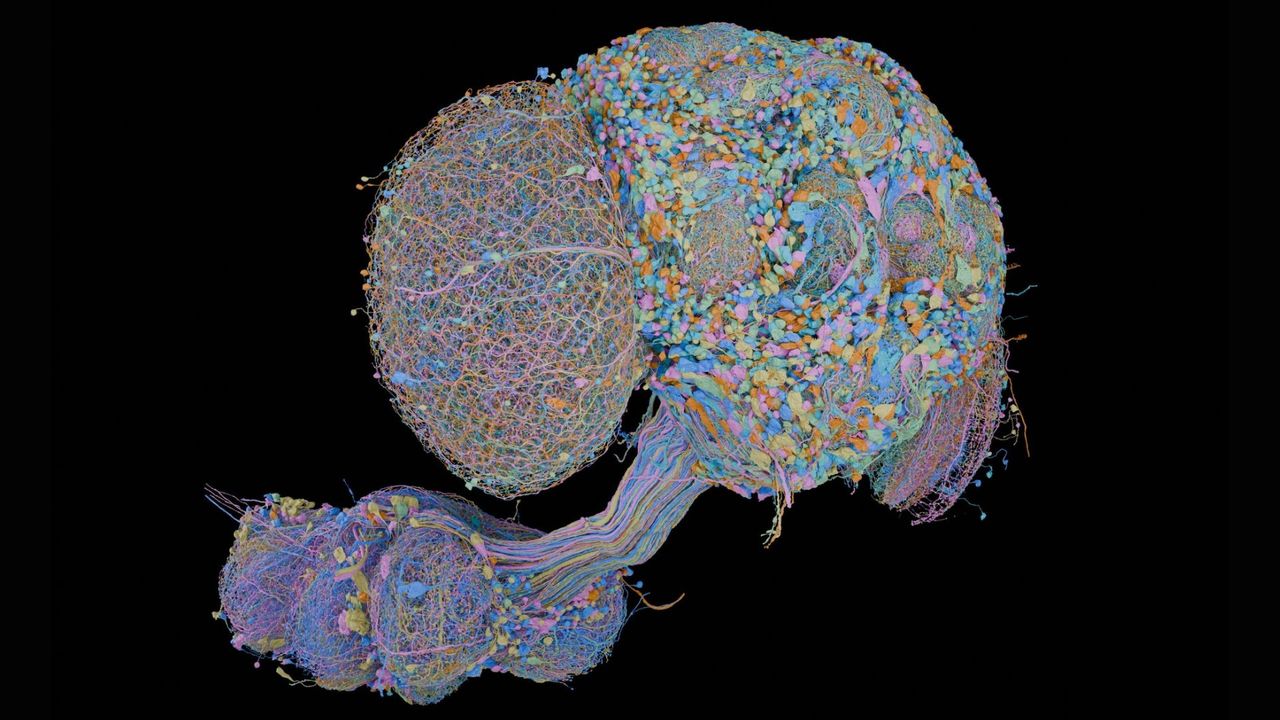
A fruit fly's brain is roughly the size of a poppy seed — and yet that tiny package contains over 100,000 neurons. A new map charts every single neuron in the male fruit fly brain, as well as the insect's equivalent of a spinal cord, totaling more than 166,000 neurons.
This new map joins a map of a female fruit fly brain that was unveiled in 2024 and covers about 140,000 neurons. These two wiring diagrams, also called "connectomes," can now be compared to see if there are differences between the sexes' brains that help to explain behavioral differences reflected during mating or in aggressive actions, including sex-specific fighting moves.
"It is the first time we can compare both sexes of an animal with complex social behavior," study co-author Gerry Rubin , head of biology and a senior group leader of the Howard Hughes Medical Institute's Janelia Research Campus, said in a statement . "Male and female flies have a lot of differences in their behavior, and neuroscientists want to understand how the brain controls those behaviors. This now allows us to easily home in on the neurons that are causing those differences."
This animation shows neurons that are specific to the male connectome, as well as neurons that are present in both males and females but differ between them. The male connectome will allow researchers to compare male and female fly brains and understand complex social behaviors — like mating and aggression — that can vary by sex. (Image credit: Data acquired and analyzed by the FlyEM Project Team at HHMI’s Janelia Research Campus, the Cambridge Connectomics Group, and Google Research. Video by Philip Hubbard/HHMI Janelia Research Campus) Initially released as a preprint , the new fly brain map was published in the journal Cell and Current Biology Thursday (Sept. 3). The study describing the map was published alongside three other papers, each of which uses the new data to explore a specific aspect of fruit fly neurobiology.
"The fly nervous system performs remarkably sophisticated computations with relatively few neurons and little energy, and its architecture could suggest principles for designing more efficient artificial systems," said Carlos Ribeiro , a principal investigator at the Champalimaud Foundation in Lisbon, Portugal, whose team contributed to the brain map and led one of the related studies.
This animation shows all the types of neurons in the central nervous system of the male fruit fly. The newly completed connectome is the first map of an entire male fruit fly central nervous system, comprising all the neurons in the brain, both optic lobes and the ventral nerve cord. (Image credit: Data acquired and analyzed by the FlyEM Project Team at HHMI’s Janelia Research Campus, the Cambridge Connectomics Group, and Google Research. Video by Philip Hubbard/HHMI Janelia Research Campus) "This work also provides a technical roadmap for more ambitious connectomics projects in the future, such as those for mice and humans," Ribeiro said in a separate statement from the Champalimaud Foundation.
In the near term, the scientists aim to map the brains of larval zebrafish ( Danio rerio ) and adult danionin fish ( Danionella ). In the long run, the goal of this research is to understand how vertebrates' brains enable complex behaviors, and then use that knowledge to help unravel the basis of neurological and psychiatric disorders in humans.
These neurons are responsible for allowing flies to process and react to tastes. (Image credit: Inês de Haan Vicente) The study led by Ribeiro and other Champalimaud Foundation scientists aimed to map the circuits in the fly brain dedicated to the insect's sense of taste. Fruit flies have taste receptors in many body parts, including their legs, wings, mouthparts and inside of the throat. The researchers identified these taste receptors and traced their connections back to the fly brain. From there, they examined how those circuits interacted with those that govern behaviors such as swallowing or walking. When it comes to eating behaviors, this circuitry helps the fly determine whether a given morsel is safe or harmful and ultimately choose whether to eat it, the researchers concluded.
This diagram of taste processing is a "hypothesis-generation tool," study co-author Inês de Haan Vicente, a research technician in Ribeiro's lab, said in the Champalimaud statement. "Suppose you are interested in how taste controls locomotion. Now you can go to the map and ask: which sensory neurons are connected to the neurons controlling locomotion? Which intermediate neurons should I manipulate? It gives you a place to start."
Related stories
Scientists built largest brain 'connectome' to date by having a lab mouse watch 'The Matrix' and 'Star Wars'
A mysterious brain network may underlie many psychiatric disorders
Google just created the most detailed image of a brain yet
The other two papers published alongside the map respectively explore the circuits behind vision processing in the fly brain and sex-specific differences in male and female fly brains . The first showed that visual processing extends deep into the brain, involving more than half of the 11,000 or so types of neurons identified in the map. The latter study found a network of cells that's specific to the male brain and appears to coordinate male-specific behaviors, such as specific aspects of fly courtship and physical aggression . (For example, female flies tend to headbutt while males lunge at their targets.)
While there were some networks specific to each sex, the circuits for sensation and movement are largely shared between males and females, the research found. At times, specific switches within those circuits reroute signals to different destinations in the male and female brain ; the consequences of that rerouting will be a focus of future investigations.
See how much you know about the most complex organ in the human body with our brain quiz!

Comments
No comments yet — be the first to weigh in 👇
No comments yet. Be the first!