
AfD poised to govern a German state for the first time since 1945
AfD's lead candidate Ulrich Siegmund is within striking distance of becoming the first far-right leader to govern a German state since 1945, ahead of Sunday's election in Saxony-Anhalt. His campaign taps into a distinct eastern German identity and widespread disillusionment with mainstream parties. Analysts argue that both Merkel's and Merz's leadership failures helped cede the east to the far right.
Full text
How Merkel and Merz lost eastern Germany to the AfD
This Sunday, the far right is well placed to take power in a German state for the first time since 1945.
By ANNE MCELVOY
in Naumburg, Germany
Illustration by Barbara Gibson for POLITICO
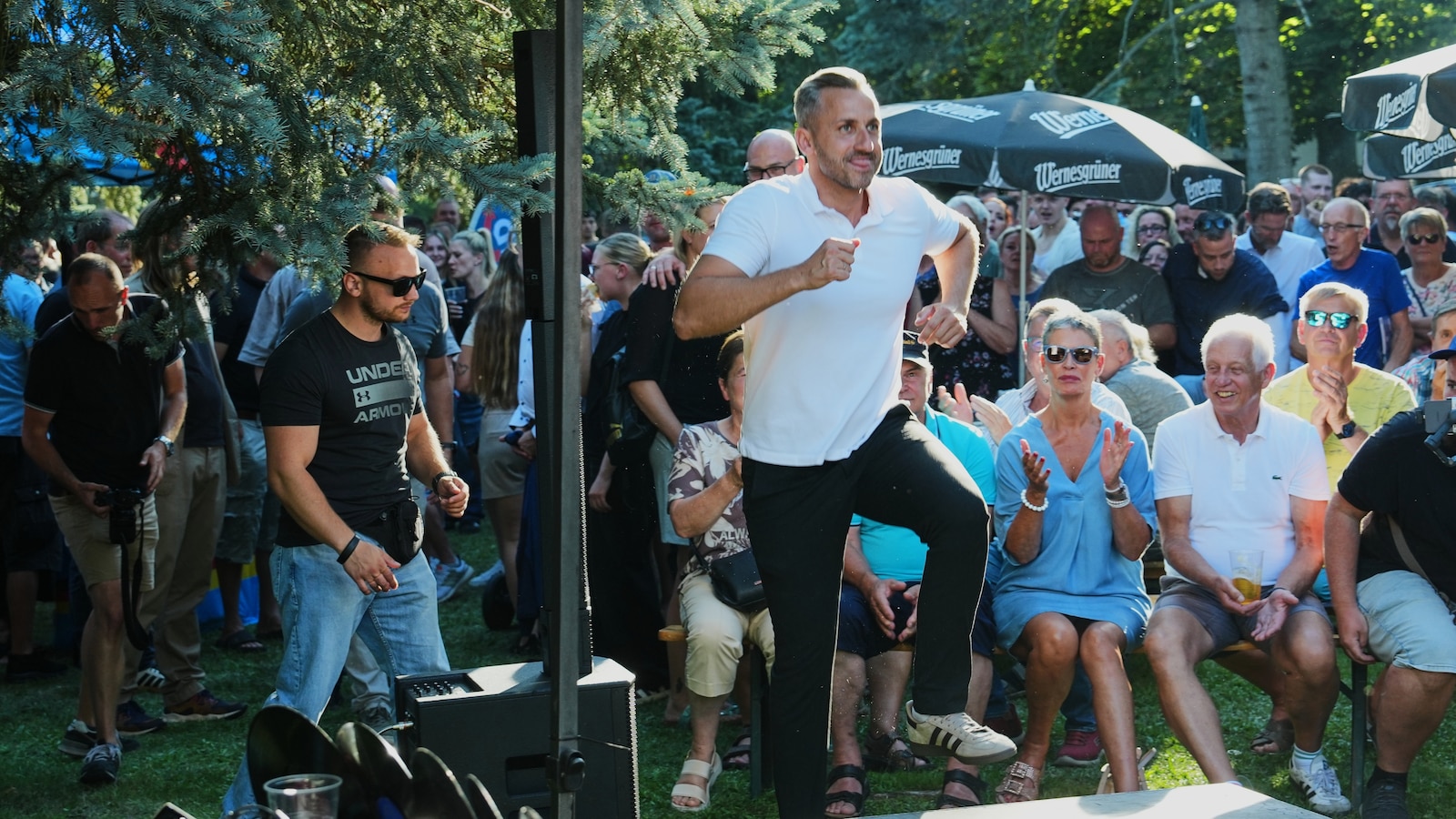
Ulrich Siegmund, lead candidate for the far-right Alternative for Germany (AfD) party, took to the stage in the central marketplace of the town of Naumburg and declared there was a new “awakening” in eastern Germany.
Ahead of a vital election in the region of Saxony-Anhalt on Sunday — in which Siegmund is within striking distance of becoming the first far-right leader to govern a German state since 1945 — that appeal to an eastern identity struck a chord.
A young man beside me was hollering “Ostdeutschland! ” although he was too young to have lived in the communist German Democratic Republic. “It was purer there,” he explained. “More German. Not America-Germany like the West.”
Advertisement
Elements of Siegmund’s new awakening sounded reminiscent of the old East, and his speech would certainly have played well in the Kremlin. He condemned the foolishness of supporting “corrupt” Ukraine and addressed the need to return to oil and gas supplies from Russia.
East Germany formally dissolved in 1990, but it did not disappear. Its struggles for identity within the sprawling German federal system, with power concentrated in Berlin, have fueled the ascent of the far right.
If the AfD does secure an outright victory this weekend , it will raise profound questions about how chancellors such as Helmut Kohl, Angela Merkel and Friedrich Merz failed to manage the post-unification transition and prevent large parts of the east from veering off on a political trajectory toward the far right.
Sausages and strongarms
In a generally upbeat line for sausages and beer in Naumburg, there were also some less cheery sorts in neo-Nazi T-shirts and regalia. One of the crowd told me the government in Berlin “sends our tax money to the Jews in Israel and [Ukrainian President Volodymyr] Zelenskyy instead of spending it here.”
It is important to stress that the eastern political identity is not monochrome nostalgia for the GDR. Indeed, the AfD is repurposing the slogan of the 1989 demonstrations against communism — “ Wir sind das Volk ” – “We are the people” — for its own ends.
Advertisement
That taps into memories of marching for freedom in the last days of the socialist state.
“And now we will show the world again,” said Dirk Huzenlaub, a metalworker in his blue overalls, whom I spoke to on another campaign pit stop in the nearby town of Lützen
He has done well as a self- employed worker, supplying many local companies. But he adds that the “people at the top don’t want us to do well — they keep us down on purpose.” A welter of internet conspiracy theories followed, including the notion that Merz and his predecessor Merkel “betrayed us — we risk our country collapsing the way the old East Germany collapsed.”
AfD supporters gather to listen to the party’s candidate in the Saxony-Anhalt election, Ulrich Siegmund, on August 24, 2026 in Naumburg. | Gallup/Getty Images
Beyond the conviviality of the sausage line, the mood can sour fast — as I discovered when I sought to speak with Siegmund in Lützen, only to be told “mainstream” press were not welcome. I was roughly jostled aside, my arm twisted by a musclebound heavy flanking Siegmund, who sported an earpiece and a lavishly tattooed neck.
“Move or I will take you to the police,” he barked. We had a short, unproductive debate about the constitutionally guaranteed right to report freely in public places.
Another hard arm twist and shove ensued, ending with me stumbling over a curb and being dragged to a police car. No one seemed much bothered by this.
Advertisement
“This woman is being un-co-operative,” the minder snarled. At the next stop in Naumburg, another attentive policeman enjoined me to stay away from “Security Zone 1” — anywhere near the stage.
Then came the more chilling warning.
“It’s for your own safety,” he added. “Best remember, in that zone, the AfD are the masters.”
Merkel and the migration backlash
The last two chancellors — Merz and Merkel — have provoked a strong backlash in eastern Germany.
For Merkel, the outcome could have been more positive. She hailed from the East herself and was an active participant in the Wende , or “turn”, away from communism. She inherited Kohl’s pledge to produce “flourishing landscapes” in the “new federal states.” Forlorn towns and cities were restored, the air pollution from brown-coal energy supplies ended, and potholed roads are now smooth enough to roar along in Mercedes and BMWs.
But the East responded far more negatively to Merkel’s decision to allow a mass influx of asylum seekers from Syria and North Africa in 2015 and 2016. She signaled her empathy for that in a conversation with me in 2018, saying she understood the heartache of easterners seeing their communities empty out demographically and traditional jobs disappear.
“Of course, these disturbing personal experiences affect people and leave a deep mark — we need to understand this,” she said.
Advertisement
But Merkel’s responses did not go far enough for people worried about the speed of social change. And from 2015, the AfD began to soar.
The Covid era deepened divisions too: a social media campaign demanded the introduction of the Russian Sputnik V vaccine ahead of better options. That demonstrated a complex blend of attitudes which feature strongly in AfD lore to this day: Distrust of Western capitalism and an acceptance of Russia.
The veteran sociologist Detlef Pollack diagnoses a “victim mythology” western politicians find hard to combat without sounding aloof. Fully three-quarters of voters who lean towards the AfD think the unified Germany has robbed them of their just deserts, in comparison with two-fifths of the public in the old GDR.
An AfD supporter carries a tote bag featuring Siegmund that reads “Our year!” | Sean Gallup/Getty Images
Frustration came to mark the dealings of Merkel and her successor Merz in talking about the mood in the old east.
“There is no point trying to convince you [about the justification for accepting over 1 million refugees],” she said at a rally I attended in her final election campaign in 2017 in the industrial town of Bitterfeld as a hostile mob booed and blew horns to stop her being heard. Backstage she shook her head, clearly furious.
The more she was lionized as a Gloriana of international liberal democracy for her robust dealings with U.S. President Donald Trump, the more alienated she became from socially conservative easterners. The AfD also learned from the MAGA movement how to unite multiple strands of thought into campaign messages, interwoven with slugs of fake or exaggerated stories.
Advertisement
document.dispatchEvent(new CustomEvent( "renderAd", {
detail: "instory_51"
}));
The arrival of Merz, a western politician not armed with a vast array of communication skills, together with struggles of the wider German economy — like the symbolic hit of massive projected job losses at the VW plant in Wolfsburg close to the old border — have taken a further shine off the lure of the Federal Republic’s prosperity model.
Falling behind
An assessment from the Halle Institute for Economic Research noted that, after the 1990s, the “initial catch-up momentum came to a halt. Since then, the East German economy has mostly grown even more slowly than the West German one.”
It blamed the “lack of productivity of East German companies,” as well as a protracted brain drain and a low rate of business formation. A German defense official, granted permission to speak confidentially to POLITICO, added: “Overwhelmingly, the new defense industries which will drive prosperity and security are based in the old Federal Republic. That gives the east less interest in arming against Russia — it’s a double hit we need to address.”
Merkel has demanded more “courage” to “fight for democracy,” channeling her own brand of 1989 nostalgia. These messages embolden the AfD’s opponents, including churchgoers now rallying as they did against the regime in 1989. Problematically, though, her appeals can also come across as “ Bevormundung, ” with eastern Germans feeling like they are being treated with haughty condescension.
People, including supporters of Antifa, protesting near an AfD rally in Naumburg on August 24, 2026. | Gallup/Getty Images
Merz warns that a far-right government in Saxony-Anhalt would mean “foreign investors steering clear of the state in future” and that the state “will face considerable problems.”
Whether that scare tactic proves persuasive remains to be seen.
(For his part, Siegmund has shed the miserabilist mantras of other AfD luminaries. “My God, the women are great-looking in this town,” I hear him announce to giggling selfie-seekers in Lützen. “Better not tell my wife.”)
Merz also does not exude much personal interest in the East, other than seeing it as a problem to be kept at bay. Very few of his Cabinet hail from that part of Germany — though the party cites the rise of a new generation of eastern Germans to the next tier of ministerial posts. That may need to accelerate soon to combat the rising mood of alienation.
Advertisement
document.dispatchEvent(new CustomEvent( "renderAd", {
detail: "instory_52"
}));
Arriving on a whistlestop visit on Monday to support Sven Schulze as his party’s candidate for minister-president, the chancellor condemned “people who trade on anger.” He did venture out among voters — something many leading politicians avoid.
Saxony-Anhalt is a small state in population — with just over 2 million inhabitants. But it is also the cradle of the Lutheran tradition of challenging the mighty — a theme that the more historically minded rally-goers raised with me.
As Siegmund puts it: “Even if we don’t get there [to an overall majority], we are not going away.” That too was a stubborn cry from the streets in late 1989. And in 2026, it spurred huge roars of approval through the marketplace in Naumburg, drowning out the counter-protests.
Siegmund is within striking distance of becoming the first far-right leader to govern a German state since 1945. | Hannibal Hanschke/EFE via EPA
On Sunday, the AfD will be put to the test.
So too will a German political establishment that won unification, only to lose much of its grip on people power.
Anne McElvoy is a former correspondent in East Germany and author of The Saddled Cow, East Germany’s Life and Legacy.
Similar stories
 🌍 World
Eastern German election could produce country's first far-right state governor since WWII
ABC News · 2d ago
🌍 World
Eastern German election could produce country's first far-right state governor since WWII
ABC News · 2d ago
 🌍 World
AfD may take power in Saxony-Anhalt; German politicians weigh unprecedented countermeasures
Onet Wiadomości · 10d ago
🌍 World
AfD may take power in Saxony-Anhalt; German politicians weigh unprecedented countermeasures
Onet Wiadomości · 10d ago
 🌍 World
AfD leads in Saxony-Anhalt polls — tactical voting campaigns launched
Rzeczpospolita · 14d ago
🌍 World
AfD leads in Saxony-Anhalt polls — tactical voting campaigns launched
Rzeczpospolita · 14d ago
Similar stories
🌍 World
Eastern German election could produce country's first far-right state governor since WWII
ABC News · 2d ago
🌍 World
AfD may take power in Saxony-Anhalt; German politicians weigh unprecedented countermeasures
Onet Wiadomości · 10d ago
🌍 World
AfD leads in Saxony-Anhalt polls — tactical voting campaigns launched
Rzeczpospolita · 14d ago
Should the AfD be allowed to govern a German state on its own?
Comments
No comments yet
Comments
No comments yet — be the first to weigh in 👇
No comments yet. Be the first!