Full text
TP-Link has unveiled two new Wi-Fi 8 routers at IFA 2026
The Archer 9 Ultra is a traditional router with a smart design and coverage of up to 3,600 square feet
The Deco 8 Ultra is a mesh system, and a 3-pack is good for a home of up to 9,800 square feet
TP-Link has revealed the world's first Wi-Fi 8 routers at IFA 2026 , with two models arriving in the form of a standard router and a mesh Wi-Fi offering.
These are the Archer 9 Ultra router and the Deco 8 Ultra, the latter being the mesh Wi-Fi system. Both are built around TP-Link's Wi-Fi 8 StabilityEngine.
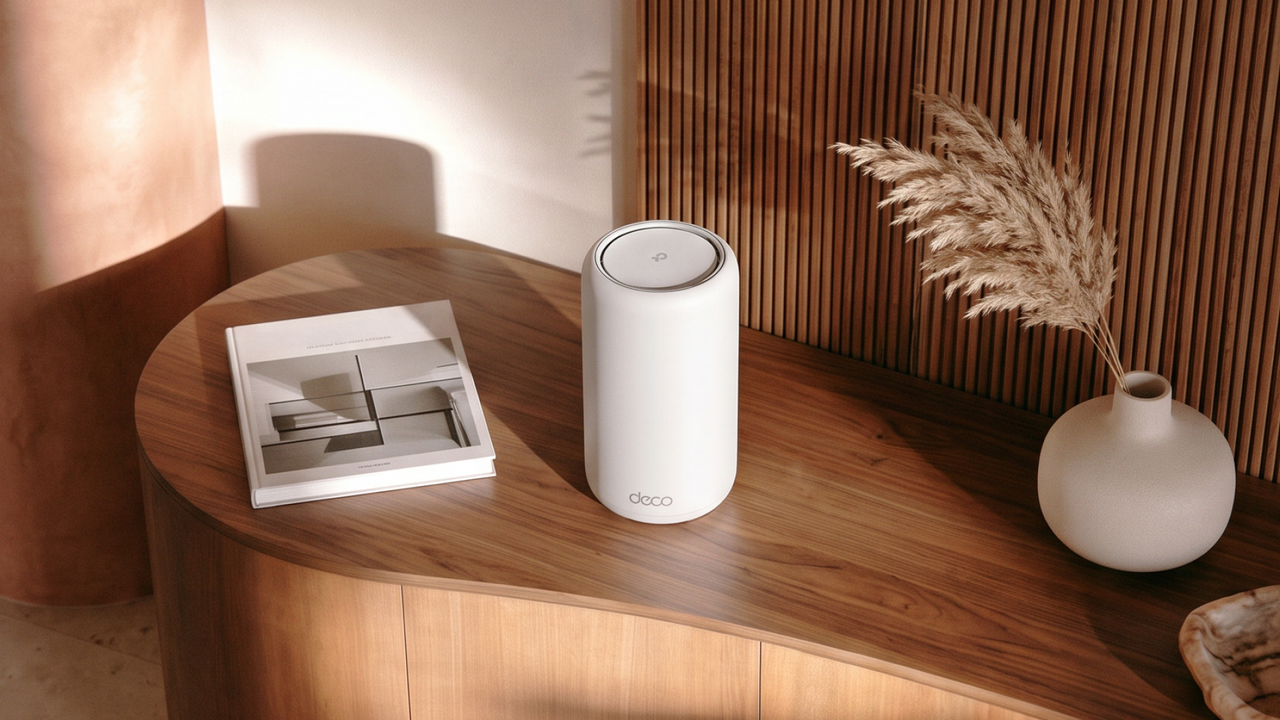
With the Deco 8 Ultra, you're getting a tri-band (including 6GHz) Wi-Fi 8 mesh system offering a speed of 22Gbps (19Gbps in Europe). A 3-pack of these cylindrical routers can cover a home of up to 9,800 square feet, with support for 200+ devices.
The Archer 9 Ultra boasts a tri-band speed of 19Gbps and bristles with 18 antennas, delivering coverage of up to 3,600 square feet in your home (or 3,000 square feet in Europe).
TP-Link underlines three key benefits of these routers thanks to Wi-Fi 8. First, they are more reliable with a greater number of devices hooked up, and they also cope much better with interference. Finally, Wi-Fi 8 allows for a better wireless connection at the edge of the system's effective range.
Handling devices more reliably is facilitated by Dynamic Sub-band Operation (DSO) and Non-Primary Channel Access (NPCA) tech. The former ensures every connected device gets only the bandwidth it needs — so more is open for other usage — and NPCA opens a second channel if the main one gets too busy. Or as TP-Link puts it, "Every device gets its own fast lane."
New modulation technology in these routers helps to deal with interference from other devices or nearby networks (like your neighbor's Wi-Fi), and boosts performance at longer distances from the router.
There are also Enhanced Long Range (ELR) and Distributed Resource Units (DRU) features with these Wi-Fi routers, which further strengthen the wireless signal at the edge of its reach.
TP-Link notes, "ELR extends the router's usable range, while DRU concentrates a device's limited uplink power into a narrower band so it can be heard clearly from far away. Uploads, calls, and camera feeds hold where they used to stutter."
Both routers benefit from a smart and contemporary design, with a minimalist and streamlined look. TP-Link argues that it needs to make its hardware look good so it won't be hidden away in a cupboard or under a table.
Gary Chang, Lead Industrial Designer at TP-Link, commented, "We stopped building a piece of networking equipment and started designing for the home. When a router's design becomes something people want to display, it ends up exactly where it performs best."
Analysis: ready for the future of Wi-Fi
(Image credit: TP-Link) Wi-Fi 8 doesn't deliver any speed boost over Wi-Fi 7 , at least not in terms of raw performance — but it does aim to improve performance by delivering a stronger signal when you're further away from the router, and a more reliable connection overall. Part of that strategy is to better deal with interference from other wireless networks (or appliances in general), and as TP-Link observes, this is a big part of the puzzle here.
We don't yet have a release date (or price) for the Archer 9 Ultra or Deco 8 Ultra, but the expectation is that these routers will ship later this year. Of course, to get the benefit of a Wi-Fi 8 router, you'll need devices that support the new wireless standard, too — and they won't be here for a while yet.
Indeed, the Wi-Fi 8 standard itself is still a draft and not finalized, and the likes of smartphones and laptops won't arrive with Wi-Fi 8 support until next year (and there probably won't be very many of them, either, to begin with).
That said, your Wi-Fi 7 (or earlier) devices will still run just fine on a Wi-Fi 8 router, because as ever, the new standard is fully backwards compatible — you just won't get the benefits that Wi-Fi 8 phones and laptops will (when they arrive).
That said, some of the improved traffic management and interference reduction tech in these routers will still help with devices that don't support Wi-Fi 8. However, buying a Wi-Fi 8 router later this year when these TP-Link models (and others) emerge is more about future-proofing than anything else for now.

Comments
No comments yet — be the first to weigh in 👇
No comments yet. Be the first!