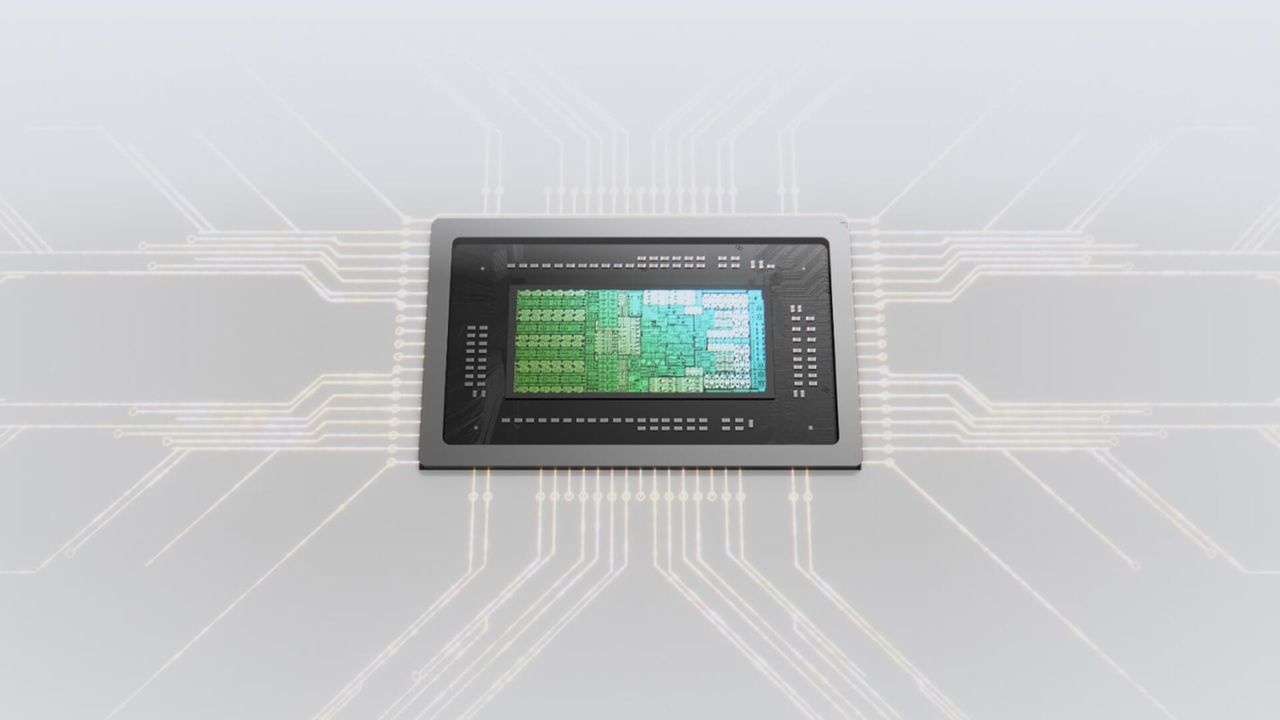
Nvidia RTX Spark SoC announced for gaming and productivity laptops
Announced at Computex 2026, Nvidia's RTX Spark is a "Superchip" SoC combining 6,144 Blackwell GPU cores, 20 Grace CPU cores, up to 128 GB of unified memory, and up to 1 petaflop of AI performance. It promises all-day battery life in slim chassis with support for DLSS, Reflex and G-Sync. Confirmed devices include the Asus ProArt P16, Dell XPS 16, HP OmniBook X 14, Lenovo Yoga Pro 9 and Microsoft Surface Laptop Ultra.
Full text
Announced during Computex 2026 , Nvidia's RTX Spark is billed as "a new beginning" for gaming laptops, productivity laptops, and small form factor PCs. Described as a "Superchip", it's an SoC that seeks to combine the company's AI technologies and its RTX graphics utility into one unified package for work and play.
The proposed RTX Spark specs are impressive on paper. 6,144 Blackwell GPU cores combined with 20 Grace CPU cores, and a maximum of 128GB of unified memory. Or, up to 1 Petaflop of AI performance, promising an all-day battery life in a slimline chassis that's purpose-built for Team Green's bespoke tech, such as DLSS , Reflex , and G-Sync .
On this side of the announcement, RTX Spark is confirmed to be coming to the Asus ProArt P16, the Dell XPS 16, the HP OmniBook X 14, the Lenovo Yoga Pro 9n, the Microsoft Surface Laptop Ultra, and the MSI Prestige N16 Flip AI+. Clearly, Nvidia is targeting not only the best laptop manufacturers, but also vying for a spot against the best gaming laptops .
Can one chip really do it all, though? While these are some bold promises, I have reservations. With the way the computing landscape is now, things will change, but that's not necessarily a good thing.
Monopolization of our modern lives
Few tech companies have had the meteoric rise that Nvidia has over the last decade. While the company made its name with graphics cards for gaming, it would then innovate time and time again as GeForce matured. The GTX generations saw graphics and rendering technologies get better than ever, with playable framerates at higher and higher resolutions achievable for even entry-level components.
I'd argue that it wasn't until the launch of the RTX 20 series and the AI boom that the rest of the world really took notice of Nvidia. It's easy to forget its history now, what with it being the biggest company in the world by market cap , beating out the likes of Apple, Alphabet (Google), Microsoft, and Amazon. This (clearly) didn't happen just because people were buying graphics cards to game on. No, Team Green made its serious cash from AI , and that's also the core selling point of RTX Spark, with its gaming functionality seemingly a secondary concern.
The AI revolution was spearheaded by Nvidia, with its chips now utilized in a myriad of different ways. Nvidia was the frontrunner in how GPU architecture could be used for wider AI applications, realizing that it's far more energy efficient than using CPU for AI, which means it's able to handle far more sophisticated demands as a result. The core Nvidia ecosystem is used to scale cloud facilities with its Blackwell, Hopper, and Grace Hopper chips, and its CUDA platform and libraries remain unrivalled.
In truth, GeForce and RTX tech is just a small part of Nvidia's business now, and it's been that way for some time. You only need to look at the Nvidia Drive infrastructure, using AI for autonomous vehicles, or the Nvidia Jetson modules for edge computing and wider mainstream robotics use. Team Green is no longer concerned with being a rival to Intel, Apple, or AMD. Instead, it wants to be the sole provider of hardware for every facet of our modern lives.
How does RTX Spark perform inside of laptops for gaming?
In a video published on August 26, Nvidia claimed that RTX Spark was Game Ready. The three-minute video outlined what consumers can expect from the upcoming unified Superchip and how it compares to a traditional CPU-and-discrete-graphics (or iGPU) setup.
The language around the RTX Spark's utility states that the Superchip is designed for "creators and developers who work on large projects who also game". What we can glean from this assessment is that being "Game Ready" here appears to be a tertiary concern for Nvidia. It's backed up by the boast of "not having to choose" between the gaming laptop and the work one, because "you'll just have the one".
Exactly how good is RTX Spark for gaming, then? We know that it runs on Windows 11, so confirmed support is standard for Steam, the Epic Games Store, and Xbox Game Pass, among others. Specifically, Alexander Mejia (Senior Product Manager) claimed that "Triple-A gaming is great on RTX Spark". Bold claims indeed. This is followed by footage of Alan Wake II , Cyberpunk 2077 , Pragmata , F1 25 , Fortnite , Neverness to Everness , Doom: The Dark Ages , Naraka: Bladepoint , Apex Legends , Arc Raiders , Anno 117 Pax Romana , and The Finals , shown to be running on the platform.
Good game stack there, sure, but what is the expected performance actually like? Nvidia gives us a (somewhat) satisfying answer: "100 FPS 1440p Gaming" when using Ray Tracing and DLSS. Unfortunately, that's all we get in terms of performance info, with no quoted statistics or more granular information available. There's quite the disparity in running Fortnite in High/Epic settings compared to pushing Cyberpunk 2077 or Doom: The Dark Ages to the max of their sliders. It's vague, but at least a little encouraging.
How does RTX Spark rival other SoCs for gaming?
The first wave of RTX Spark laptops have been confirmed, although hardware manufacturers don't seem ready to talk about them yet (Image credit: Nvidia) We only have 100 FPS in 1440p to go off with RTX Spark's projected gaming performance, so the next logical course of action is to weigh that up against the likes of Qualcomm's Snapdragon X2 Elite , the Intel Arc G3 Extreme , and the AMD Ryzen AI Max series as a point of comparison.
We know that AI-powered upscaling (DLSS / XeSS / FSR 4) and AI-generated frame interpolation (Frame Generation / MFG) must be used to achieve playable framerates at target resolutions. In 1080p, with 2X MFG, Team Blue's chip can do 121 FPS in Cyberpunk 2077 and 178 FPS in Naraka: Bladepoint . Doubling that to 4X MFG, the incoming chip can go as high as 199 FPS and 267 FPS, respectively. In 1080p, the Radeon 8060S iGPU baked onto the Ryzen AI Max 395+ APU could do 66 FPS in Cyberpunk 2077 when rasterized and 45 FPS on average with ray tracing enabled.
This is about what can be expected from the native performance of the Qualcomm Adreno X2-90 iGPU baked onto the Snapdragon X2 Elite , which is able to achieve 43 FPS in Cyberpunk 2077 (via Notebookcheck) on High settings in native (no AI-scaling) 1080p. Where this SoC shines, though, is in its power consumption, with an estimated 0.841 FPS per Watt, only lagging behind Apple's M5 chip , as found inside the Apple MacBook Air 13 M5 model.
Taken as an average, the RTX Spark looks to be about on point with what those devices can do, but we won't have a full remit of the performance potential until we see the full game-by-game benchmarks closer to the proposed launch date. The real deciding factor for unifying between a CPU and a GPU for both work and play comes down to the factor that can sway people away from (or towards) a dedicated gaming laptop: the price tag.
Intergrated hardware you cannot afford
Given the price hikes of laptops, phones, and games consoles in 2026, we're not expecting the first-generation RTX Spark machines to come cheap (Image credit: Nvidia) Computing components are more expensive now than ever; there's no other way to put that. Anything that utilizes memory in particular, such as graphics cards, flash storage, and RAM, has seen its street prices rise far above the usual MSRP, and they're not coming down any time soon. It's the case for price hikes of even the best phones and the best games consoles , nothing is safe from the supply-and-demand loop here, so RTX Spark-enabled laptops aren't expected to be cheap.
Ultrabooks in particular, which are the primary demographic market for RTX Spark, have never been affordable, but 2026 has meant an entirely new definition. You only need to see how the pricing has escalated from competitors to gauge how bad it could be. The Apple MacBook M5 range MSRP increased by 20% , and something similar could be observed with the likes of the Galaxy Book6 Ultra , which also shot up by 20%, just a month after launch, too.
If the prices of components that we know have historic rates are increasing month-on-month, then what about something as unproven and unknown as the RTX Spark Superchip? Nvidia has full dominion over pricing its CPU + GPU combo however it likes. As the most profitable and in-demand company on the planet, it holds all the cards here. We're at a turning point where products can almost double in price overnight, so who is to say that the cheapest RTX Spark-enabled laptop won't carry an eye-watering MSRP?
The idea behind RTX Spark is solid: a simple, unified approach built by Nvidia that combines all you need for work and play, similar to what Apple did when it started manufacturing its own silicon in 2021, albeit with more of an AI focus. RTX Spark will sink (or swim) based on its price-to-performance offering and whether consumers want an all-in-one device. One thing's for sure: Nvidia has the cash to muscle in on the market and can afford to lose face burying its competition in the process.
TechRadar reached out to Acer, Asus, Lenovo, MSI, and Razer for their takes on how Nvidia's RTX Spark could impact the computing market. A PR representative from Acer declined to comment, and despite PR representatives from each company forwarding our questions to the relevant teams and chasing the answers, none have commented on RTX Spark at this time. Team Green's Superchip stands on the precipice of change and progress, but at what cost?
Similar stories


Similar stories
Is an integrated SoC the better future for gaming laptops over discrete GPUs?
Comments
No comments yet
Comments
No comments yet — be the first to weigh in 👇
No comments yet. Be the first!