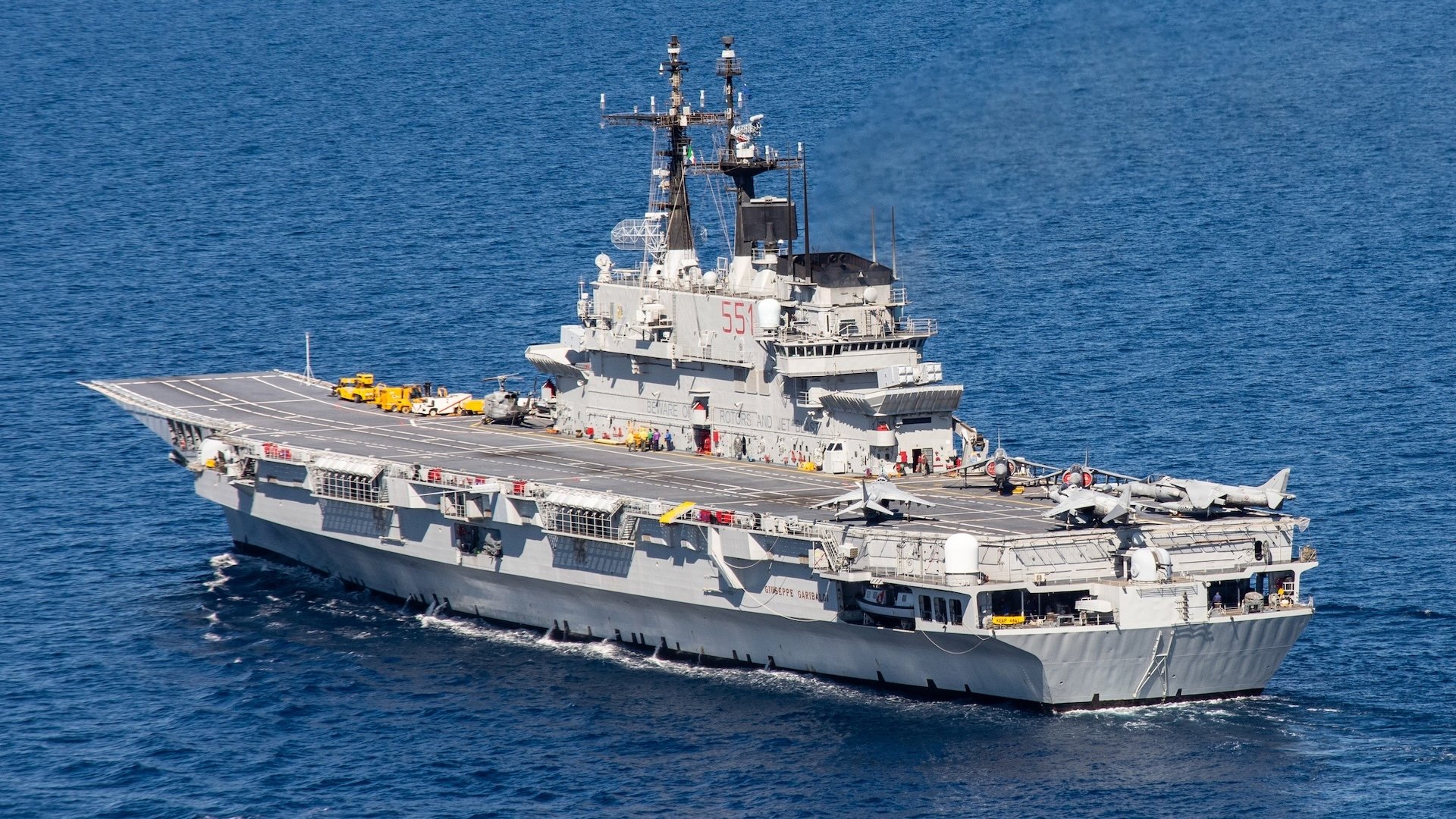
Former Italian carrier Giuseppe Garibaldi departs for Indonesia to become KRI Gajah Mada
The former Italian Navy aircraft carrier Giuseppe Garibaldi has departed Italy bound for Indonesia, where it will be commissioned as KRI Gajah Mada, confirmed by Indonesian Navy Chief Admiral Muhammad Ali. The voyage through the Suez Canal and Red Sea will take over 20 days, with Italian frigates escorting the carrier. Indonesia will become only the second Southeast Asian nation to operate an aircraft carrier, after Thailand.
Full text
Indonesia is about to become the second Southeast Asian country to operate an aircraft carrier, nearly three decades after Thailand became the first with HTMS Chakri Naruebet . The latest addition to the region’s small carrier club is the former Italian Navy carrier Giuseppe Garibaldi , which departed Italy earlier this week, bound for Indonesia, where it will eventually become KRI Gajah Mada . Indonesian Navy Chief of Staff Admiral Muhammad Ali confirmed the ship’s departure on Tuesday.
Garibaldi is expected to spend more than 20 days making the journey from Italy to Indonesia, passing through the Suez Canal and Red Sea. Italian frigates are accompanying the carrier during the transit.
The Italian aircraft carrier Giuseppe Garibaldi alongside the Arleigh Burke class destroyer USS Forrest Sherman in the U.S. Sixth Fleet area of operations in 2022. U.S. Navy photo by Naval Air Crewman (Helicopter) 2nd Class Reuben Richardson
According to Admiral Ali, the ship is scheduled to reach Indonesia between September 15 and 20.
The carrier will retain its Italian identity throughout the voyage, sailing as Giuseppe Garibaldi under the Italian flag until the formal transfer, when it will be renamed and placed under Indonesian command.
Commissioned in 1985, Garibaldi was initially described as a “helicopter cruiser” before being redesignated as an aircraft-carrying cruiser in 1989 and receiving the Italian Navy’s AV-8B Harrier II jump jets. The ship subsequently served as Italy’s flagship and later shifted toward amphibious operations and command-and-control duties after the larger Cavour entered service.
At around 13,850 tons full load, Garibaldi combined a relatively compact aviation capability with a multirole weapon and sensor fit, at least in its early period of service. Its armament historically included two octuple launchers for Sea Sparrow/Aspide surface-to-air missiles, four Otomat Mk 2 anti-ship missiles, two 2 triple torpedo tubes, and three twin Oto Melara 40mm guns.
The Giuseppe Garibaldi underway in the Mediterranean during its early period of Italian Navy service. Note the Mk 29 octuple launcher for Sea Sparrow/Aspide immediately in front of the bridge. In the background is the Spanish Navy aircraft carrier Príncipe de Asturias, on which the Chakri Naruebet is closely based. U.S. Department of Defense
Indonesia is acquiring the ship through an intergovernmental grant arrangement rather than purchasing it through a conventional commercial transaction.
Although it has spent almost four decades in Italian service, the ship offers considerable flexibility, combining a large aviation facility with the ability to serve as a command and support platform.
Jakarta says it plans to use the ship primarily as a helicopter-capable aviation platform, with aircraft from the Indonesian Navy, Air Force, and Army expected to operate from its deck.
An Indonesian Navy AS565 Panther helicopter lands on the flight deck of the amphibious transport dock ship USS Green Bay , during a cross-deck exercise in the Java Sea in 2024. U.S. Marine Corps photo by Lance Cpl. Peter J. Eilen
Ahead of the ship’s arrival, preparations have included establishing a training facility at Juanda Naval Air Station/International Airport in Sidoarjo, East Java. Here, the large outline of a carrier flight deck has been painted on an apron/helipad area on the southern side of the installation, to familiarize naval pilots and deck crews with carrier flight-deck procedures.
The carrier flight deck outline at Juanda Naval Air Station. TNI AL
Thailand’s experience provides useful context here. When Chakri Naruebet entered service in 1997, it was configured to operate AV-8S Harriers as well as helicopters. The Harriers were subsequently retired, leaving the ship to perform a much broader range of roles, including helicopter operations, disaster response, training, and VIP duties. TWZ has previously examined that unusual evolution in detail .
HTMS Chakri Naruebet underway in the South China Sea in April 2001 with a single AV-8S and an S-70B seen on the deck. U.S. Navy
Once in service, Indonesia will likely operate the Gajah Mada as a mobile aviation base. This will allow helicopters to provide transport, surveillance, logistics, search and rescue, disaster relief, and potentially anti-submarine warfare and amphibious support capabilities over much greater distances than when operating from land bases, and in much larger numbers than operating from other Indonesian Navy vessels.
The potential mission set is particularly relevant for Indonesia, whose territory stretches across thousands of islands.
Occupying a strategic position at the southern end of the South China Sea , Indonesia is also locked in a maritime dispute with China, including incidents in which Chinese fishing boats accompanied by Chinese Coast Guard vessels have entered Indonesia’s exclusive economic zone in the South China Sea. The tense situation as regards China seems to be driving something of a defense spending spree in Indonesia, with high-profile acquisitions including French-made Rafale fighters and submarines .
Meanwhile, in peacetime, disaster response is also a significant consideration for Indonesia. The Gajah Mada will be able to bring helicopters, personnel, supplies, and command-and-control capabilities to areas where local infrastructure has been damaged or where access is otherwise difficult.
The ship is also likely to take part in maritime security missions and regional deployments including multinational training exercises.
There is potential for Indonesia to adapt the warship for drone operations too, something that Italian shipbuilder Fincantieri has previously proposed . While Indonesia has not announced such a capability as part of the ship’s initial configuration, it has acquired Turkish-made Bayraktar TB3 drones, which have demonstrated operations from carrier decks.
Infographic on the TB3’s operational capabilities. Baykar
As well as Turkey’s Anadolu , which has evolved into a platform for operating drones after Turkey lost access to the F-35B program , other navies are similarly experimenting with integrating uncrewed aircraft into helicopter-carrier-sized ships, reflecting a broader shift toward using large flight decks for mixed crewed and uncrewed aviation . The trend includes experiments with fixed-wing drones on amphibious assault ships , including in China and the United States .
A Bayraktar TB3 on the deck of Anadolu during an exercise in the Eastern Mediterranean in April 2026. Photo by Orhan Cicek/Anadolu via Getty Images Anadolu
For Indonesia, a future combination of helicopters and drones could provide the Gajah Mada with persistent surveillance and potentially strike capabilities without requiring the country to develop a conventional fixed-wing carrier air wing.
How extensively Indonesia eventually makes use of any of its capabilities will depend on its ability to sustain the ship and build the associated aviation infrastructure and expertise.
The Indonesian Navy is constructing the warship’s future base in Lampung, on the southern tip of the Indonesian island of Sumatra. The facility is expected to be finished around the time the ship arrives and operational by the end of September.
The Italian carrier Giuseppe Garibaldi (C551) and the USS America (CV-66) conduct joint operations in the Adriatic Sea off the coast of Croatia in 1996. The image provides a good size comparison between the Italian warship and even a non-nuclear U.S. Navy aircraft carrier. DoD photo by Petty Officer 3rd Class Michael D. Flinn, U.S. Navy
The ship’s formal transformation into an Indonesian warship is planned for September 25. A commissioning and flag-changing ceremony is scheduled for that date, with President Prabowo Subianto expected to attend and officiate.
At that point, the carrier will become KRI Gajah Mada , taking its name from the famous Majapahit-era military commander and statesman .
The Navy plans to include the ship in celebrations marking the 81st anniversary of the Indonesian National Defense Forces, or TNI, in October.
Thailand’s experience with the Chakri Naruebet, which only very rarely goes to sea for any length of time, underscores the fact that buying a carrier is the relatively easy part. Creating a sustainable carrier aviation capability around it is much more challenging.
Nevertheless, the Gajah Mada gives Jakarta something it has never previously possessed: a large, dedicated maritime aviation platform capable of carrying helicopters from multiple services. As such, it could prove useful across a wide spectrum of missions.
Ciontact the author: thomas@thewarzone.com
The post Indonesia’s First Aircraft Carrier Is On Its Way From Italy appeared first on TWZ .
Similar stories
 🌍 World
Indonesia's neutrality tested by joint naval drill with China near Taiwan
DW News · 11d ago
🌍 World
Indonesia's neutrality tested by joint naval drill with China near Taiwan
DW News · 11d ago
 🪖 Military
US Navy blockade slashes Iran oil exports as Washington shifts to economic warfare
CNBC · 9h ago
🪖 Military
US Navy blockade slashes Iran oil exports as Washington shifts to economic warfare
CNBC · 9h ago
 🪖 Military
Record 244 Chinese vessels spotted near Taiwan — mapping seabed for possible underwater warfare
Rzeczpospolita · 10h ago
🪖 Military
Record 244 Chinese vessels spotted near Taiwan — mapping seabed for possible underwater warfare
Rzeczpospolita · 10h ago
Similar stories
🌍 World
Indonesia's neutrality tested by joint naval drill with China near Taiwan
DW News · 11d ago
🪖 Military
US Navy blockade slashes Iran oil exports as Washington shifts to economic warfare
CNBC · 9h ago
🪖 Military
Record 244 Chinese vessels spotted near Taiwan — mapping seabed for possible underwater warfare
Rzeczpospolita · 10h ago
Does Indonesia need an aircraft carrier for its regional security?
Comments
No comments yet
Comments
No comments yet — be the first to weigh in 👇
No comments yet. Be the first!