China rapidly expands secretive flight-test base for next-generation combat aircraft
China is rapidly expanding a secretive military flight-test centre in the country's northwest, often compared to the US Air Force's Area 51. Satellite imagery from Planet Labs taken on August 27 shows extensive new construction at the facility near Lop Nur, which boasts one of the world's longest runways at 16,400 feet. The base is used by the People's Liberation Army to test experimental platforms and next-generation combat aircraft.
Full text
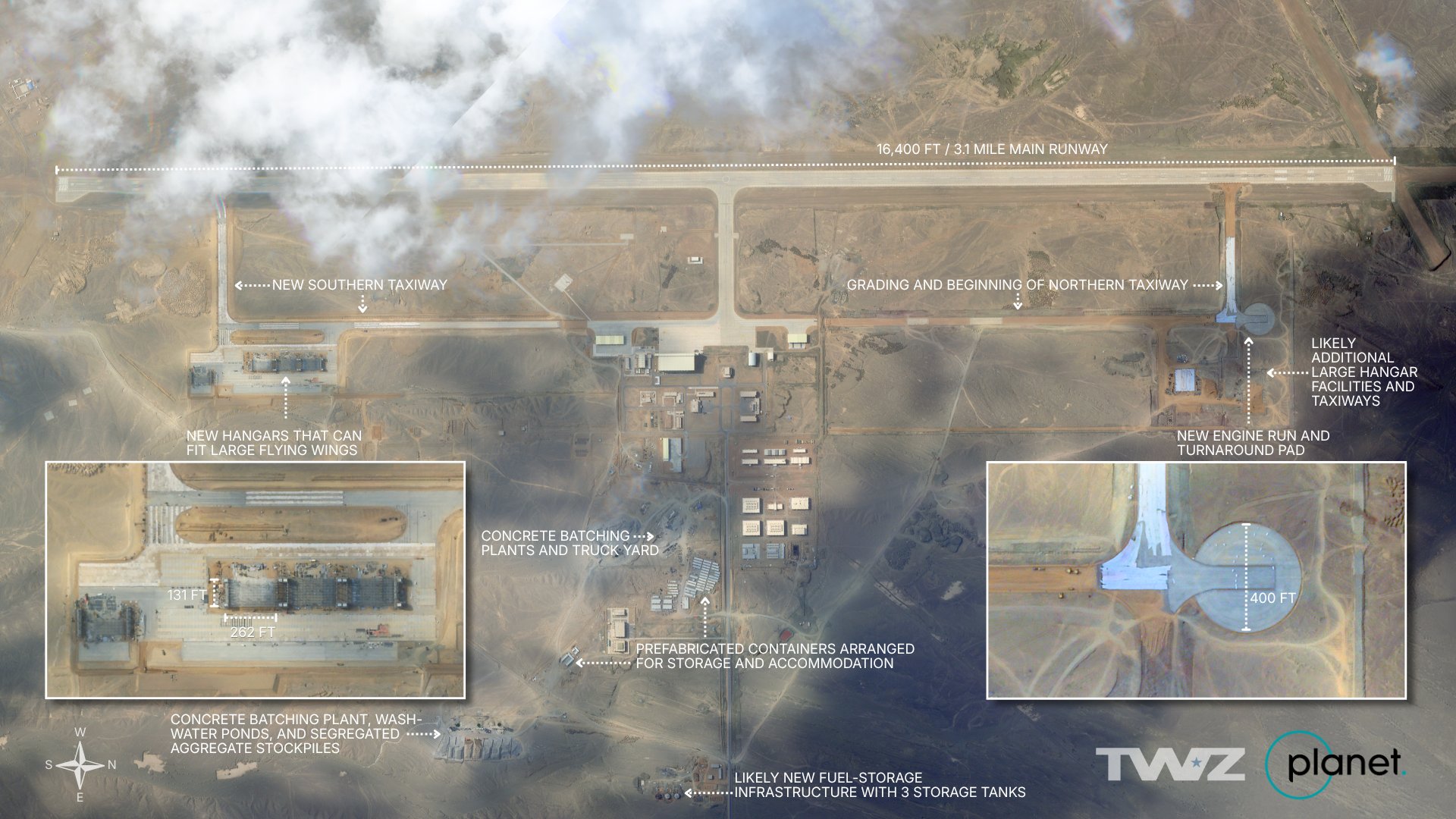
The People’s Republic of China (PRC) is rapidly expanding a secretive airbase in the northwest of the country that is loosely akin to America’s top-secret proving ground at Area 51 . The facility is used to test experimental platforms and next-generation combat aircraft, sporting one of the longest runways in the world at 16,400 feet. It has transformed from a relatively austere and remote airstrip into an increasingly sprawling People’s Liberation Army (PLA) flight-test center over the past few years, and there is no sign that construction will slow anytime soon. In fact, it’s accelerating, and one of its newest features is of significant interest.
Satellite imagery taken by Planet Labs on August 27, 2026 shows the scale and scope of the buildout in high-resolution detail.
TWZ/IAN ELLIS-JONES WITH DAMIEN SYMON (HIGH RESOLUTION)
The installation is located near the infamous Lop Nur Nuclear Test Base in the desolate, arid Xinjiang autonomous region of northwestern China. Lop Nur is the PRC’s primary testing facility for nuclear weapons and where China detonated its first nuclear device, codenamed Project 596, in 1964, becoming the world’s fifth nuclear power.
Location of Lop Nur Airbase in the Xinjian region of northwestern China. Photo: Google Earth
Last year, TWZ spotted both of China’s sixth-generation stealth fighter designs, the J-36 and J-XDS , at the base for the first time − far from the home airfields of their respective manufacturers, Chengdu and Shenyang. Before supporting the development of advanced air combat technologies, the facility was linked to military space development efforts and testing reusable space planes as far back as 2020. At that point, the site was nothing more than a 3.1-mile runway with a small hangar and a few scattered vehicles.
Lop Nur Airbase back in 2020. Photo © 2026 Planet Labs Inc. All rights reserved. Reprinted with permission.
In 2023, the main apron was significantly expanded and a new large hangar was added. In 2025, new hangars were added on both sides of the main ramp area via extensions. These shelters appeared to be optimized for tactical fixed-wing aircraft. Not long after those facilities were complete, the two 6th-generation fighter aircraft showed up . The pace of further construction ramped in May 2025 and hasn’t let up since. The time-lapse below visualizes the gradual, then all at once progression over the past six years.
Time-lapse of Lop Nur Airbase from 2020 to 2026. Photos © 2026 Planet Labs Inc. All rights reserved. Reprinted with permission.
“New taxiways, aircraft turning pads, hangars and possible fuel-storage infrastructure substantially increase the airfield’s capacity to support aircraft movements and sustained flight-test activity,” Damien Symon, a geo-intelligence researcher and friend of TWZ , told us. Symon assisted TWZ in identifying the new structures.
Birds-eye view of Lop Nur Airbase as of August 27, 2026. Photo © 2026 Planet Labs Inc. All rights reserved. Reprinted with permission.
Several key areas of the site have been reshaped since the beginning of the year, marked on the annotated graphic near the top of this story.
Below the southern end of the runway, construction is moving fast on a new taxiway extension running parallel to the runway, connecting it to the central apron and main hangar. The nearly completed route will allow additional aircraft to move more freely without having to back-taxi on the runway, which is a huge problem for higher operations tempos and more complex sortie launches and recoveries.
“Of particular interest are several large aircraft hangars in the southern section of the airbase, each measuring approximately 80 by 40 meters (262 by 131 feet),” Symon said of the four hangars being constructed on the south ramp. The fourth appears on its own just farther south on that apron, with different dimensions. The hangars, with direct access to the new southern taxiway, are sized to accommodate all of the tactical and strategic aircraft in the PLA’s current fleet. For scale, the PRC’s only strategic bomber in active service, the Xi’an H-6, has a wingspan of approximately 108 feet. But what’s already flying operationally isn’t the focus of these new facilities: it’s a unique class of aircraft, some of which are in testing now and more will be in the future.
Four new, large hangars with apron and access to the southern taxiway. Photo © 2026 Planet Labs Inc. All rights reserved. Reprinted with permission.
The hangars’ wide proportions are similar to new ones found at China’s other secretive major test airbase in Xinjiang, located near Malan, which is largely focused on unmanned aircraft. The buildout comes as two massive stealth flying wing drones are in flight testing and we await the still-unseen H-20 stealth bomber. It remains unclear where the H-20, which still hasn’t made a public appearance, will be tested . However, Lop Nur would be an ideal locale considering how sensitive the program is, and these new hangars could very well be in preparation for its arrival. It’s also worth noting that this installation appears more focused on crewed platforms, not drones, like at Malan. So sending the H-20 here for at least part of its test program would make sense, although this is just speculation at this time.
An image of the two massive flying wing drones, one as large as B-2 bomber, operating out of Malan. The third aircraft appears to be a high-performance unmanned combat air vehicle/collaborative combat aircraft also undergoing test. The large flying wings have similar wide and low-slung hangars built for them as part of a new advanced test facility recently constructed at the base. TWZ/IAN ELLIS-JONES
Broad construction continues behind the central apron area, with several buildings that were in development late last year now completed. A cluster of prefabricated containers arranged in tight rows for storage and accommodation has appeared since our last review. The additional laborers, materials, or equipment are housed there to support the aggressive pace of development, as a much larger workforce would be required to speed up the construction process. Excavation and construction have started at other locations nearby, but they are in the early stages of development and their future purpose is unknown. Further east, on the outskirts of the facility, a concrete batching plant with wash-water ponds and segregated aggregate stockpiles was recently built.
Development behind the central apron area from November 2025 to August 2026. Photo © 2026 Planet Labs Inc. All rights reserved. Reprinted with permission.
Grading is underway for another taxiway that will connect the central apron to the northern part of the main runway. The latest imagery suggests that concrete has just started to be poured. A circular pad with a 400-foot diameter has taken shape at the northern end with direct access to both the runway and the main base, which TWZ assesses to be an engine run and turnaround pad. If a shelter were added, it could also act as a ‘scoot and hide’ area for keeping sensitive test articles from being seen by satellites passing overhead. An apron extension near the circular pad is also under construction, with at least two large hangars being built there, although they will have more traditional proportions compared to the four wide ones on the south ramp.
Likely additional large hangar facilities and taxiways in development on the northern section of the base. Photo © 2026 Planet Labs Inc. All rights reserved. Reprinted with permission.
Additionally, Symon identified possible fuel-storage infrastructure under construction that would “further expand the base’s aviation-support capacity.” If confirmed, “the additional infrastructure could support a higher sortie rate and longer periods of sustained flight activity, consistent with an expansion in the scale or tempo of operations at Lop Nur,” he added.
Possible fuel-storage infrastructure under construction with three likely storage tanks. Photo © 2026 Planet Labs Inc. All rights reserved. Reprinted with permission.
The facility is clearly in the process of taking on a very important role in China’s advanced aerospace development ecosystem, and its significance will only grow as it expands to accommodate more, and bigger, airframes. With the hangar additions we are seeing, clearly major programs are about to migrate there, even on a detachment basis, for extensive testing. The new southern hangars, in particular, suggest the PLA expects to be testing aircraft with far wider wingspans in the not-too-distant future.
Contact the author: ian.ellis-jones@recurrent.io or on X @ianellisjones
Author’s note: Special thanks to Damien Symon for assisting with the imagery analysis, be sure to follow him on X at @detresfa_
The post China’s Area 51 Is Undergoing A Massive Expansion appeared first on TWZ .
Similar stories
 🪖 Military
China's PLA used drones to deliver gold bars and cash in Taiwan invasion financial drill
TechRadar · 7d ago
🪖 Military
China's PLA used drones to deliver gold bars and cash in Taiwan invasion financial drill
TechRadar · 7d ago
 🪖 Military
Taiwan fortifies Penghu archipelago against potential Chinese attack
Wirtualna Polska · 56min ago
🪖 Military
Taiwan fortifies Penghu archipelago against potential Chinese attack
Wirtualna Polska · 56min ago
 💻 Technology
Scammers exploit Microsoft Teams and Webex to defraud victims in China
Wired · 1h ago
💻 Technology
Scammers exploit Microsoft Teams and Webex to defraud victims in China
Wired · 1h ago
Similar stories
🪖 Military
China's PLA used drones to deliver gold bars and cash in Taiwan invasion financial drill
TechRadar · 7d ago
🪖 Military
Taiwan fortifies Penghu archipelago against potential Chinese attack
Wirtualna Polska · 56min ago
💻 Technology
Scammers exploit Microsoft Teams and Webex to defraud victims in China
Wired · 1h ago
Does China's expansion of its secret airbase pose a threat to global security?
Comments
No comments yet
Comments
No comments yet — be the first to weigh in 👇
No comments yet. Be the first!