Full text
KYIV — Before I go to sleep, I make a second bed — my air alert bed.
When the chorus of sirens announcing a Russian attack howls behind my windows and jolts me out of my slumber, I’m trained to jump up and run to my hallway, where this other bed is waiting. There, I usually try to sleep and wait until the attack ends in the morning.
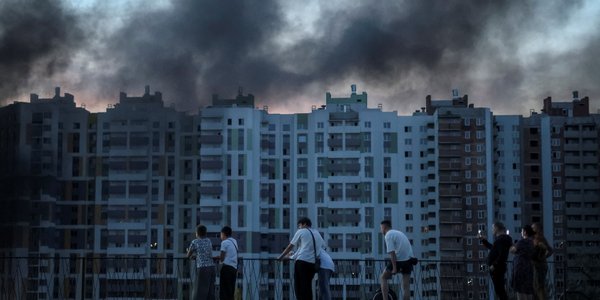
Over the past two days, however, the alerts did not end at sunrise; they droned on into the day and the following night. It’s a nerve-wracking wailing, on top of explosions and the knowledge that your life is constantly under threat.
Kyiv has survived more than 20 air raid alerts since Thursday night. Some were an hour long, while others lasted for up to 10 minutes.
Indeed, every alert, as Russia continues its persistent destruction of millions of books , food warehouses and liquor factories , also means everything has to stop until we hear the words: “Air raid alert is over.” Dozens of trains are delayed , and businesses shut down and wait, losing customers and money.
But “survivors must still go to work,” as we like to joke bitterly. People are still expected to commute, even though Kyiv’s subway has stopped running between the left and right banks of the River Dnipro. Sleep-deprived civilians need to walk for hours, squeeze themselves into buses, or get stuck in traffic on bridges, just to get to work and back home. Transport chaos overground means even more danger for people stuck in large groups all around the city.
But our wartime economy, on which we need to rely more and more due to the slowing of foreign aid , cannot afford to stop.
“The country’s defense spending is constantly growing, and this requires maximum mobilization of domestic resources,” said Hlib Vyshlinsky, the executive director of the Center for Economic Strategy think tank based in Kyiv. “The policy of zero tolerance for the risk to the life and health of civilians under constant missile and drone strikes becomes irrelevant, because the state is still not able to protect them at 100 percent.”
As a Kyivan, I can tell you that this terror sends your mental stability into a spiral.
And that is exactly why Russia keeps it going.
“You think we are calling for some kinds of atrocities, while we are aiming to demoralize the public to such an extent that they come out with their little paws raised to meet our troops,” Deputy Speaker of the Russian Duma Pyotr Tolstoy said this week.
That cuts no ice in Kyiv.
“Such statements by a Russian official calling for war crimes and demanding unbearable living conditions for civilians should lead to an ICC arrest warrant. As for ‘raised hands’ — the only reason to raise them is to give Tolstoy and his fellow war criminals the middle finger,” Ukrainian Foreign Ministry Spokesperson Heorhii Tykhyi responded .
Of course, it’s not as if Ukraine isn’t giving Russia a taste of its own medicine.
While peace negotiations have stalled, both sides have turned to total war tactics to the extent their capacity allows. While Ukraine has now also extended its targets from oil depots and military factories to bombing retail warehouses and energy facilities, Russia has embarked on a maximum escalation, attacking civilian housing, postal services, businesses, book and food warehouses — and that list covers only the past couple of days .
In July, the U.N. recorded the highest mortality rates among civilians in Ukraine since March 2022. Russia also reports more civilian deaths caused by Ukrainian attacks, even though, unlike Moscow, Kyiv does not deliberately target civilians but aims to bring the war “ where it came from. “
Ukraine’s Deputy Prime Minister Denys Shmyhal best described the situation when talking to me about the attacks on the energy system last month: “It’s like the 12th round and each boxer hopes their rival will fall first.”
While troops on the frontline are largely stuck, with neither side making much progress on the ground, it’s us, civilians, who are being targeted more and more frequently.
Ukrainian military analyst Mykola Bielieskov called it “a mutual driving of each other into the Stone Age, with the hope to do it before the other side does.”
While our soldiers hold the Russian army at the front line, it’s ordinary Ukrainians — with our mental fortitude, our ability to outlive yet another missile, our capacity to adapt and go to work to keep the economy running no matter what — who will eventually decide the outcome of this war, Vyshlinsky said.
“As Mr. Tolstoy said, this is a tactic of deliberate exhaustion of civilians, pushing the rear to accept a war outcome unfavorable to the state,” Vyshlinsky added.
So we must endure until the other fighter falls.
And first, we need to wait for the best words that can boom from our loudspeakers: Air raid alert is over!

 Kremlin sources: Russia mulls major escalation in Ukraine, including Kyiv strikes
Onet Wiadomości · 1d ago
Kremlin sources: Russia mulls major escalation in Ukraine, including Kyiv strikes
Onet Wiadomości · 1d ago
 Ukrainian troops shooting down missiles with rifles as Russia bombs Kyiv with impunity
Rzeczpospolita · 4d ago
Kyiv residents sift through rubble after Russian overnight barrage
Euronews · 7d ago
Ukrainian troops shooting down missiles with rifles as Russia bombs Kyiv with impunity
Rzeczpospolita · 4d ago
Kyiv residents sift through rubble after Russian overnight barrage
Euronews · 7d ago
Comments
No comments yet — be the first to weigh in 👇
No comments yet. Be the first!