Full text
The Iran war is undermining the Pentagon’s ability to project power in other regions of the world — and leaving allies and former defense officials questioning whether Washington can effectively deter its adversaries.
To focus resources in the Middle East, the Pentagon has pulled key air defenses and its last remaining aircraft carrier out of the Pacific. It has largely stopped maritime missions in the South China Sea aimed at curbing China’s territorial ambitions. And it has limited fighter jet rotations around Europe that defend NATO’s borders with Russia.
The notably reduced U.S. military presence in the Pacific and in Europe — and President Donald Trump’s conciliatory approach to traditional foes such as Russia and North Korea — has threatened the Pentagon’s influence around the world, according to five former defense officials and a person familiar with Defense Department planning.
“The obvious question that nobody seems to want to overly press the administration on right now is: Do we still have a credible deterrent?” said one of the officials. “Given where the resources are at, there’s a pretty big gap.”
The Pentagon’s inability to subdue Tehran, coupled with drastically reduced stockpiles of missile interceptors and other key munitions, has fueled an increasing consensus that the U.S. military is losing the clout it once held with allies.
“There’s just a real hollowing out of confidence,” said a second former defense official, who, like others, was granted anonymity to discuss sensitive military issues.
The U.S. still has substantial resources in the Middle East. More than 50,000 American troops, a dozen warships and hundreds of aircraft all stand ready to resume fighting if Trump decides to do so. But America’s distancing from allies — including trashing Canada and canceling military exercises with South Korea — has left traditional partners feeling exposed. This is especially true in Asia, where Trump has appeared to embrace Chinese leader Xi Jinping and North Korean ruler Kim Jong Un.
“The president’s apparent interest in accommodation with China is creating a perfect storm that increases [allies’] vulnerability,” the second former official said.
The White House has turned to economic pressure on Tehran as the Iran war hits a stalemate, a potentially risky move for global markets. But the Pentagon has largely welcomed Treasury Secretary Scott Bessent’s shift from air strikes to sanctions, given how difficult it has been to come up with a strategy to wrap up the war, according to the person familiar with Pentagon planning.
“Wars are hard to get out of, no matter how easy they might be to get into,” the person said. “You can’t always get a Venezuela.”
The Pentagon denied any threat to the country’s prestige. “America’s military remains the most powerful fighting force on earth,” said Pentagon spokesperson Sean Parnell. “We have already executed successful operations while maintaining a deep, ready arsenal to defend our people and our interests. Any adversary who confuses media noise with American weakness will discover the truth the hard way.”
The White House argued the U.S. continues to have the ability to achieve any of the president’s goals. “As Operation Epic Fury demonstrated, America’s military might is stronger than it’s ever been,” said White House spokesperson Anna Kelly, referencing the government’s name for the campaign against Tehran.
The Iran war has led to a musical chairs of sorts with weapon supplies. Gen. Xavier Brunson, who leads U.S. forces in Korea, told the Senate Armed Services Committee in April that the Pentagon had removed munitions from the peninsula for the military conflict with Iran. He said, though, that the region’s main missile defense system, known as THAAD, remained in place.
But allies from Australia to Taiwan are voicing concerns they won’t have the U.S. munitions they need if a conflict occurs in the region. Beijing has kept up a steady drumbeat of incursions into Taiwan’s airspace in recent months.
“There’s deep anxiety,” said an official in the Pacific. “I personally find the lack of urgency shocking.”
But it’s the smaller Asian countries who are going to feel the most impact, said Bryan Clark, a former Navy officer and now an expert on naval operations with the conservative Hudson Institute think tank. “Not being there with a carrier while China is [there], is not going to help our case.”
The Iran war has also put enormous demands on the U.S. Navy. Two key aircraft carriers, the USS Gerald Ford and USS Abraham Lincoln, are just returning from record-breaking deployments and in need of maintenance work.
The USS Theodore Roosevelt will leave San Diego in coming weeks, and officials have already said it will face a longer deployment than the usual seven months.
“I typically am not a fan of extensions,” Adm. Daryl Caudle, the Navy’s top officer, said this week. “I push back hard on that. But the enemy gets a vote.”
Signs of American retrenchment are occurring in Europe as well.
Defense Secretary Pete Hegseth in June announced a six-month review of troops in Europe. And he has removed several top officers who played key roles in assisting with Ukraine’s war against Russia.
U.S. Army Europe and Africa commander Gen. Christopher Donahue, who Hegseth relieved in July, helped equip tech companies that work with the Army on drone programs. Gen. Christopher LaNeve, the Army’s new acting chief of staff, also recently stopped a joint training program between U.S. and Ukrainian troops on drone warfare.
“We’re about to lose an enormous amount of knowledge about how major wars are being fought from people doing the fighting,” said a U.S. official.
Even in the Middle East, the U.S. is finding it has fewer safe options.
Navy warships have had to resupply far beyond the range of Iranian weapons. “They can’t operate out of any of the ports that are close to Iran that they’re used to operating out of, and so they’re doing all the resupply from Diego Garcia, which is like two or 3,000 miles back,” said a person close to the Pentagon.
The problem would be magnified, the person said, in a war against China since it has large enough arsenals to hammer U.S. bases repeatedly with ballistic missiles.
All of these dynamics have dealt reputational damage to U.S. credibility.
“What’s more important is the message that’s being sent quietly by diplomats behind closed doors, which is that the United States is unreliable, the United States is unfocused, and China is focused,” said the second former defense official. “It’s here, and it’s not going away.”

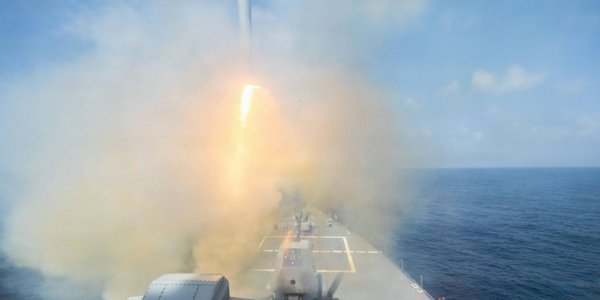 US left with ~1,000 Patriot and THAAD missiles after Iran war; China has 3,000+
Rzeczpospolita · 1d ago
US left with ~1,000 Patriot and THAAD missiles after Iran war; China has 3,000+
Rzeczpospolita · 1d ago
Comments
No comments yet — be the first to weigh in 👇
No comments yet. Be the first!