Europe races to develop next-generation beyond-visual-range air-to-air missiles
Europe is accelerating development of next-generation beyond-visual-range (BVR) air-to-air missiles in response to rapid advances in Chinese systems, particularly the PL-15. The India-Pakistan air combat experience sharpened the urgency, revealing the operational risks of underestimating an adversary's long-range missile capabilities. Several parallel European programmes are now underway to field homegrown next-generation systems.
Full text
Europe is entering an interesting, and potentially highly consequential, period in the development of beyond-visual-range (BVR) air-to-air weapons. While the public emergence of new U.S. weapons in this class has unsurprisingly grabbed the headlines in recent months, Europe is meanwhile working on several projects that ultimately seek to field its next generation of far-reaching air-to-air missiles.
As in the United States , the immediate catalyst is the rapid evolution of Chinese air-to-air missiles , particularly the PL-15 and newer systems that are emerging around it . The India-Pakistan air combat experience from last year has brought the issue into sharper focus, demonstrating the operational consequences of underestimating an opponent’s long-range air-to-air capabilities. However, while Pakistan said its Chinese-made fighters and missiles shot down several Indian aircraft, the precise circumstances, numbers, and tactics involved remain the subject of competing claims and outside analysis.
Pictures of the PL-15E missile body that came down in India’s Punjab region during the Indo-Pakistan conflict in May 2025. via X
For Europe, the MBDA Meteor is currently the state of the art in terms of BVR air-to-air missiles, and its unique set of capabilites is something we have discussed in depth in the past . The question is increasingly not simply how to improve the Meteor, but what should come after it, and what kind of weapons architecture (or ‘kill chain’) will be needed for the next generation of crewed and uncrewed combat aircraft and their weapons.
A U.K. Royal Air Force Typhoon takes off, loaded with Meteor missiles below the fuselage. Crown Copyright
One of the most intriguing current developments is France’s Comet program, which appears to be led by the French side of the pan-European MBDA consortium. Very little is publicly known about the weapon, and its exact specifications remain unclear. It nevertheless appears to represent an effort to provide a significant step beyond the current MICA family, offering greater range and speed. If the apparent timeline of around 2030 is correct, Comet could be viewed as a relatively near-term response to an increasingly demanding threat environment.
Douglas Barrie , senior fellow for military aerospace at the International Institute for Strategic Studies (IISS) research institute in London, told TWZ that Comet looks like “a response to the exchanges between the Pakistanis and the Indians, where, on day one, the Indians underestimated how aggressive the Pakistanis were going to be, particularly with PL-15. It seems coincidental at the very least that this kind of thing has just popped up onto the horizon.”
Four dummy PL-15 missiles in the internal weapons bay of a Chinese J-20 fighter. Chinese Internet
That would distinguish Comet from the U.K.’s Future Air Superiority Effectors, or FASE, program which appears to be associated much more closely with the longer-term requirements of the U.K.’s Future Combat Air System and GCAP/Tempest .
Talking to TWZ , Justin Bronk , a research fellow for airpower at the Royal United Services Institute (RUSI), explained that FASE “is likely aimed at providing significantly better combat capabilities by the early-mid 2030s than a mid-life upgrade of the Meteor missile would be able to offer within the bounds of its basic layout and size.”
Creating an interesting overlap with FASE and Comet is a joint Franco-British study looking at what comes after Meteor. In April, the two countries signed a memorandum of understanding launching the 12-month effort that will assess future air-combat threats and potential next-generation missile concepts. The study is intended to identify the technologies required for a successor weapon and establish a development roadmap. While the two countries are at least formally examining the same post-Meteor problem, their longer-term combat air priorities appear to be diverging.
Beyond Meteor
Meteor remains one of Europe’s most capable air-to-air weapons. Its ramjet propulsion system gives it an important advantage over conventional solid-rocket missiles by allowing it to retain propulsion and energy much further into an engagement.
However, the threat environment that Meteor was designed against is changing. Meteor’s requirements were established in an environment dominated by the Soviet/Russian air-to-air missile threat. Today’s planning increasingly has to account for Chinese weapons such as the PL-15 and newer systems that may combine very long range with substantially greater speed.
A Su-35S launches an R-37M — the longet-range Russian air-to-air missile. Russian Ministry of Defense screencap
“Since the Meteor is still more than a match for current Russian air-to-air missiles in air-to-air engagements, it is likely that the capability goals for the FASE program will use far more capable Chinese air-to-air missiles, aircraft, and sensors as pacing threats,” Bronk added.
That raises the uncomfortable question of what happens when both sides can launch extremely capable BVR weapons against each other?
Simply put, higher speed now matters more, because it reduces the target’s reaction time and can make the terminal engagement substantially more demanding. One of Meteor’s advantages is the considerable energy it retains when it reaches the terminal phase, but the tradeoff is a slower average speed across the entirety of its flight envelope.
Barrie explained: “Meteor’s fly-out speed is somewhere between Mach 3.5 and somewhere below Mach 4. If you launch a PL-15 off a J-20 , which is doing Mach 2, that weapon probably stays above Mach 5 for an awfully long time, which is one of the issues. It’s that risk of a mutual kill. Obviously, if the weapon against the J-20 is coming out at Mach 3.5 to Mach 4, then you have a bit an issue there.”
At the same time, a missile’s effectiveness depends on many other factors, including launch conditions, flight profile, midcourse guidance, seeker performance, electronic warfare environment, and target maneuvering.
However, the nature of the threat may push the next generation of European weapons toward a combination of greater range, substantially higher speed and greater terminal energy rather than simply another incremental improvement to Meteor. Indeed, the United Kingdom has dropped its plans for a Meteor mid-life upgrade, presumably to focus its efforts on an altogether more ambitious and capable successor, or successors.
Does the next weapon need a ramjet?
The Meteor was designed around a ramjet motor, especially since it was expected to face a ramjet version of the Russian R-77 (AA-12 Adder) missile. This was never fielded, and, as far as we know, China doesn’t have a weapon in this class either. A Meteor successor therefore won’t necessarily use the same kind of propulsion.
Chinese People’s Liberation Army Air Force personnel move standard R-77 missiles. PLA
Meteor demonstrated the advantages of air-breathing propulsion, but there are trade-offs involved in using a ramjet or another air-breathing system. Achieving very high speeds while maintaining useful range and maneuverability can become increasingly difficult, and propulsion complexity adds cost and potentially consumes valuable internal volume.
The performance being attributed in open sources to Chinese solid-propellant weapons like the PL-15 suggests that another approach is possible.
Barrie would not be surprised if the ramjet is dropped. “The issue with a ramjet is it’s not impossible to get above Mach 5, but it’s difficult, and there are lots of compromises you probably have to make … I wonder if they may just look at energetic solids.”
A future European missile could therefore use a substantially larger solid-propellant motor, potentially coupled with a different boost and sustain architecture, to achieve the required combination of speed and range. Using more than one stage , or a multi-pulse solid rocket motor could be other solutions to the issue.
The size problem
Perhaps the biggest opportunity for a new European BVR weapon comes from the aircraft that will carry it.
Meteor was developed within the physical constraints imposed by existing fighter aircraft and their weapons-carriage arrangements, including internal carriage in the F-35. A future combat aircraft such as Tempest is expected to have significantly greater internal volume available for weapons.
“One of the drivers for Tempest is internal carriage, obviously, but lots of it,” Barrie continued. “A big main bay, and then probably sizeable side bays as well. That lets you carry a considerably larger weapon mass internally than an F-35. If you look at size of the platform in terms of what they’ve released, it’s a big aircraft, and one would assume it has a very significant internal weapons bay.”
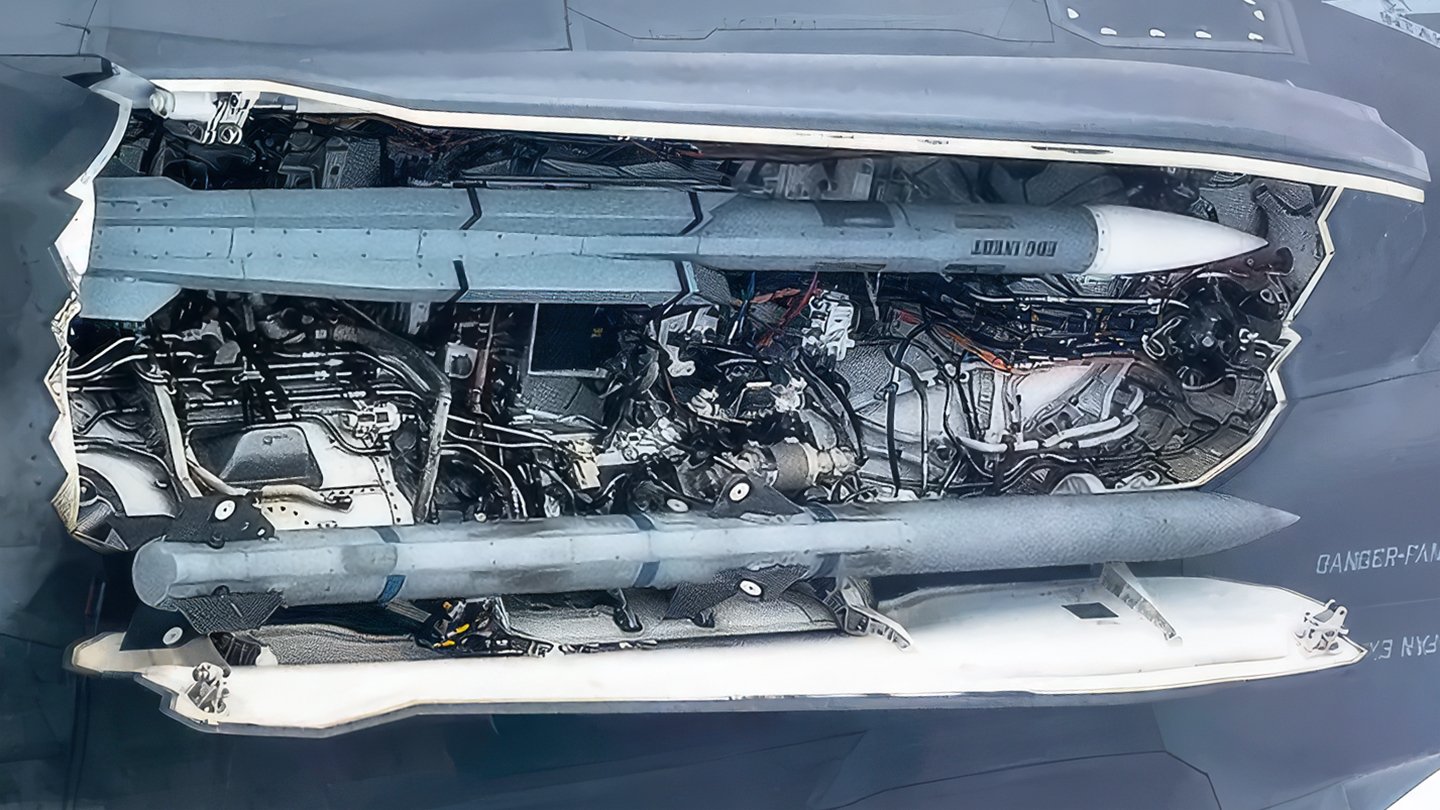
The current AIM-120 AMRAAM internal carriage configuration on the F-35, with two missiles in each weapons bay. Crown Copyright
A larger missile can carry more propellant, potentially support a more powerful propulsion system, accommodate a larger or more capable seeker, and provide additional volume for electronics and other subsystems.
As we have explained in the past :
There are different ways of increasing the range of an air-to-air missile, but this process is always easier if the weapon can be made larger . Bigger dimensions can translate to a bigger engine, more fuel, multi-stage rocket motors, and air-breathing engines, like the ramjet used in the Meteor. Other range-extending options that the United States has examined include throttleable “ multi-pulse solid rocket motors ” and more exotic “ propellants, grain configurations , cases, and liners,” all of which would also be able to ensure greater range — as well as higher speed — compared to existing weapons.
The result could be a weapon that is considerably larger than Meteor but still fully compatible with the aircraft for which it was designed.
This realuty, and the use of the plural effectors in the U.K.’s FASE terminology raises the possibility that the future European BVR requirement may not be for one missile, but for a family of weapons — at least as far as the British are concerned.
Why “effectors” may matter
If FASE ultimately refers to multiple effectors rather than a single missile, that could point to the broader direction of future air combat, involving crewed aircraft as well as various uncrewed wingmen.
Tempest is expected to operate as a so-called quarterback, supported by a number of uncrewed combat aircraft, remote carriers, or other systems operating considerably farther forward. Those uncrewed systems will have different size, payload and weapons-carriage constraints from the crewed aircraft.
This means that not every platform will need the same BVR weapon, or even be able to accommodate them, when it comes to the larger missiles.
Instead, a future force might require something resembling a family:
A large, long-range, high-speed weapon for the crewed Tempest aircraft, optimized for the highest-end air-superiority engagements.
A medium-sized weapon suitable for existing fighters and potentially future aircraft with more constrained weapons carriage.
A smaller weapon optimized for CCAs or other uncrewed systems where internal bay dimensions, payload and cost are more restrictive.
A modular missile could possibly cover two of these categories at once. More broadly, these weapons could share technologies without necessarily being identical missiles. Common seekers, electronics, datalinks, software, guidance technologies or other subsystems could potentially be reused across the family.
The result would be a fundamentally different approach from simply developing a single Meteor replacement.
The seeker may be as important as the motor
The front end of a future European BVR weapon is another area where significant change is likely.
An active electronically scanned array (AESA) seeker would seem a logical baseline for a next-generation weapon. The United Kingdom’s previous work with Japan on the Joint New Air-to-Air Missile program, or JNAAM effort was particularly interesting in this regard, given Japan’s experience with active electronically scanned air-to-air seekers.
An infographic for the JNAAM program provides a loose visual indication of how it would have combined Japanese and British components in a single missile. Japan Ministry of Defense
A future weapon could also incorporate a passive radio-frequency capability alongside its active radar. That would provide another means of detecting or tracking emitting targets and could increase the weapon’s resilience in a heavily contested electromagnetic environment.
For its PL-17 ultra-long-range air-to-air missile, China appears to have chosen a combination of active and passive seekers, although, as Barrie points out, it also appears to have been designed around a very specific target set: E-7 Wedgetail , E-2 Hawkeye , other airborne early warning and control platforms, and support assets, like tankers and strategic electronic surveillance and attack aircraft.
This 2016 image provided our first look at the PL-17. Chinese internet
Whether such a capability is worth the additional cost and complexity is another question. A highly sophisticated multimode missile will inevitably be expensive, however, the same technologies could potentially provide utility against a broader range of targets than conventional fighter-on-fighter engagements. An air-to-surface capability should also not be ruled out, with a passive seeker potentially bestowing an anti-radiation missile (ARM) capability on the weapon.
Another passive seeker alternative could be based on an imaging infrared (IIR) sensor . This could provide an interesting complement to an active-radar seeker, making use of the same kind of two-way datalinked midcourse guidance system already included in Meteor. It could be esepcially relevant for engaging small or low-signature (stealthy) targets and in a heavily contested electromagnetic environment.
The weapon is becoming part of the network
Perhaps the biggest change will be the extent to which future BVR missiles exploit the wider kill chain , becoming much more than weapons guided by the aircraft that launches them.
The key requirement is for the missile to be track-source agnostic. This means a future long-range air-to-air missile could receive targeting information from a CCA, an airborne early warning aircraft, another fighter, a naval platform, or potentially space-based sensors.
For example, with Tempest operating alongside forward-deployed CCAs, the sensor that initially detects a target could be the CCA. The launching aircraft could then receive the track, launch a weapon, and continue receiving updates from multiple platforms.
Alternatively, a CCA could launch the weapon using targeting information generated by the crewed aircraft or another sensor elsewhere in the force, provided it is on the network.
A graphic from BAE Systems shows a Tempest fighter working as part of a networked team together with Typhoon, F-35, E-7 Wedgetail, and ‘loyal wingman’ type drones. BAE Systems
Two-way datalinks, midcourse guidance, electronic warfare resilience, and the ability to accept high-quality third-party targeting information become central requirements. Some of this functionality is available, to varying extents, on some current air-to-air missiles, but it will be even more important as air combat becomes increasingly reliant on distributed sensor networks and crewed/uncrewed aircraft teaming.
If it can rely on offboard sensors, the missile’s engagement range no longer needs to be constrained by the organic sensor range of the launching fighter. Faced increasingly by the realities of an anti-access/area-denial (A2/AD) environment, this could enable weapons that fly far beyond what the launch platform could independently detect and engage. The A2/AD threat is alreayd pushing research into much farther-reaching air defese missiles, potentially with a range of up to 1,000 miles.
This also opens the door to more exotic propulsion concepts, including multi-stage weapons designed to combine very high-speed boost with a separate sustain or terminal stage.
The next generation of long-range air-to-air missile may therefore be defined as much by the kill chain they plug into as by the architecture and performance of the missile itself.
What happens to Meteor?
Meteor is one of Europe’s strongest examples of a successful multinational defense program. Six European nations participated in its development, and the program eventually produced a weapon that is widely regarded as a highly capable system.
Now, however, the countries that developed Meteor do not necessarily have identical requirements for the next generation.
The United Kingdom is moving toward GCAP/Tempest with Japan and Italy. Its future combat air requirements will increasingly be shaped by that program and by the threat assessment driving it.
The latest full-size mockup of the Tempest gives some idea of its size. GCAP
The United Kingdom appears to want a very large, very high-performance weapon optimized for Tempest and the future air-superiority mission, especially in the Indo-Pacific region. Japan likely needs very much the same.
Meanwhile, other Meteor users may prioritize a weapon that can be integrated onto existing fighters and remain affordable in larger numbers.
France’s Comet effort could meet that requirement, since it appears to be a comparatively rapid response to the emerging threat. With that in mind, France could eventually find itself with a near-term weapon, a future clean-sheet requirement, and a continuing relationship with the Meteor family, all while pursuing its own future combat air requirements.
Overall, it is far from clear whether the Meteor consortium will survive for another generation, at least in its current form.
Could Japan become part of the answer?
Given that it’s a partner in GCAP/Tempest, and based on its previous air-to-air missile studies with the British, Japan is particularly interesting in this context.
Japan faces a threat environment in which long-range air combat is of obvious importance, and Japan has already demonstrated advanced capabilities in active electronically scanned air-to-air seekers. The Japanese-developed Mitsubishi AAM-4B became the first air-to-air missile to feature an AESA seeker.
Although earlier air-to-air missile cooperation between Japan and the United Kingdom did not evolve into an operational program, the two countries are now developing a combat aircraft together through GCAP.
With Britain and Japan designing the future combat aircraft together, they could eventually develop some of its principal weapons together as well, although Italy’s requirements are likely very different.
Thinking beyond the missile
Europe can almost certainly build a faster missile than Meteor, but there are plenty more questions about what kind of air combat system that missile — or missiles — will fit into.
A future BVR weapon will have to operate from multiple types of platforms (crewed and uncrewed), receive targeting data from offboard sensors, communicate with CCAs, function in a highly contested electromagnetic environment, engage maneuvering targets at extreme range, and retain enough energy to remain dangerous in the terminal phase.
Increasingly, it seems that, rather than a single weapon, a family of effectors will be the solution.
For the United Kingdom, FASE may become one of the most important programs to watch because it could reveal how Britain intends to bridge the gap between Meteor and the weapons of the GCAP/Tempest era. At this stage, FASE appears to be ‘for U.K. eyes only,’ although Japan and Italy would appear to be likely beneficiaries, due to their teaming on GCAP.
A scale model of a possible Tempest configuration, in Italian Air Force markings. Leonardo
Elsewhere, Comet could provide an early indication of how France intends to respond to the emerging long-range missile threat while maintaining flexibility for a future system.
And for the wider Meteor consortium, it remains to be seen whether the program’s success can be carried forward into another multinational weapon, or whether the emergence of GCAP/Tempest and increasingly divergent national requirements marks the beginning of the end for the Meteor model.
Either way, the next generation of European BVR weapons is likely to be larger, faster, more networked, and more deeply integrated with the combat air system around it. At the same time, the need to create a family of effectors designed around a distributed force of crewed aircraft, CCAs, and offboard sensors will bring some formidable challenges.
Contact the author: thomas@thewarzone.com
The post What Europe Needs Next In Beyond-Visual-Range Air-To-Air Missiles appeared first on TWZ .
Similar stories
 🪖 Military
Mystery J-20-like shapes at Chinese airbases turn out to be firefighting training mock-ups
The War Zone · 2d ago
🪖 Military
Mystery J-20-like shapes at Chinese airbases turn out to be firefighting training mock-ups
The War Zone · 2d ago
 🌍 World
Mudslide surges through China's Gyirong border port after Nepal disaster
Euronews · 3h ago
🌍 World
Mudslide surges through China's Gyirong border port after Nepal disaster
Euronews · 3h ago
 🌍 World
China displaces Russia as main arms supplier in Central Asia
Onet Wiadomości · 4h ago
🌍 World
China displaces Russia as main arms supplier in Central Asia
Onet Wiadomości · 4h ago
Similar stories
🪖 Military
Mystery J-20-like shapes at Chinese airbases turn out to be firefighting training mock-ups
The War Zone · 2d ago
🌍 World
Mudslide surges through China's Gyirong border port after Nepal disaster
Euronews · 3h ago
🌍 World
China displaces Russia as main arms supplier in Central Asia
Onet Wiadomości · 4h ago
Should Europe develop a single joint BVR missile programme instead of separate national ones?
Comments
No comments yet
Comments
No comments yet — be the first to weigh in 👇
No comments yet. Be the first!