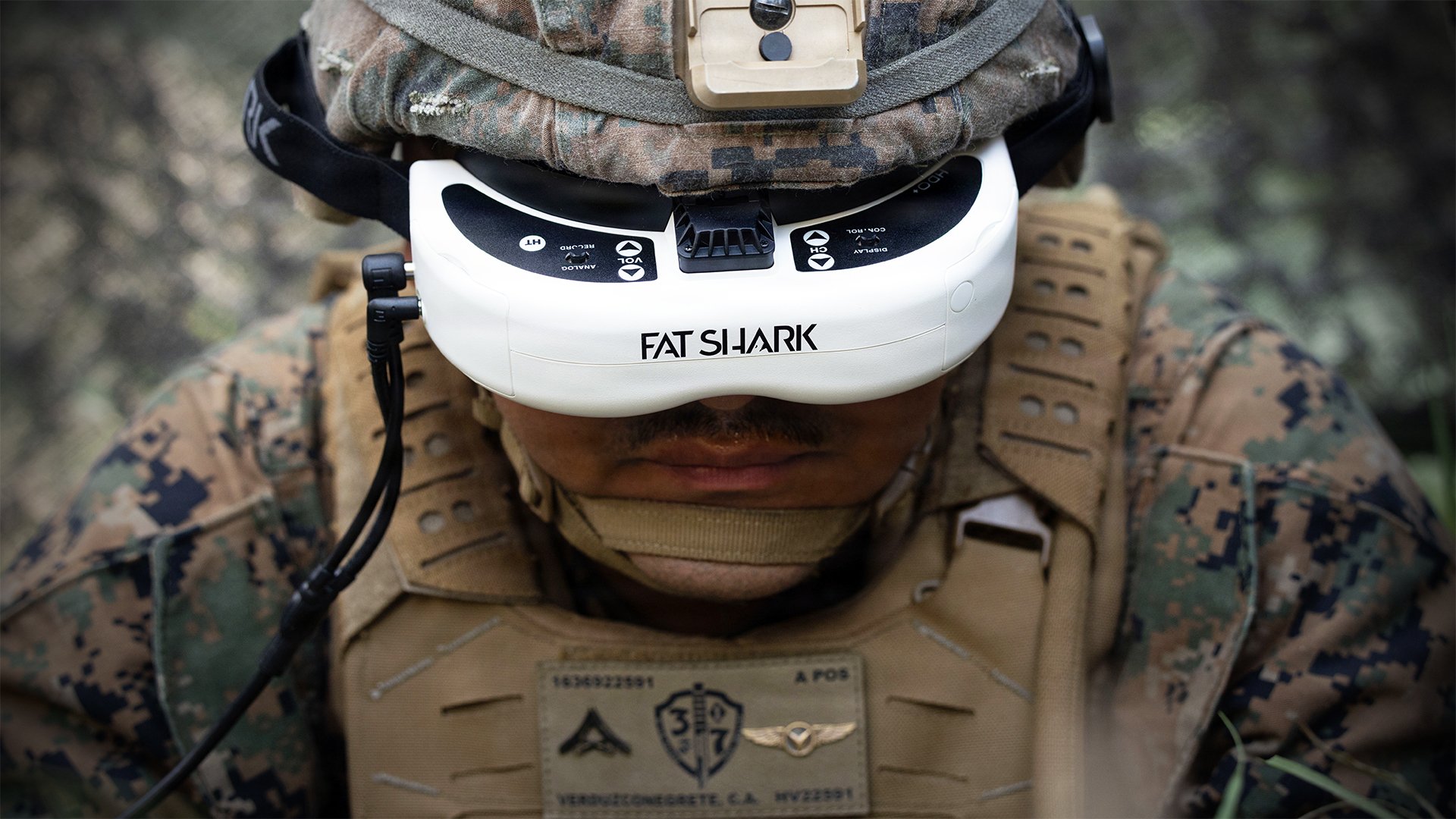
US Marine Corps unveils its vision for drone-dominated ground combat by 2040
The US Marine Corps unveiled its "Ground Combat Element 2040" (GCE 2040) document, laying out the future of ground combat in a drone-dominated battlefield. The strategy focuses on littoral warfare and countering anti-access systems, with a future Pacific conflict scenario in mind. The document specifies required equipment and training down to the squad level.
Full text
Faced with having to fight as technology rapidly transforms the nature of warfare, the U.S. Marine Corps on Wednesday unveiled its vision for the future of ground combat . Dubbed Ground Combat Element (GCE) 2040, the document lays out how Marines will fight and what kinds of equipment and training they will need to succeed, down to the squad level. Though the document doesn’t mention a specific adversary, it focuses heavily on the kind of littoral, anti-access battle a future Pacific fight would entail.
“I think that you would agree that the global security landscape today demonstrates an intensity for that kind of modernization,” Lt. Gen. Jay M. Bargeron, Deputy Commandant, Plans, Policies, and Operations, said today during a media roundtable to introduce GCE 2040 that TWZ attended virtually. “It’s a landscape that’s defined by rapid technological change and the reemergence, importantly, of peer-level adversaries like China and Russia.”
A working concept of the plan was presented for the first time back in April during a panel at the Modern Day Marine Expo held in Washington, D.C.
In a future fight against enemies with ubiquitous sensors, advanced artificial intelligence and machine learning (AI/ML) capabilities, waves of expendable drones, offensive and defensive electronic warfare systems and long-range precision weapons, smaller Marine units like rifle squads will have to act more independently to defend themselves and execute successful attacks.
The new plan recognizes that “widespread use of drones underscores the need for effective organic protective measures across the GCE, down to the squad level. The evolving drone threat presents the most significant risk to ground maneuver, requiring layered active and passive counter-UAS capabilities to retain the initiative. Survivability must be addressed by comprehensively encompassing improved training, updated doctrine, and technological advancements.”
You can see an example of how small drones are being used against Ukrainian forces in the following video.
Video showing a Russian fiber-optic FPV drone hitting one of the 4 IFVs returning from this attack today
What this shows :
It seems that mainly fiber-optic drones are being used (it was the same during May 22nd assault), which means there is an important Ukrainian… https://t.co/uy2IrCFLsf pic.twitter.com/UBrZNzm2yV
— Clément Molin (@clement_molin) August 24, 2026
The ubiquity of drones on the battlefield has devastated both Russian and Ukrainian forces, which are each using these weapons to create an ever-growing no-go zone . Bargeron acknowledged that providing protection from drones for smaller Marine units presents a major challenge.
“The ability for our lowest echelon units – squad, platoon, company – to defend themselves against one-way attack systems is really maybe one of the biggest holes in our swing, and so we’re working hard on that,” the general admitted.
To protect these forces will require a forward, layered approach involving ground-based air defenses (GBAD) and other means, Bargeron explained. From longer ranges, systems like the Marine Air Defense Integrated System (MADIS), Light Marine Air Defense Integrated Systems (LMADIS) and Medium-Range Intercept Capability [MRIC] , will defend Marines, he said.
The Marine Air Defense Integrated System (MADIS). (USMC) US Marine Corps Marine Air Defense Integrated System (MADIS) vehicles. USMC
In addition, Bargeron said the Marines will also rely on a system called “Home Alone,” which a spokesman for the service told us “is a Counter-small Unmanned Aircraft System (CsUAS) that is a semi-fixed site GBAD solution that supports our layered defense structure.” The Marines declined to provide any details about how that system works, citing its classified nature.
For protection at the squad level, “the GCE 2040 integrates both active and passive measures to ensure organic protection,” a Marine official told us. “A key component of this is the Organic Counter-small UAS, or O-CsUAS, initiative. This program has fielded dismounted kits directly to the squads. These kits provide Marines with the ability to actively and passively detect drone threats and to defeat them using both kinetic and non-kinetic means.”
Those kits are “complemented by the use of frangible 5.56 ammunition for standard-issue rifles , which is more effective against aerial targets, and the continued employment of passive countermeasures like multi-spectral camouflage, dispersion, and displacement to degrade enemy targeting,” the official added.
Bargeron noted that the Marines have already purchased 400,000 of the frangible counter-drone rounds and that they are undergoing training on how to use them.
You can read more about the Marines’ emerging doctrine for devolving air defense down to the individual Marine in our story here .
As noted earlier in this story, GCE 2040 also calls for providing squads with longer-range offensive weapons.
“What we’re trying to do is to bring precision strike capabilities down to the lowest level,” the general noted. “That’s a great example of using advanced technology to enhance the lethality of Marines that are already doing that job. The OPF [Organic Precision Fires] increases the individual Marine’s or Marine rifle squads’ ability to strike targets, at ranges that you had previously needed fixed-wing air or aviation fire support or indirect fire.”
The goal is for squads to be able to strike targets at a range of about 20 kilometers, Bargeron stated.
“So in the hands of the individual Marines to be able to strike targets like that…will be dramatic,” he exclaimed.
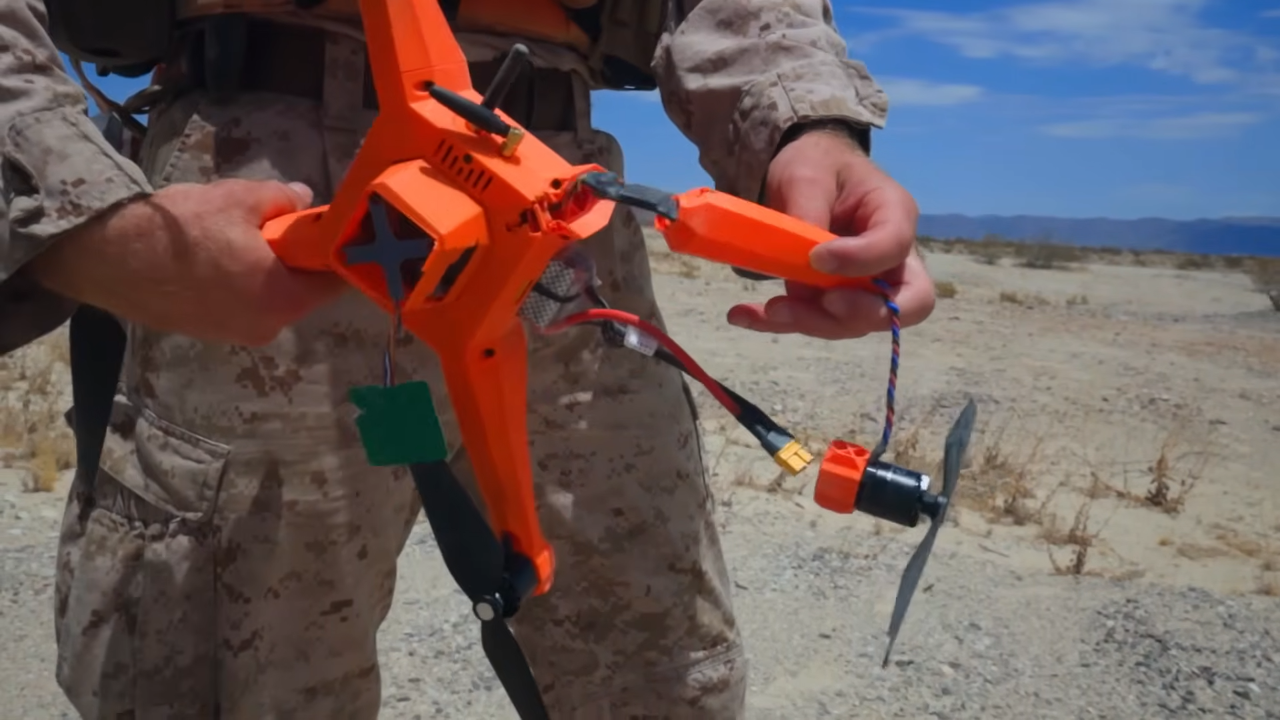
Bargeron added that the Marines are currently using the Neros Archer first-person view (FPV) drones for this purpose. They are “capable of carrying a 2 kg/4.5 lb payload over 20 kilometers,” the company asserts on its LinkedIn page .
They are also being sent to Ukraine , where the use of these systems by small units is a daily fact of life, not a vision for the future.
A Neros Archer first-person view drone sits on a case during a demonstration range at Weapons Training Battalion on Marine Corps Base Quantico, Virginia, March 7, 2025. (U.S. Marine Corps photo by Cpl. Joshua Barker) Cpl. Joshua Barker
Bargeron offered no other details on specific offensive squad-level longer-range weapons options that will be developed and fielded over the coming years.
The plan itself is vague in terms of overall timelines, noting that there will be a “phased approach to modernization” occurring across “three overlapping time periods.”
Near-Term (2026-2030): This period focuses on refining and accelerating ongoing Force Design modernization efforts, addressing the immediate threat of drones, and setting
conditions for future investments.
Mid-Term (2031-2035): Investments in AI and autonomous systems will mature, enhancing headquarters functions, streamlining logistics, and improving operational tempo. Drone/unmanned formations and layered counter-
UAS capabilities become critical.
Long-Range (2036-2040): The GCE is transformed by AI-enabled command and control, widespread Human-Machine
Teaming, and resilient, dispersed formations. It operates with increased combat power and survivability, providing the Joint Force with a decisive advantage on key littoral terrain.
Ukraine has shown American troops up close and personal how difficult it is to defend against drones . In a recent training exercise in Germany, U.S. Army soldiers were trounced by Ukrainian drone operators, only improving their performance after the lessons learned from initial engagements. While there are still many unknowns about the goals and rules put in place for that exercise, which accomplished its mission of learning, it underlines long-standing questions about why the U.S. military has taken so long to adapt to a glaringly different battlefield. Whether the new Marine Corps plan will do so fast enough, especially as major foes, especially China, are moving aggressively in employing new weapons and tactics based on lessons learned in global conflicts, is still up for debate.
That being said, the Marines acknowledge that GCE 2040 is a work-in-progress, but the changes it is trying to address are critical to operating against threats the U.S. military has yet to face at the scale it would against China or Russia.
Contact the author: howard@twz.com
The post How Marine Rifle Squads Plan To Fight Future Wars Dominated By Drones appeared first on TWZ .
Similar stories
 🪖 Military
Military investigates drones found on beach near Varna, Bulgaria
Bankier.pl · 11h ago
🪖 Military
After Iran war, US faces a strategic pivot between the Middle East and Pacific
Konflikty.pl · 5d ago
🪖 Military
Military investigates drones found on beach near Varna, Bulgaria
Bankier.pl · 11h ago
🪖 Military
After Iran war, US faces a strategic pivot between the Middle East and Pacific
Konflikty.pl · 5d ago
 🪖 Military
US Marines train to shoot down drones with rifles and shotguns
TechRadar · 8d ago
🪖 Military
US Marines train to shoot down drones with rifles and shotguns
TechRadar · 8d ago
Similar stories
🪖 Military
Military investigates drones found on beach near Varna, Bulgaria
Bankier.pl · 11h ago
🪖 Military
After Iran war, US faces a strategic pivot between the Middle East and Pacific
Konflikty.pl · 5d ago
🪖 Military
US Marines train to shoot down drones with rifles and shotguns
TechRadar · 8d ago
Are the US adequately prepared for drone-dominated warfare?
Comments
No comments yet
Comments
No comments yet — be the first to weigh in 👇
No comments yet. Be the first!