Full text
Astronomers have discovered a new ocean world outside the solar system that orbits extremely close to its parent star. This means that the extrasolar planet, or "exoplanet," is in hot water, both literally and figuratively.
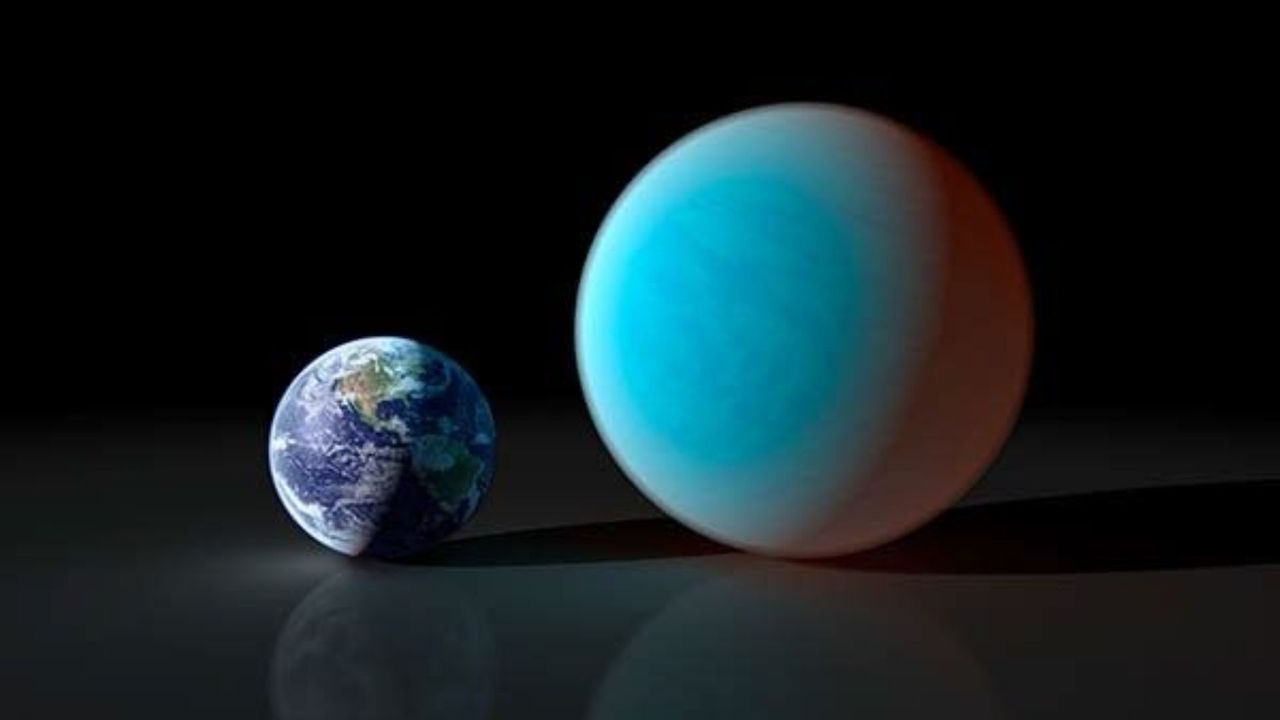
The exoplanet orbits the star HD 176071 located around 335 light-years away, and is about two and a half times the size of Earth , but has about eight and a half times the mass of our planet. That indicates to scientists that this planet is about 50% water. At a distance from its star of just under 1.5 million miles (about 1.6% of the distance between the Earth and the sun ) and with a year lasting just 14 hours, HD 176071 b is a rare example of a "hot water world."
That close distance to its star means the planet experiences extreme tidal forces due to the pull of the star's gravity. These forces are driving the planet, designated HD 176071 b, towards a rapid and inexorable fatal encounter that will see it eventually violently devoured by its host star.
The exoplanet is also a rare occupant of what scientists call " Neptunian Desert " a term which describes a lack of Neptune sized worlds orbiting very close to their host stars. This is thought to be because intense stellar radiation strips planets of their gaseous layers effectively shrinking them. However, HD 176071 b seems to defy this suggestion, as this water world possesses surprisingly a dynamic atmosphere that hasn't been stripped away.
"Comparing historical data from the Kepler space telescope with new TESS (Transisting Exoplante Survey Satellite) observations six years later, we noticed an unexpected phase shift in the modulation of the reflected light," lead researcher Sylvain N. Breton of the Italian National Institute for Astrophysics (INAF) said in a statement.
"This tells us that we are not looking at a static photograph, but a living and changing atmosphere, in which dense, highly reflective clouds form, evolve, and move along the planet's coldest edges."
That isn't the only extraordinary thing about HD 176071 b. The way the ocean exoplanet was initially discovered is pretty special too.
This ocean world doesn't cross its stellar parent
Currently NASA's catalog of confirmed exoplanets has over 6,000 entries with thousands more worlds beyond the solar system awaiting conformation. The vast majority of these were discovered when they passed in from of their host star and caused a tiny dip in starlight reaching us from that stellar body in what's known as the transit method of exoplanet detection .
Thus, the transit method requires the planet to pass between its star and Earth. As you may imagine, that's a really fortunate arrangement for astronomers to find new planets in. Most known planets in the Milky Way don't do that.
"The vast majority of planets in the universe never transit in front of their star from Earth's perspective, making them virtually invisible," Breton said.
HD 176071 b is just such a world, with this geometric hinderance, so Breton and colleagues had to be crafty to discover this water world.
A diagram shows how the transit method of exoplanet detection works (Image credit: NASA) The team still used the starlight of the parent star of HD 176071 b to detect the exoplanet, but instead hunted for tiny fluctuations in brightness caused when the light from this star was reflected from the planet. HD 176071 b is tidally locked , meaning it has a permanent "dayside" facing its star, and a perpetual "nightside" facing out to space. The variations in brightness result because sometimes the nightside of the planet faces us, and other times our instruments see its dayside.
"Thanks to the dataset acquired with the HARPS-N instrument on the Galileo National Telescope, we have managed to overcome this geometric obstacle: by measuring with extreme precision how the light reflected by the planet varies throughout its orbital journey, we can not only detect these elusive worlds, but also begin to characterize their structure and atmosphere, opening a fundamental window onto previously almost inaccessible planetary populations," Breton said.
The discovery of HD 176071 b shows that current astronomy techniques are sophisticated enough to characterize the atmosphere and internal structure of worlds beyond the solar system. That is a big boost for the detection of worlds that don't pass between Earth and their host star.
The team's research was published on Tuesday (August 25) in the journal Astronomy & Astrophysics.

Comments
No comments yet — be the first to weigh in 👇
No comments yet. Be the first!