US Army tests Bradley Fighting Vehicle as carrier for FireAnt ground drone swarms
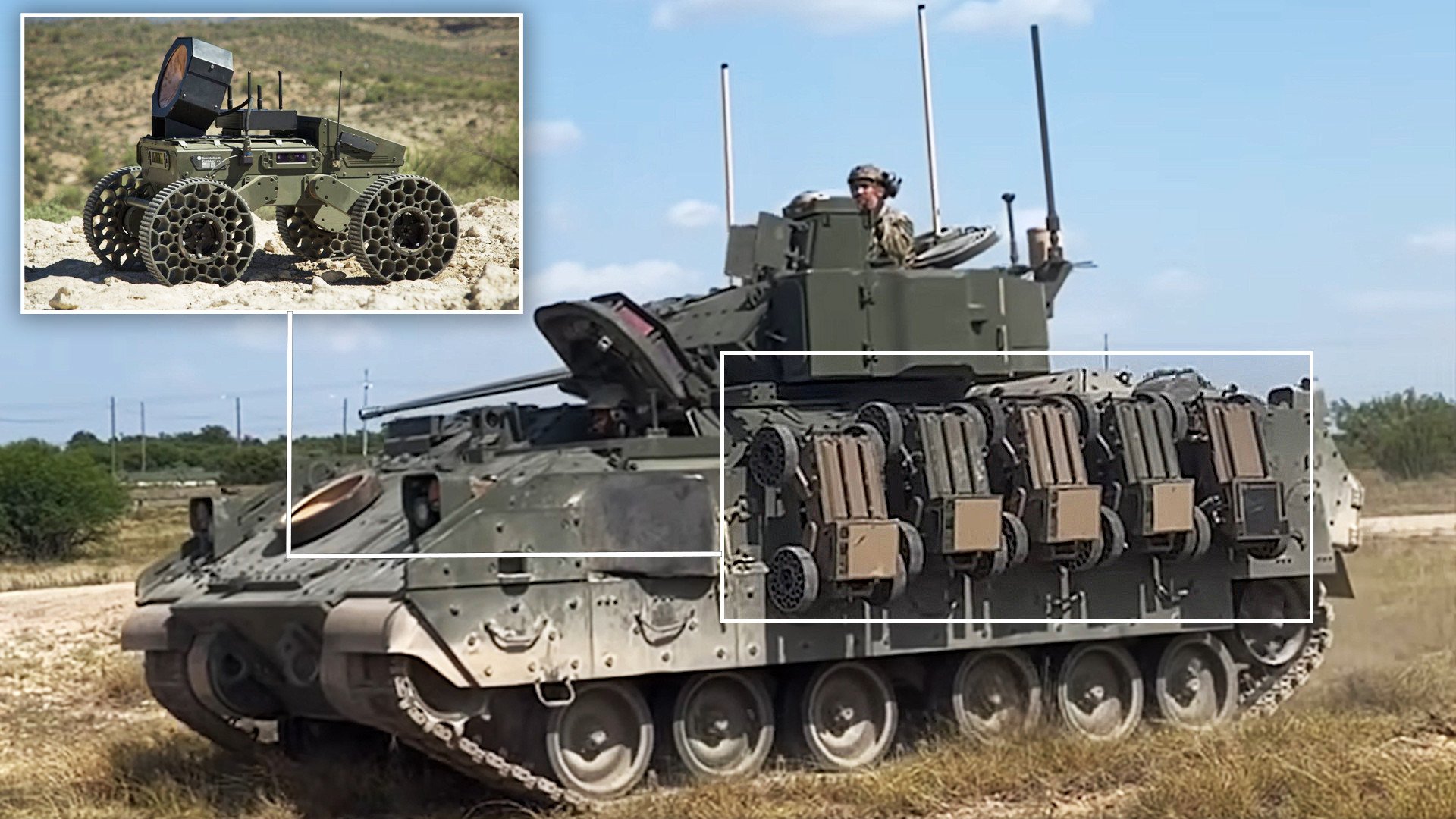
During the Pegasus Charge 3 exercise, US Army soldiers used a Bradley Fighting Vehicle to carry five FireAnt uncrewed ground vehicles (UGVs) developed by Swarmbotics AI. The compact 4×4 drones can be configured for one-way attack missions, electronic warfare, or reconnaissance. The tests are part of the 1st Cavalry Division's Transformation In Contact modernisation programme.
Full text
U.S. Army soldiers used a Bradley Fighting Vehicle as a carrier for FireAnt uncrewed ground vehicles (UGV) during a recent test exercise. The small 4×4 UGVs can be configured as one-way attack munitions, as well as for electronic warfare, surveillance and reconnaissance, and other missions. Bradleys acting as transports and controllers for swarms of UGVs like the FireAnt could open up important new operational possibilities.
Swarmbotics AI , the developer of the FireAnt, shared a video on its LinkedIn page yesterday showing the Bradley with five of the UGVs attached to its side. The post says the footage was taken during Pegasus Charge 3, the third iteration of a 1st Cavalry Division-led test exercise series . The division is one of the operational formations supporting the Army’s larger Transformation In Contact (TIC) modernization initiative. Units assigned to the 1st Cavalry have been testing and evaluating various new weapon systems and other capabilities through Pegasus Charge events and other exercises.
A U.S. Army 1st Cavalry Division M2A4 Bradley IFV was spotted carrying five Swarmbotics AI FireAnt anti-armor UGVs on its side storage racks. Weighing around 27 kg, FireAnt is a low-cost attritable robotic system designed for AI-enabled swarm operations, including ISR,… https://t.co/dbikmUtOey pic.twitter.com/WYIRlLJd9A
— 笑脸男人 (@lfx160219) August 26, 2026
“The US Army has picked Swarmbotics AI (SBAI) to build swarming, attritable, small unmanned ground vehicles (sUGVs) to advance Transformation in Contact (TiC) with the 1st Cavalry Division,” the company announced in a press release back in February. “The award results from successful participation at last year’s xTech Overwatch competition.”
xTech is an in-house Army technology accelerator that regularly hosts “innovation challenges” to support new developments that could be of interest to the service.
“During xTech Overwatch evaluations, soldiers from the 1st Cavalry Division assessed several contractor’s autonomous capabilities that spanned from ground, airborne, payload, and mission planning,” Swarmbotics AI’s release added. “This competitive assessment, facilitated by T2COM [the Army’s Transformation and Training Command] and key stakeholders, aimed to accelerate the adoption of autonomous systems in line with the Chief of Staff of the Army’s directive.”
From what is seen in the video from Swarmbotics AI, it is not immediately clear whether or not the FireAnts can be released remotely from within the Bradley, or if personnel have to unload them manually. Where the UGVs are seen stowed on the side is space that is often taken up by explosive reactive armor (ERA) blocks. A Bradley could carry additional FireAnts internally and deploy them via the rear ramp.
A stock picture of a current-generation US Army M2A4 Bradley Infantry Fighting Vehicle with explosive reactive armor (ERA) blocks fitted on the side, as well as on the front of the hull. US Army
How the roughly 70-pound FireAnts were controlled and otherwise employed during Pegasus Charge 3 is also unclear. Swarmbotics AI has said in the past that human operators are responsible for directing groups of the UGVs. In its press release in February, the company said a squad-sized Army unit had operated 10 FireAnts during the xTech Overwatch competition.
Swarmbotics AI has also said that FireAnt has a significant degree of artificial intelligence (AI) driven autonomy to carry out assigned tasks. When networked together in a swarm, the UGVs are capable of “coordinated behavior across mixed teams and missions,” the company said previously, according to a story from Interesting Engineering .
TWZ has reached out for more information.
As already mentioned, FireAnt is designed to be readily reconfigurable for different missions using modular payloads. The anti-armor configuration, which arms the UGV with an explosively formed penetrator (EFP) warhead, has received the most attention to date. In this role, FireAnt has to get close to its target to be effective. Swarming capability would be very beneficial here for overwhelming defenders, as well as just launching attacks on large groups of tanks and other armored vehicles across a broader area.
FireAnt UGVs armed with explosively formed penetrator (EFP) warheads. Swarmbotics AI
Screen captures from a previous Swarmbotics AI video showing a FireAnt launching a kamikaze attack on a test target. Swarmbotics AI captures
With sensor and electronic warfare payloads, FireAnts could also help scout ahead, provide added general situational awareness, and even launch non-kinetic attacks. Swarmbotics AI has also raised the possibility of a counter-drone role for its UGVs. FireAnts could also conceivably act as signal relay nodes, which would also be especially useful when employing the UGVs in semi-autonomous swarms and/or for pushing them further forward of the main body of a friendly force.
“Mass is our objective, by employing swarms of heterogeneous small sUGVs [small UGVs] we create multiple dilemmas for our adversaries at fractions of the cost of exquisite platforms,” Stephen Houghton, Swarmbotics AI’s CEO, said in a statement accompanying the company’s February release.
It is worth noting here that the Army has previously demonstrated the ability of the Bradley to serve as a forward control node for UGVs. Bradleys could also bring groups of FireAnts or similarly-sized designs to the front lines and hand off control to other nodes.
Previous Army-sponsored testing has also involved FireAnts deployed from larger UGVs, as seen in the video below. This demonstrates an additional layer of crewed-uncrewed teaming capability that could push the entire chain further forward on the battlefield. This, in turn, would help keep human personnel even further removed from potential threats.
UGVs have already become a notable fixture in the ongoing conflict in Ukraine. This includes types in the same general size category as FireAnt configured for kamikaze attacks, as well as large ones armed with various anti-tank guided missiles, automatic grenade launchers, and machine guns. Various UGVs and other uncrewed capabilities were the centerpieces of the annual Independence Day parade in the Ukrainian capital Kyiv just on Monday, as seen in the video below.
On the battlefields of Ukraine, UGVs are generally being employed via links with an operator, either in first-person direct or a third-person semi-autonomous mode, with the help of cameras on the vehicle. In that conflict, uncrewed ground systems face the same electronic warfare threats as their aerial counterparts, and designs with hard-wired fiber-optic control links have been developed in response. TWZ has also previously highlighted the impacts, in general, that the continued development and proliferation of AI-enabled automated target recognition capabilities and new autonomous technologies are already having on aerial one-way-attack drones. This applies, in broad terms, to uncrewed platforms on the ground, as well.
“The key takeaway is that robot swarms are here to stay,” Drew Watson, Swarmbotics AI’s CTO, said in a statement in the press release in February. “Working with 1st Cav in 2026 we’ll baseline concepts for hundreds of robots deployed on the X and at the breach.”
It is still to be seen how FireAnt, specifically, may slot into the Army’s future force structure, overall. That being said, the image of the Bradley at Pegasus Charge 3 carrying a load of the UGVs does look to be a sign of things to come
Special thanks to user @lfx160219 on X for bringing Swarmbotics AI ‘s video from Pegasus Charge 3 to our attention.
Contact the author: joe@twz.com
The post Bradley Fighting Vehicle Lugging Load Of Swarming Ground Drones Is A Sign Of What’s To Come appeared first on TWZ .
Similar stories
 🪖 Military
Pentagon picks prototype supplier for M777A2 howitzer replacement
Defence24 · 3d ago
🪖 Military
Pentagon picks prototype supplier for M777A2 howitzer replacement
Defence24 · 3d ago
 🪖 Military
Gen. Gromadziński: land drones must be part of a system, not a catalogue purchase
Defence24 · 3d ago
🪖 Military
Gen. Gromadziński: land drones must be part of a system, not a catalogue purchase
Defence24 · 3d ago
 🪖 Military
US Army trains AI agents for specialized cyber roles alongside troops
TechRadar · 3d ago
🪖 Military
US Army trains AI agents for specialized cyber roles alongside troops
TechRadar · 3d ago
Similar stories
🪖 Military
Pentagon picks prototype supplier for M777A2 howitzer replacement
Defence24 · 3d ago
🪖 Military
Gen. Gromadziński: land drones must be part of a system, not a catalogue purchase
Defence24 · 3d ago
🪖 Military
US Army trains AI agents for specialized cyber roles alongside troops
TechRadar · 3d ago
Will swarms of ground drones fundamentally change land warfare?
Comments
No comments yet
Comments
No comments yet — be the first to weigh in 👇
No comments yet. Be the first!