Full text
China’s new medium-sized tactical airlifter is emerging from the shadows, as much clearer imagery becomes available. Previously widely referred to as the “Y-30,” the four-turboprop transport now appears to be designated the Y-15, a change reflected by the prototype’s apparent “15001” serial number and increasingly supported by open-source reporting.
A new inflight view of the Y-15. via Chinese internet
New imagery provides a much better appreciation of the aircraft’s configuration. Developed by Shaanxi Aircraft Corporation (SAC), the Y-15 is intended to provide a modern replacement for older Y-8-series transports and, eventually, the Y-9 , while giving China a more capable turboprop airlifter suited to operations from relatively austere airfields. While the Y-9 is a modernized Y-8, the older design is a direct copy of the Soviet Antonov An-12 , first flown in 1957.
The Y-15 in the process of retracting or deploying its landing gear. via Chinese internet via Chinese internet
The new Chinese aircraft first became publicly associated with the Y-30 designation after a model appeared at the 2014 Zhuhai Airshow. That designation subsequently became widely used in reporting about the program.
A model of the “Y-30” displayed at the Zhuhai Airshow in 2014. via Chinese internet
The program then went quiet, before unofficial reports in 2023 that work had resumed at SAC. The first flight-test imagery of the prototype appeared in December 2025, as we reported at the time .
Above and below: Two of the first images of the Y-15. via Chinese internet
via Chinese internet
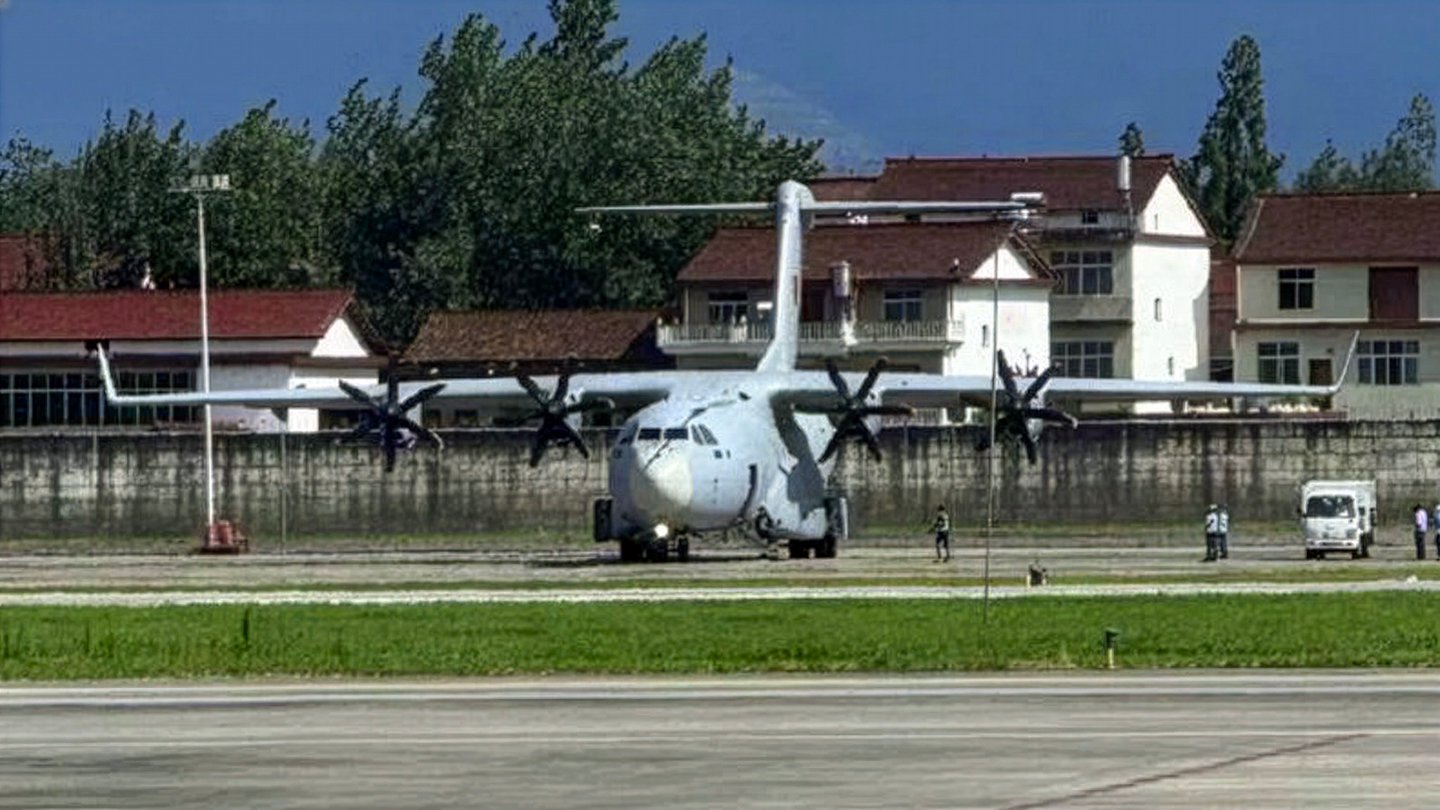
The Y-15 has four turboprop engines driving six-blade high-efficiency propellers. Its overall configuration is notably different from China’s larger, jet-powered Y-20 and instead puts it in the same broad operational category as aircraft such as the Lockheed Martin C-130J .
The configuration also has some obvious visual similarities to the Airbus A400M . The Chinese aircraft has a relatively broad fuselage, a rear loading ramp, heavy-duty landing gear, a high-mounted wing, and a T-tail.
Unlike the swept wing of the A400M, the Chinese transport has a comparatively straight high-lift wing, with substantial winglets (lacking on the European design) at the tips. The arrangement should help the aircraft combine useful cruise efficiency with the low-speed performance needed for tactical transport operations.
Despite its A400M-like appearance, the Y-15 appears to be a smaller aircraft in a different weight and performance class. The A400M’s four TP400-D6 engines each produce around 11,000 horsepower, while the Chinese aircraft’s WJ-10 turboprops are understood to produce substantially less — around 6,800 horsepower.
That suggests the Y-15 is a more natural counterpart to the C-130J and China’s own Y-9 than to the A400M.
Unconfirmed estimates have suggested a payload of around 30 metric tons, although that figure should be treated cautiously while the aircraft remains in testing. For comparison, the Y-9 is generally credited with a payload of roughly 25 tons, while the C-130J-30 is in the roughly 21-ton range. At the same time, the Y-15 is assessed to have a larger internal cargo space than the Y-9, with a greater height and width to accomodate bulkier payloads.
via Chinese internet
Interesting size comparison of all three PLAAF transports: Y-9, Y-15 & Y-20 as CG made by @大包CG pic.twitter.com/9JsykjK2Ei
— @Rupprecht_A (@RupprechtDeino) December 17, 2025
One of the most obvious features of the flight-test aircraft is the long air-data boom projecting from the nose. Such booms are standard equipment on developmental aircraft, allowing engineers to collect precise measurements of air pressure, temperature, airflow, and other parameters during testing. Previous reports have erroneously identified this feature as an inflight refueling probe.
There is currently no refueling probe fitted to the prototype. That does not necessarily mean the capability will never be incorporated, however, especially as China continues to build its aerial tanker fleet.
A YY-20A aerial tanker tops up a pair of J-16s. via Chinese internet
Chinese Y-8 and Y-9 derivatives have demonstrated how a common transport airframe can become the basis for substantially different configurations, including aircraft equipped for specialized missions . The same is likely for the Y-15, once it enters People’s Liberation Army Air Force (PLAAF) service.
For the PLAAF, the aircraft’s rear loading ramp and heavy-duty landing gear will likely be particularly important. The aircraft appears designed not simply to move cargo between major airbases, but to operate closer to the battlefield and from runways that may be shorter, rougher, or otherwise less developed.
An early rear three-quarter view of the Y-15. via Chinese internet
The PLAAF still operates substantial numbers of older Y-8-family transports, while the Y-9 has become the more modern turboprop workhorse. At the heavier end, the Y-20 is rapidly replacing remaining PLAAF Il-76 transports and provides the long-range strategic airlift capacity that the older fleet could not match.
Speaking to TWZ , Andreas Rupprecht, an expert on Chinese aviation and contributor to this website, said he expected the Y-15 to replace the Y-9, a type that the PLAAF does not consider adequate for the tactical transport role, on account of its small cargo hold and underpowered engines.
Its turboprop propulsion and apparent emphasis on short-field performance should make it particularly useful for moving troops, vehicles, supplies, and other equipment into locations where operating a large Y-20 would be impractical.
Another new underside view of the Y-15. via Chinese internet
That could include dispersed bases and remote Chinese facilities, as well as the country’s island outposts . The rapid reinforcement of units in remote regions such as Tibet would also be an obvious wartime mission. The aircraft could also provide a useful platform for airborne assault and airdrop missions, capabilities that have become increasingly important as the PLA has expanded the scope and sophistication of its joint operations.
An export drive is also highly likely, especially as the Y-15 will be immune to the tight export restrictions that typically apply to comparable Western designs. In the meantime, the Y-9 continues to win foreign orders, most recently being bought by Kazakhstan, which already operates the A400M — another signal of these two types’ very different capabilities.
Well, that's an interesting start into the day: Two mayor Y-9 news!!
First, as the Y-9E's second customer (after Namibia), the Kazakhstan AF has introduced this type. pic.twitter.com/saHqbEF3oN
— @Rupprecht_A (@RupprechtDeino) August 14, 2026
With flight testing now apparently ramping up, the next major questions will be how closely its eventual performance matches the estimates surrounding it, and how quickly China moves from a single prototype to a production fleet.
Contact the author: thomas@thewarzone.com
The post Our Best Look At China’s New Y-15 Turboprop Airlifter appeared first on TWZ .
 China's PLA used drones to deliver gold bars and cash in Taiwan invasion financial drill
TechRadar · 24min ago
China's PLA used drones to deliver gold bars and cash in Taiwan invasion financial drill
TechRadar · 24min ago
 China's Chang'e-7 moon probe launches this weekend in historic lunar mission
Space.com · 1h ago
China's Chang'e-7 moon probe launches this weekend in historic lunar mission
Space.com · 1h ago
 China and Switzerland expand free trade deal, eliminating tariffs on 99.8% of Swiss exports
Bankier.pl · 4h ago
China and Switzerland expand free trade deal, eliminating tariffs on 99.8% of Swiss exports
Bankier.pl · 4h ago
Comments
No comments yet — be the first to weigh in 👇
No comments yet. Be the first!