
Tusk proposes middle-class tax cuts funded by higher rates for top earners and large firms
Donald Tusk's government has unveiled plans to cut income tax for around 3.5 million people earning at or slightly above average salaries. The costs would be covered by raising corporate tax for large companies and income tax for top earners. The changes require parliamentary approval and are due to take effect next year, ahead of elections.
Full text
Keep our news free from ads and paywalls by making a donation to support our work!
Notes from Poland is run by a small editorial team and is published by an independent, non-profit foundation that is funded through donations from our readers. We cannot do what we do without your support.
Poland’s government has unveiled plans to reduce income tax rates for an estimated 3.5 million people earning around or slightly above average salaries. The costs of the cuts would be covered by increasing the tax rate for large companies and individuals with the highest earnings.
The changes, which Prime Minister Donald Tusk says are intended to “provide relief and assistance to the growing middle class”, would come into effect from next year – when the government is facing re-election.
However, the proposals still require approval from parliament, where Tusk’s ruling coalition, which ranges from left to centre right, has a majority, and President Karol Nawrocki, who is aligned with the right-wing opposition and has vetoed a record number of bills.
📊 Nowa skala PIT będzie lepiej dopasowana do rosnących wynagrodzeń. Do 130 tys. zł pozostaje stawka 12%, między 130 a 150 tys. zł pojawi się 24%, a 32% zacznie obowiązywać dopiero powyżej 150 tys. zł. 💰 #WięcejWPortfelu pic.twitter.com/1S2MpSkVoC
— Kancelaria Premiera (@PremierRP) August 19, 2026
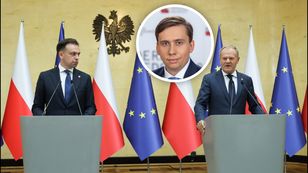
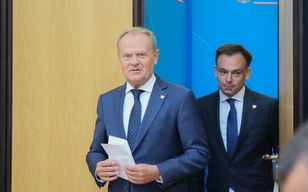
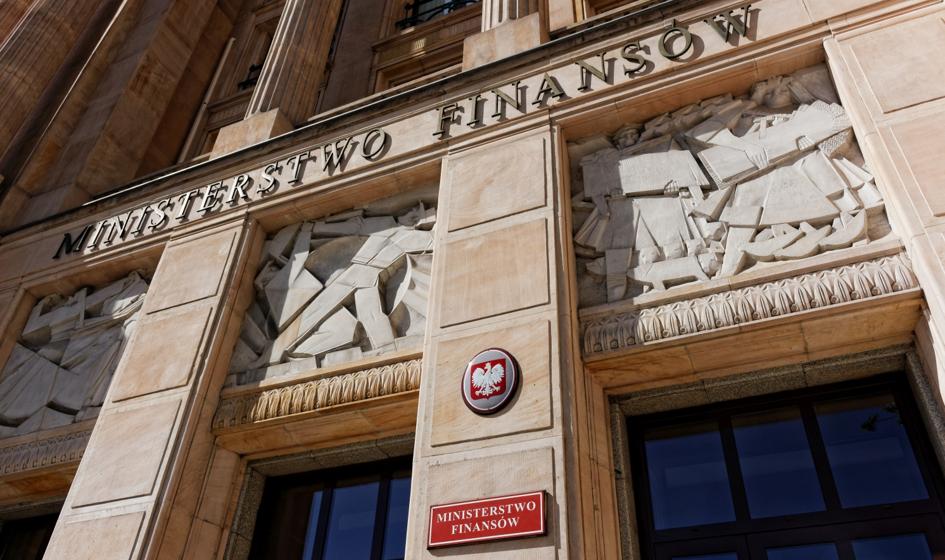
The main elements of the proposed changes, which were outlined by Tusk and finance minister Andrzej Domański on Wednesday, are an increase in the earnings threshold at which the lowest rate of income tax is paid and the introduction of a new rate between the lowest and highest earnings brackets.
Currently, there are two income tax brackets: the first taxes earnings of up to 120,000 zloty (around €27,800) at a rate of 12%; the second taxes earnings above that level at a rate of 32%.
There is also a tax-free allowance for earnings of up to 30,000 zloty. Meanwhile, anyone who earns more than 1 million zloty a year pays an additional “solidarity levy” (effectively a third tax bracket) of 4% on income above that amount.
Under the new proposals, the threshold for the first 12% tax bracket would be raised to 130,000 zloty. For earnings between 130,000 and 150,000 zloty, a new tax bracket of 24% would be introduced. Then earnings above 150,000 would be taxed at 32%.
Click here to help us continue providing news free from paywalls and ads
Tusk noted that, since his government took office, wages in Poland have increased by around 30%, bringing increasing numbers of people into the higher tax bracket.
According to figures from Statistics Poland (GUS), a state agency, in June this year, average monthly earnings at companies employing more than nine people were 9,401.58 zloty, the equivalent of almost 113,000 zloty a year.
“We’re not talking about millionaires here; we’re talking about a growing middle class…on whose shoulders the financing of state security, defence spending, etc. rests to a large extent,” said Domański.
“We want to change this…so that those who work hard to earn their average wage can clearly feel the relief,” added Tusk. “And we want this to be financed by the wealthiest companies and the wealthiest individuals, who have the lowest tax burden.”
The number of ultra-wealthy individuals in Poland has more than doubled since 2021, a faster rate of growth than anywhere else in the world, according to a new study https://t.co/MNKgmjzn2U
— Notes from Poland 🇵🇱 (@notesfrompoland) May 11, 2026
Therefore, in order to finance the middle-class tax cuts, Tusk and Domański announced that the government would seek to increase corporate income tax from 19% to 22% for firms and tax capital groups that generate annual revenues above €50 million.
Meanwhile, the solidarity levy for individuals earning over 1 million zloty a year would be increased by one percentage point, to 5%.
“I am absolutely convinced that this will make our tax system more equitable,” declared Tusk.
However, he also conceded that raising the income-tax-free amount from 30,000 to 60,000 zloty – as his Civic Platform (KO) party promised to do within its first 100 days in office – would not be possible for budgetary reasons, in particular the need to finance high defence spending .
Poland has introduced a new type of account that will allow individuals to invest up to 100,000 zloty (€23,200) tax free.
The government says the scheme is designed to encourage Poles to build savings and channel money into the domestic financial market https://t.co/1xDHHJGYKX
— Notes from Poland 🇵🇱 (@notesfrompoland) August 14, 2026
The prime minister said that the planned tax changes would be discussed further this week at a cabinet meeting devoted to next year’s state budget, which is currently being prepared.
The relevant legislation will subsequently be submitted to parliament, with the aim of bringing it into force in 2027. However, Tusk acknowledged that there is a strong possibility of a veto by Nawrocki, who has blocked dozens of government bills , including fiscal measures.
In December, Nawrocki vetoed an increase in the tax on alcoholic and sweet drinks. Last month, he effectively blocked a windfall tax on fuel companies’ excess profits by sending it to the constitutional court for review. However, he did approve a law increasing the corporate income tax rate for banks.
President @NawrockiKn has obstructed a planned windfall tax on fuel companies by sending it to the constitutional court, where it could stay for years
The tax aimed to offset fuel price protection costs after the Iran war surge https://t.co/UojVuYhvdV
— Notes from Poland 🇵🇱 (@notesfrompoland) July 27, 2026
Next year’s budget will be closely watched given that Poland’s fiscal situation has become increasingly problematic in recent years. In 2024, the European Union placed Poland under its excessive deficit procedure , requiring Warsaw to commit to measures to bring down the deficit.
However, last year the deficit actually rose , from 6.4% of GDP in 2024 to 7.3% in 2025, which was the second-highest level among all EU member states. This year, Poland’s public debt passed the EU’s limit of 60% of GDP for the first time on record.
The situation has led two of the big three rating agencies, Fitch and Moody’s, to shift Poland’s credit outlook to negative . This year, Fitch warned that the political gridlock between Nawrocki and the government was making tackling the deficit and debt more difficult.
Given that Poland will hold parliamentary elections in autumn 2027, it is unlikely that either the government or Nawrocki – who will be supporting the right-wing opposition – will be keen on any fiscal measures that either raise taxes or reduce spending in areas such as social policy and defence.
Poland’s public debt has passed 60% of GDP for the first time, thereby exceeding the limit enshrined in EU law.
The country is already under the EU's excessive deficit procedure, requiring it to take steps to bring public finances under greater control https://t.co/LNJ0YrP2Ge
— Notes from Poland 🇵🇱 (@notesfrompoland) June 12, 2026
Notes from Poland is run by a small editorial team and published by an independent, non-profit foundation that is funded through donations from our readers. We cannot do what we do without your support.
Main image credit: KPRM/Flickr (under CC BY-NC-ND 4.0 )
Similar stories
Similar stories
Is cutting middle-class income tax by raising corporate rates a fair trade-off?
Comments
No comments yet
Comments
No comments yet — be the first to weigh in 👇
No comments yet. Be the first!