Full text
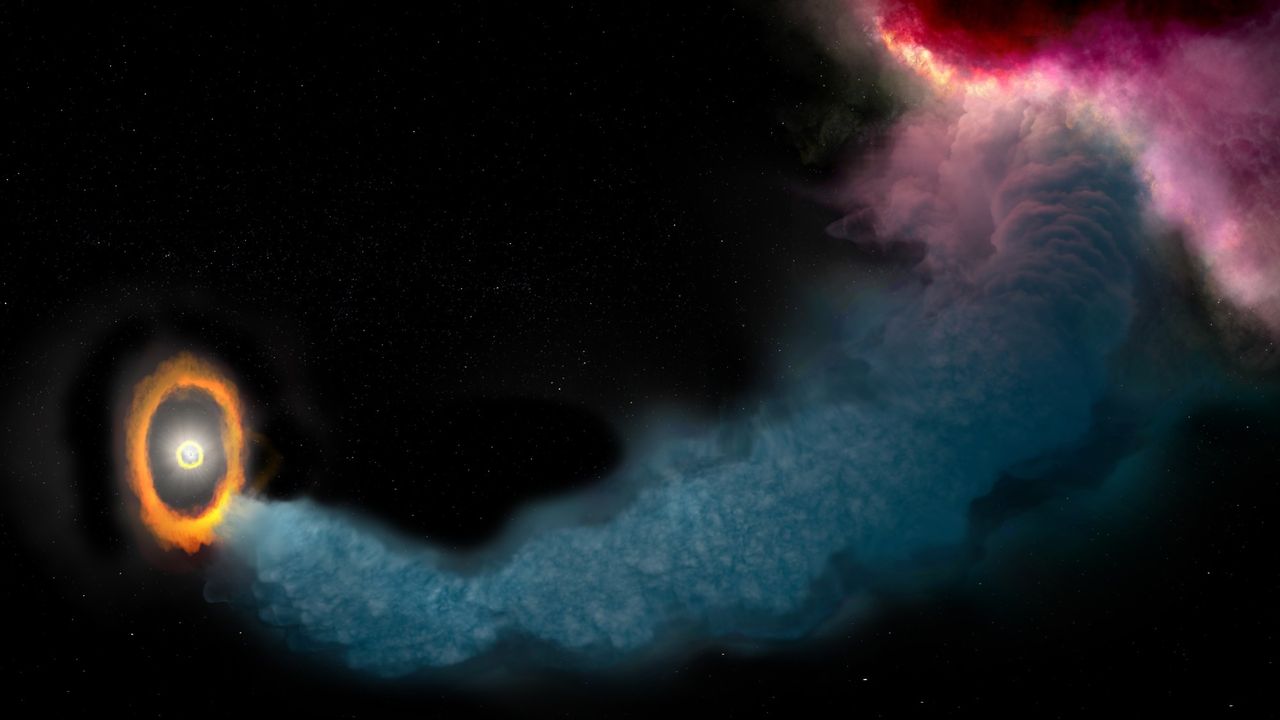
A rare planet-forming disk around a young triple-star system in the Orion constellation has been tipped over by a river of gas over 1 trillion miles (1.6 trillion kilometers) long. The discovery, made at radio wavelengths with ALMA, the Atacama Large Millimeter/submillimeter Array in Chile, could explain why astronomers keep finding planets with orbits that are drastically misaligned with the rotational axes of their stars.
GW Orionis is a triple system consisting of three pre- main sequence stars , meaning that they are still forming and contracting and have not yet initiated fusion reactions of hydrogen in their core. The stars are located roughly 1,300 light-years away, in the Lambda Orionis star-forming molecular ring in the constellation of Orion, the Hunter . Finding a planet-forming disk of gas and dust encircling all three stars in a system is very rare, and finding a disk consisting of three rings with misaligned orbits is even stranger.
"Previous studies of GW Orionis revealed that the system's inner, middle and outer rings are misaligned, with each ring tilted at a different angle," said Maria Galloway-Sprietsma, a PhD student at the University of Florida who led the research, in a statement .
The outer ring, which is one of the largest ever seen around a young star, is the most noticeably misaligned. It had previously been thought that an unseen gas giant planet , having carved out a gap between the middle and outer ring, was perturbing the outer ring.
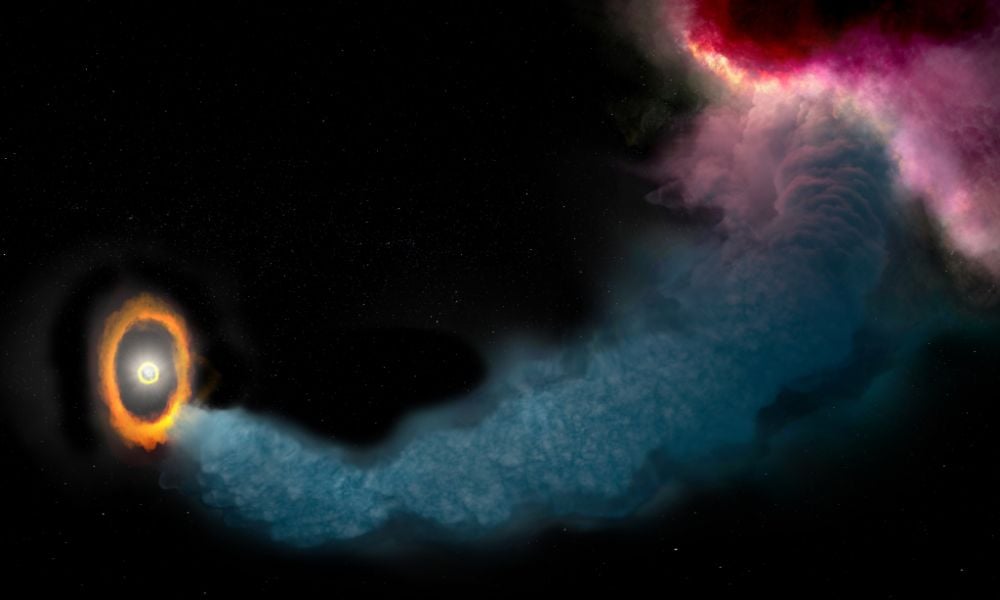
Now though, Galloway-Sprietsma and colleagues have discovered the hidden truth: an enormous finger of gas reaching in from the surrounding molecular cloud is disturbing the outer ring, and the exchange of angular momentum, or rotational energy, between the two is warping the ring and tipping it over.
The disk around GW Orionis is composed of three rings, beginning at radii of 4.1, 17.4 and 31.6 billion miles (6.7, 28 and 51 billion kilometers/44, 187 and 340 astronomical units ) from the center of the tight triple system.
The streamer of gas tilting the system's outer ring was discovered through new ALMA observations. Such streamers are thought to be how stars grow, delivering mass onto nascent suns. The streamer is composed mostly of molecular hydrogen, but since molecular hydrogen is invisible at radio wavelengths, ALMA searched for molecules of carbon monoxide in the streamer instead.
The length of the streamer is astounding, stretching 0.2 light years (12,600 astronomical units, 1.9 trillion kilometers or 1.2 trillion miles).
"When our team modeled the infall of this streamer, we found that the angle at which it impacts the disk is closely aligned with the outer ring," said Galloway-Sprietsma.
This superimposed image of of the GW Orionis star system shows images from the ALMA radio telescope (in blue) overlayed on the ESO Very Large Telescope's SPHERE instrument's view, which shows the shadow of the system's innermost ring. (Image credit: ESO/Exeter/Kraus et al., ALMA (ESO/NAOJ/NRAO)) It is believed that the streamer has already done most of the work in tipping over the outer ring of the disk. Today, its angular momentum, or spin, is less than that of the disk.
"In the past it likely had a greater angular momentum, and that allowed the disk to become misaligned," said Bae.
The discovery of the streamer might put to bed more than just the mystery of what tipped over GW Orionis' disk.
In our solar system , all the planets orbit around the sun in the ecliptic plane, which is a narrow plane aligned with the sun's equator and direction of rotation. Most exoplanets orbit their star in similar fashion, but astronomers have also previously discovered some planets that have highly inclined or even retrograde orbits around their star, as though some mighty force had tipped their orbits over. With the discovery of the GW Orionis streamer, astronomers may have found the nature of the force that creates these wonky planets.
"If these streamers are common, then we can naturally explain why planets may not necessarily end up in very orderly systems," said Bae in another statement . "They can have much more random orientations."
However, the team recognizes that such a conclusion is potentially a big leap based on discovering just one planet-forming disk being influenced in such a manner. So the plan is to find more.
"What we need next is a systematic survey of young stars to see how many have streamers and how many don't," said Galloway-Sprietsma. "That will tell us how important they are in shaping planetary systems."
The findings were published on Aug. 6 in The Astronomical Journal .
 Massive gas stream may have tilted planet-forming disk in GW Orionis triple-star system
Universe Today · 3d ago
Massive gas stream may have tilted planet-forming disk in GW Orionis triple-star system
Universe Today · 3d ago
 After a century of searching, astronomers image Betelgeuse's companion star
Universe Today · 17d ago
After a century of searching, astronomers image Betelgeuse's companion star
Universe Today · 17d ago
 ALMA telescope's millimetre waves open new frontier in SETI search
benchmark.pl · 22d ago
ALMA telescope's millimetre waves open new frontier in SETI search
benchmark.pl · 22d ago
Comments
No comments yet — be the first to weigh in 👇
No comments yet. Be the first!