Full text
Blue Origin plans to return its Florida launch site to a dual-pad facility to support its bigger, more powerful New Glenn "9x4" rocket, which is still under development.
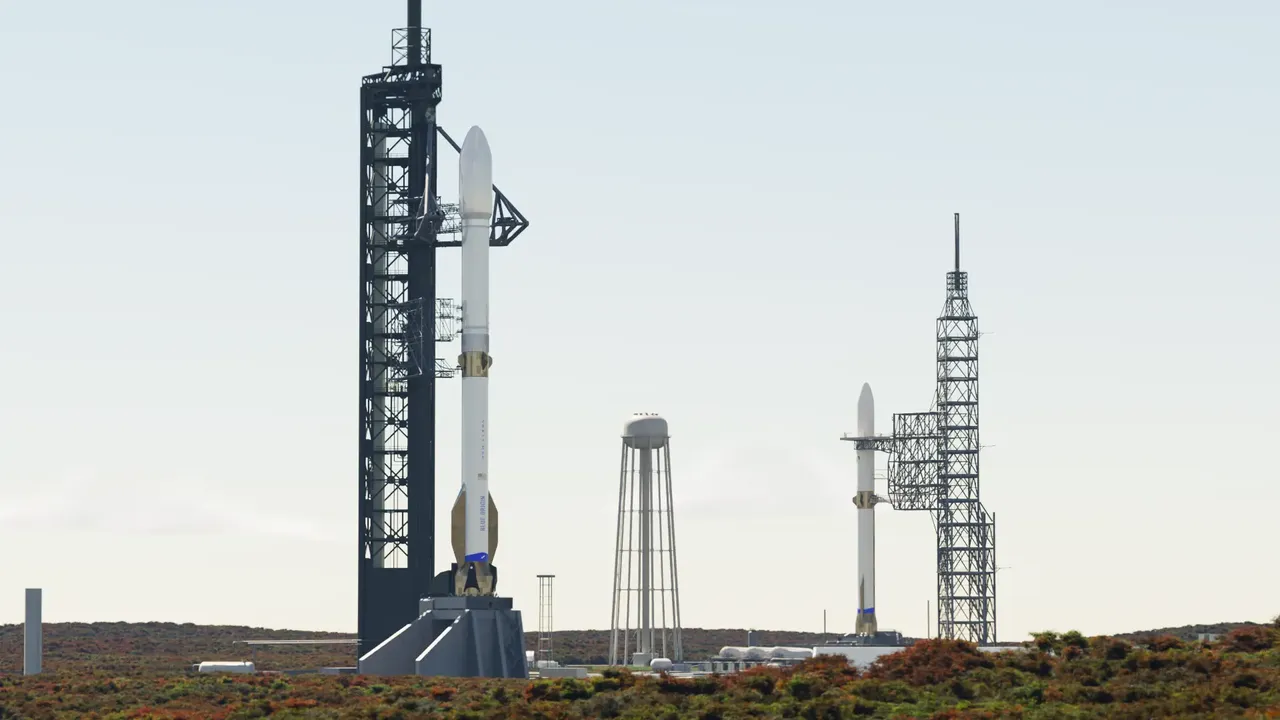
As facility repairs continue following the explosion of one of Blue Origin's New Glenn "7x2" rockets during tests at Cape Canaveral Space Force Station's Launch Complex-36 in May, the company has announced its intent to expand the site with an additional pad. The company also plans to build operations infrastructure for the complex on land nearby, which will include a Vertical Integration Facility (VIF) for the New Glenn 9x4 vehicle, and a Payload Processing Facility (PPF).
Blue Origin has expressed confidence in its ability to complete repairs at its existing LC-36 pad (LC-36A) in time for New Glenn 7x2 to return to launch by the end of the year, but the company did not state a timeline for the readiness of LC-36B or an expected debut of New Glenn 9x4.
The 7x2 and 9x4 designations are a denotation of the rockets' engine configurations. It's similar to SpaceX's name for the Falcon 9 rocket, which is powered by nine Merlin 1D engines on its first stage, arranged in a circle of eight around a single engine in the center. New Glenn's first stage is powered by Blue Origin's BE-4 engines, and the rocket's second stage uses BE-3Us.
Both New Glenn first-stage configurations are designed for landing and reusability. The 7x2 flies with seven BE-4 engines on its first stage and two BE-3Us on its second stage. Subsequently, the taller, yet-to-debut New Glenn 9x4 will be powered by nine BE-4 engines on its first stage and four BE-3Us on its second stage. It will therefore be capable of launching larger, heavier payloads into space.
For roughly four decades beginning in the 1960s, LC-36 was home to two pads that supported the Atlas-Centaur family and, later, the Atlas I, II and III rockets. In that time, the pads hosted launches of NASA's Surveyor , Mariner and Pioneer probes, as well as commercial and national-security payloads. But that era ended in the mid-aughts as those Atlas rockets reached retirement. LC-36A hosted its final launch in 2004, LC-36B launched its last rocket in 2005, and the complex was decommissioned and demolished.
A render of the Vertical Integration Facility with Launch Complexes 36A & 36B in the distance. (Image credit: Blue Origin) Blue Origin took over the lease for LC-36 in 2015, began construction of its own launch facility in 2016, and launched the first New Glenn 7x2 rocket from the facility in 2025. Since that debut, New Glenn has flown two more missions, with the most recent lifting off in April. The company had planned for as many as eight to 12 launches in 2026, but May's static test fire explosion has reduced that number to a hopeful one (1).
The fourth New Glenn rocket (NG-4) was slated to deliver a stack of Amazon Leo wireless internet satellites to orbit before its destruction during testing on May 8, which also resulted in extensive damage to LC-36 facilities. Less than a month later, Blue Origin CEO Dave Limp provided a repair update with the assurance that New Glenn would fly again before the end of 2026 . He also outlined some early upgrades that would be integrated into LC-36 as a result of the unexpected repairs , including the replacement of New Glenn's transporter erector with "an alternative vertical conop (operational concept)," for transporting the rocket to the pad.
Proud to honor the legacy of Launch Complex 36. Rebuilding LC-36A and flying again this year remains our priority. Alongside that work, a separate team is beginning work on LC-36B, the operational home for New Glenn's 9x4. We're sourcing 2,500 tons of steel columns that will be… https://t.co/7MkYajmGLz August 12, 2026
"LC-36 has served as a cornerstone of American spaceflight for decades, supporting a broad range of missions for NASA and commercial partners," Blue Origin said in a statement . "Now, this historic site is entering a new era, furthering New Glenn operations."
According to Limp, the additional pad will require as much as 2,500 tons of steel, much of which will go toward building a700-foot-tall (213 meters) launch tower.
"Proud to honor the legacy of Launch Complex 36. Rebuilding LC-36A and flying again this year remains our priority. Alongside that work, a separate team is beginning work on LC-36B, the operational home for New Glenn's 9x4," Limp said in an Aug. 12 social media post .

Comments
No comments yet — be the first to weigh in 👇
No comments yet. Be the first!