Full text
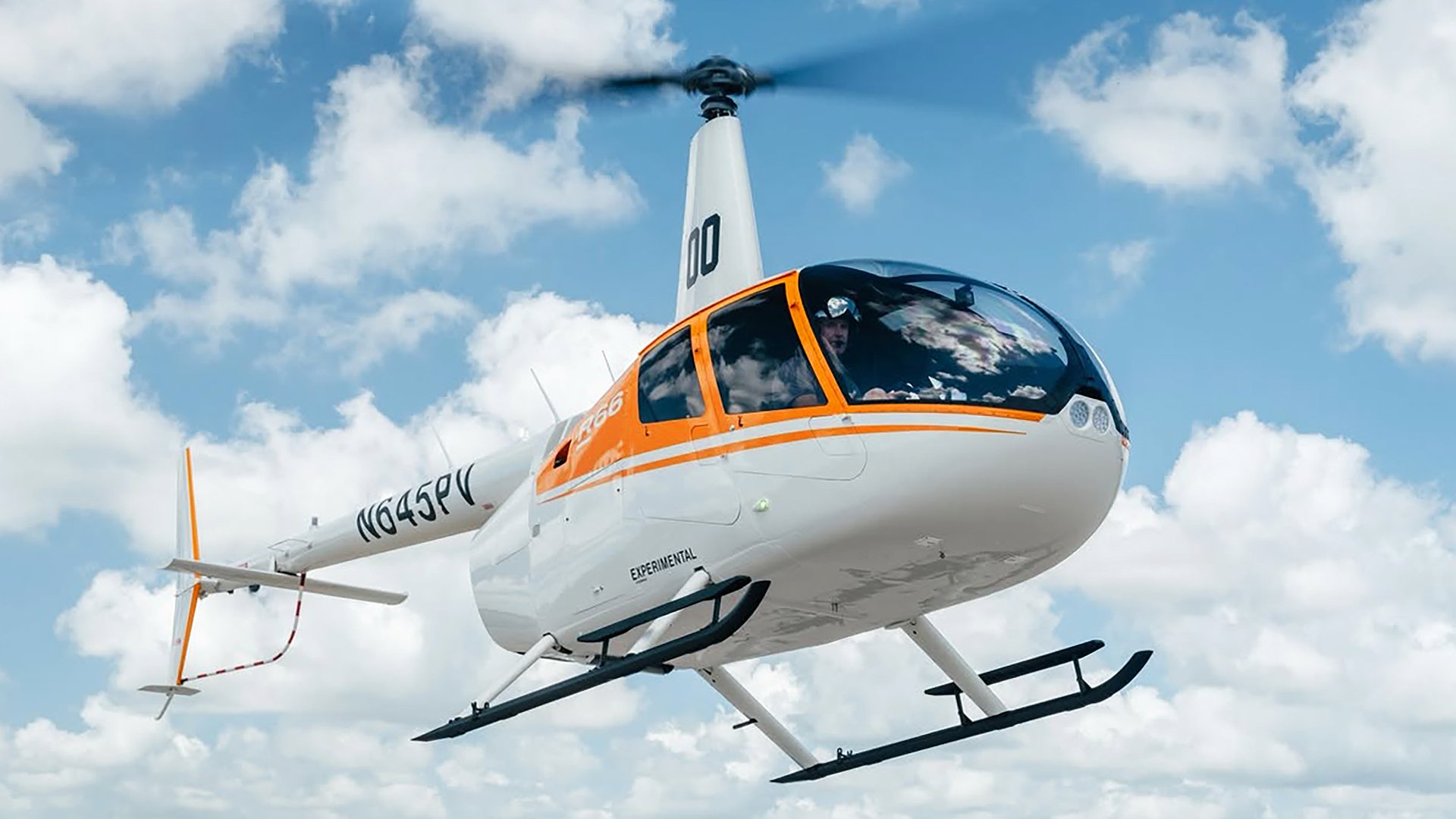
The U.S. Army will be getting the Robinson R66 Turbine as the primary trainer for its new Flight School Next program, putting the light helicopter at the center of a sweeping overhaul of how the service trains its entry-level rotary-wing pilots.
The Army on August 13 awarded M1 Support Services a potentially $10-billion contract to run the new training enterprise at Fort Rucker, Alabama. An aviation training services specialist based in Texas, M1 will provide the aircraft, maintenance, simulators, flight and academic instruction, and other support under a contractor-owned, contractor-operated (COCO) model.
Flight School Next is planned to train between 800 and 1,500 Army helicopter pilots each year. The Army currently produces about 1,250 new aviators annually through its Initial Entry Rotary-Wing Flight Training program.
The contract has a potential 26-year duration, although the first task order is expected to cover three to four years as M1 transitions the training operation to the new system.
After narrowing down the initial selection of six helicopter manufacturers and contractors , M1’s R66-based solution defeated a rival bid from Bell , which offered its Model 505 for the program.
The R66, a single-turbine engine design, is best known as a five-seat light rotorcraft on the commercial market. The aircraft is currently in widespread civilian service as a trainer, passenger, and utility helicopter. Powered by a Rolls-Royce RR300 turboshaft and closely related in layout and handling to Robinson’s ubiquitous piston-powered R44, the relatively simple design, low operating costs, and commercial availability of the R66 make it well suited to high-volume basic flight training. The aircraft’s Garmin avionics provide a modern digital cockpit, improving situational awareness while familiarizing students with the kinds of systems they will encounter on more advanced aircraft.
Robinson R44. Robinson Helicopter Facebook
The R66 already has something of a foothold with the U.S. military, with the TH-66 Sage having been used to train U.S. Army and Navy helicopter operators under contract, as part of a test program by Helicopter Institute. This saw the TH-66 train military aviators according to the Civilian FAA Part 141 curriculum, providing students with private pilot, rotorcraft helicopter, and instrument helicopter certifications before they advance to formal military helicopter training.
Under the Flight School Next program, the R66 will be a significant departure from the current Army training fleet, which relies on the Airbus Helicopters UH-72A Lakota , a twin-engine design that can accommodate up to nine troops as well as two crew.
While the Lakota is considered an advanced and reliable airframe, Army officials have acknowledged that its extensive automation and sophisticated avionics can become a crutch for inexperienced pilots. Instructors argue that new aviators should first develop a strong command of the fundamentals by learning to fly aircraft with simpler controls.
The Army ultimately sought to overhaul its aviator training approach and return to those fundamentals in an effort to reduce future accidents, particularly as helicopter mishaps have drawn increased scrutiny from lawmakers. Maj. Gen. Clair Gill , the program acquisition executive of Maneuver Air, told Breaking Defense last fall that the service was therefore looking for a “very simple aircraft.”
Warrant Officer Caleb Franklin, an Initial Entry Rotary-Wing (IERW) student, and his instructor fly approaches at a Fort Novosel stagefield during the primary phase of UH-72 Lakota helicopter training on November 30, 2023. U.S. Army photo by 2nd Lt. Hannah Lamb 2nd Lt. Hannah Lamb
The original solicitation for the Flight School Next requirement also called for a single-engine rotary-wing aircraft, which fits with the Army’s broader interest in getting students back to fundamental helicopter-flying skills before introducing them to increasingly automated and complex military aircraft.
The service says the new program will use a streamlined commercial fleet and modern simulators while consolidating several existing training contracts into a single operation.
M1 will own and operate the new training aircraft and provide the instructors and maintenance needed to run the school. The Army will retain control of training standards, safety requirements and overall outcomes.
Robinson R66 Turbine in U.S. Army configuration. Robinson Helicopter Facebook EVAN_ZAVITZ
“Flight School Next delivers a critical improvement in our Initial Entry Rotary-Wing Training model,” said Maj. Gen. Clair A. Gill, commander of the U.S. Army Aviation Center of Excellence. “Simply put, it delivers new military helicopter pilots with far better foundational skills.”
The new syllabus is intended to produce pilots proficient in basic aircraft handling, visual and instrument flight, terrain flight, navigation and tactical mission planning.
The Army also expects the new arrangement to reduce long-term training costs.
“This is a major step forward in modernizing how we train our aviation force,” explained Assistant Secretary of the Army for Acquisition, Logistics and Technology Brent G. Ingraham. “Flight School Next delivers the next generation of training capabilities our aviators need to succeed in increasingly complex operational environments.”
Here seen flying in a UH-72A, Hon. Brent G. Ingraham, Assistant Secretary of the Army for Acquisition, Logistics and Technology, visited the Aviation Center of Excellence to witness the ongoing efforts driving the future of Army Aviation at Fort Rucker, Alabama, earlier this year. U.S. Army photo by Kelly Morris Kelly Morris
As for the R66, in addition to the TH-66 Sage, the uncrewed Turbinetruck variant was awarded a U.S. Marine Corps contract earlier this year. The Turbinetruck is one of at least two new autonomous cargo helicopters that will be tested as that service looks to field new platforms that can rapidly resupply Marines in contested environments. The Turbinetruck inserts Sikorsky’s MATRIX autonomy system in the R66 airframe and could provide a route to further increasing the design’s footprint with the U.S. military.
The R66 Turbinetruck that combines the Robinson R66 airframe with Sikorsky’s MATRIX autonomy system. Robinson Unmanned
The Army says its Flight School Next program is intended to provide a sustainable training system through 2030 and beyond, combining commercial aircraft and training expertise with Army oversight of the standards required of its aviators.
The service is betting that a smaller, commercially derived helicopter can produce better pilots before they ever reach a frontline airframe. If the model works as advertised, Flight School Next could reshape not just what Army aviators train on, but how they are trained from day one.
Contact the author: thomas@thewarzone.com
The post Army To Use Robinson R66 For Its New Helicopter Pilot Training Concept appeared first on TWZ .
 U.S. Army seeks affordable 1,000-km strike missile to hit high-value targets
The War Zone · 6h ago
U.S. Army seeks affordable 1,000-km strike missile to hit high-value targets
The War Zone · 6h ago
 Ukrainian drone pilots exposed US armoured brigade's weaknesses at Bavaria exercises
Onet Wiadomości · 13h ago
US military lost to Ukrainian drones in joint exercise, Pentagon struggling to adapt
The Independent World · 1d ago
Ukrainian drone pilots exposed US armoured brigade's weaknesses at Bavaria exercises
Onet Wiadomości · 13h ago
US military lost to Ukrainian drones in joint exercise, Pentagon struggling to adapt
The Independent World · 1d ago
Comments
No comments yet — be the first to weigh in 👇
No comments yet. Be the first!