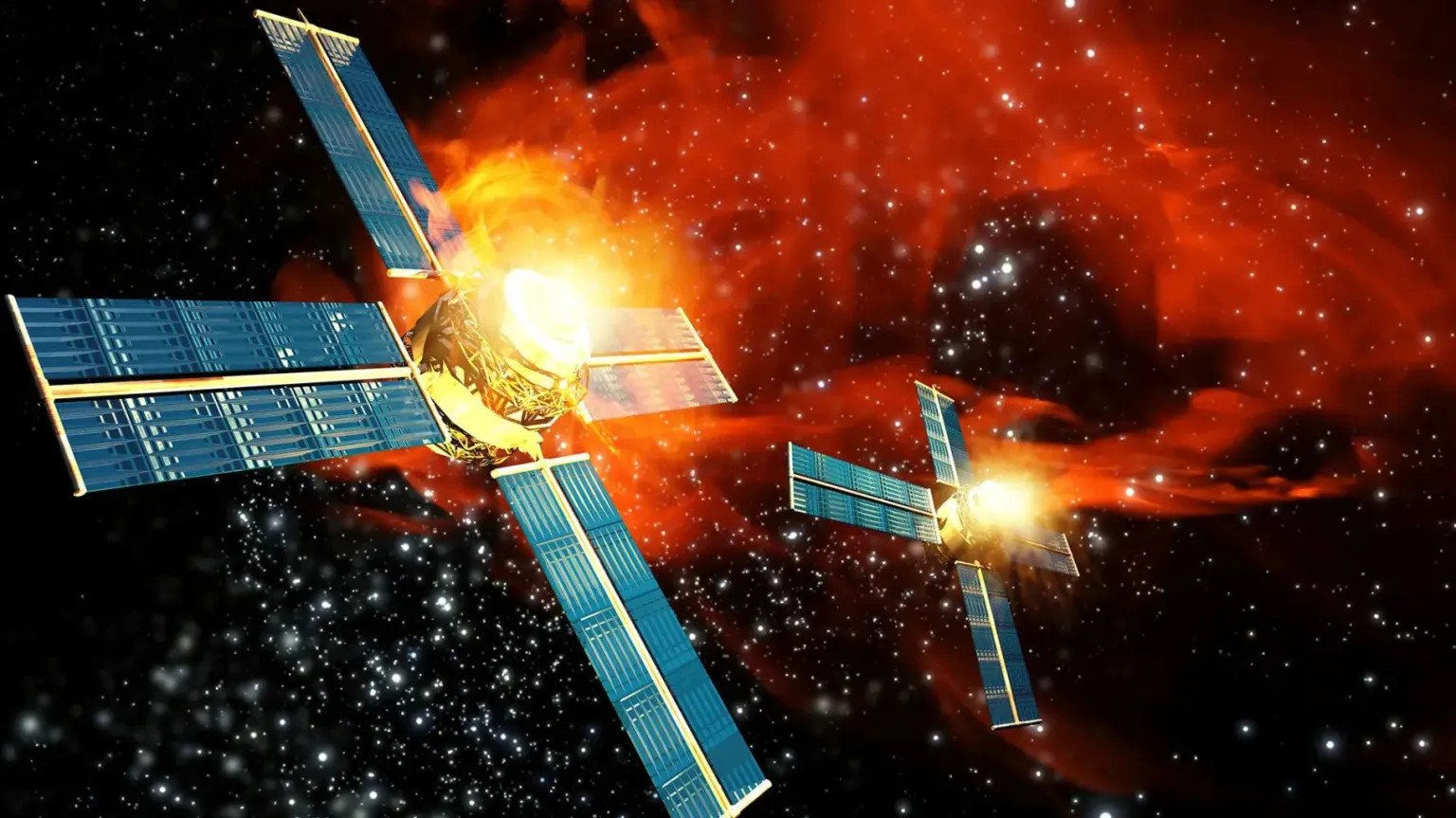
U.S. Space Command makes anti-satellite offensive weapons an official top priority
U.S. Space Command chief Gen. Stephen Whiting explicitly called for new "integrated space fires" capabilities — including both kinetic and non-kinetic options — during the Space & Missile Defense Symposium in Huntsville, Alabama. He said a "credible, acknowledged" ability to damage or destroy enemy space assets is essential to deterrence. China's rapid build-up of orbital intelligence and anti-satellite weapons is the central driver behind the push.
Full text
The head of U.S. Space Command (SPACECOM) says having a “credible, acknowledged” means of damaging or even destroying enemy assets in space is vital to deterring opponents and surviving if a major fight in orbit does break out. American officials have already been steadily more open about their desire for new offensive “orbital warfare” capabilities . China’s breakneck expansion of its intelligence-gathering and other capabilities in orbit, as well as its arsenal of anti-satellite weapons, has been a central factor behind this push .
U.S. Space Force Gen. Stephen Whiting made an explicit call for new “integrated space fires” capabilities, including both non-kinetic and kinetic options in orbit and/or within the atmosphere, during a talk yesterday at the annual Space & Missile Defense (SMD) Symposium in Huntsville, Alabama, at which TWZ is in attendance. SPACECOM is the main joint service command in charge of all U.S. military activities in space.
U.S. Space Force Gen. Stephen Whiting, head of US Space Command, seen speaking at the separate 2026 DoDIIS Worldwide Conference on August 10, 2026. DIA
“From the broadest perspective, maybe the most critical characteristic of the responsive and adaptive national security space architecture called for in the President’s Ensuring American Space Superiority executive order is that survivability matters at least as much as performance,” Whiting said. “In space, there is no safe harbor. You can’t dig a trench or build a shield. Our satellites are consistently or predictably in an opponent’s weapons engagement zone. And we can build the most high-performing, exquisite satellites in human history, but if they depend on fragile, targetable supporting infrastructure, their performance will drop to zero on the first day of the next war.”
“Space survivability isn’t just good to have or nice to have. It is need to have. Now let’s get specific. I’ve explained how durable we need our kit to be, but now I want to tell you about our FY29-to-33 [Fiscal Years 2029 to 2033] integrated priorities list,” the SPACECOM boss continued. “We’ve looked at risks and potential gaps and determined these are the top five capabilities we need to meet our Title 10 and Unified Command Plan responsibilities. This isn’t just a wish list. It’s a clear demand signal to several audiences, describing the warfighting capabilities we need to meet our mission.”
“Number one and two are integrated space fires and counter-pLEO that enable us to establish space superiority,” he said. pLEO, also sometimes written P-LEO, stands for proliferated low Earth orbit, and refers to distributed constellations of hundreds or potentially thousands of satellites in that orbital region. The U.S. military itself is investing heavily in this arena to develop and field new space-based capabilities that are more resilient to attack .
DARPA
The other three lines of effort Gen. Whiting outlined during his talk had to do with improved command and control, better situational awareness in space, and increased ability to maneuver assets in orbit.
“We’re a combatant command, and we fight to win wars,” Whiting declared. “To win, we need credible, acknowledged, kinetic, and non-kinetic fires. They are a key component of how we establish space superiority and restore credible deterrence.”
“Our space assets need to shoot, move, and communicate just like the rest of the joint force, so that our space assets can enable the joint force to shoot, move, and communicate,” the head of SPACECOM also said. “In short, space needs to fight like the joint force to empower the joint forces’ ability to fight and undermine our adversaries’ ability to do so.”
Whiting did not elaborate on what these future integrated fires and counter-pLEO capabilities might look like. An accompanying briefing slide did include a graphic depicting a kinetic attack on a satellite originating from within the Earth’s atmosphere utilizing what might be a laser-directed energy weapon.
A close-up look at the “integrated space fires” graphic, at left, and the full briefing slide from Gen. Whiting’s talk, at right. National Defense Industry Association
The threats that directed energy weapons, as well as cyber attacks, pose to friendly satellites, even ones in distributed constellations, had come up at a separate panel discussion at the SMD Symposium on Tuesday.
“If you have 10,000 satellites that are providing you with service, surely you’re not going to try and attack with a direct ascent ASAT [anti-satellite interceptors fired from within the Earth’s atmosphere] 10,000 satellites,” U.S. Army Lt. Gen. Rick Zellmann, Deputy Commander of SPACECOM, said during the panel. “I encourage our adversaries to try and shoot down 10,000 satellites that way. I don’t think they will. And, so, just like we do, our targeting folks will try to find the various nodes where you can get a one-to-many solution.”
“Those, I think, one-to-many solutions for proliferated constellations are twofold. One is cyber,” he continued. “I think the other is directed energy, because that doesn’t cost too much for a shot, right? So those two technologies are the ones I’d be concerned about.”
“Non-kinetic effects of directed energy, mounted on all types of platforms, from the surface all the way to space and everywhere in between,” could also be “opportunities,” Brig. Gen. Drew Morgan, the deputy head of the Army’s Space and Missile Defense Command (SMDC), another one of the panelists, also said later on. In a space context, non-kinetic directed energy ‘effect’ could include what is known as ‘dazzling’ using lasers to blind optics on satellites without causing permanent damage. In the past, U.S. officials have said that friendly assets in orbit are routinely subjected to various kinds of non-destructive attacks .
At present, a family of ground-based electronic warfare systems called the Counter Communications System (CCS) is the U.S. military’s only publicly acknowledged offensive counter-space capability. In June, the U.S. Space Force announced it had “operationally accepted” the latest version of the system, called Block 10.3, and also known by the codename Meadowlands.
Trailer-mounted antennas associated with the Counter Communications System (CCS). USSF
There have been hints for years that the U.S. military might have other operational anti-satellite capabilities in the classified realm, or at least have been actively experimenting with them. In 2019, then-Secretary of the Air Force Heather Wilson notably suggested a public live-fire demonstration of some kind could be necessary to deter potential opponents, such as Russia and China, from attacking American space-based assets.
It’s also worth noting that President Joe Biden’s administration announced a self-imposed moratorium on destructive direct ascent ASAT weapons testing in 2022, but it is unclear whether that is still in force. As TWZ pointed out at the time , this did not rule out the possibility that the U.S. military could use other testing means to help develop those capabilities. Space-based anti-missile interceptors are now a key component of President Donald Trump’s Golden Dome missile defense initiative .
“Protective measures on satellites is just like thinking about protective measures on aircraft, okay? And we’re working through that,” Lt. Gen. Gregory Gagnon, head of the Space Force’s Combat Forces Command (CFC), told TWZ and others more recently at a roundtable at the Air & Space Forces Association’s (AFA) Warfare Symposium in February. “I won’t provide specifics, because I want those protective measures to work, right? I don’t want to tell Beijing and Moscow what I’ve done.”
“But protecting and defending satellites can’t simply be done by protect and defend. You can’t run away from a bully forever. Sometimes you got to turn around and punch,” Gagnon continued. “So protect and defend, although necessary, is insufficient to deliver space control. We also need, as part of our joint force, the ability to attack.”
The first official painting commissioned by the Space Force, seen here, explicitly depicts a duel between a reusable spaceplane and a hostile ‘killer satellite.’ USSF
At that time, Gagnon also stressed that challenging China’s still-growing array of space-based capabilities was another key driver behind this desire for new offensive counter-space capabilities.
What “[China’s] President Xi [Jinping] has decided to do is build the second-best remote sensing architecture in the world from outer space, and that’s now what they have,” Gagnon also said at that time. “So when 2013 started, and he came to power, he had less than 100 satellites that were the total of what China had in outer space. They have about 1,900 today. Over 500 of those satellites are remote sensing satellites, which are purposely designed and networked to track mobile forces such as U.S. carriers, destroyers, and cruisers in the Pacific, as well as aircraft that deploy around the Pacific. Those have been built with a purpose. The purpose is to cue their long-range fire weapons.”
Gen. Whiting also said China, and its anti-satellite capabilities in particular, remained the greatest challenge facing the U.S. military in the space domain during his talk at the SMD Symposium yesterday.
“Number one is the development of counter-space weapons that I highlighted in my remarks. These are not future possibilities,” the head of SPACECOM said. “Some of you have played the war games over the years where we have to give the ‘red force’ [the side playing the mock adversary] additional capability, maybe project five years forward and give them what we think they’ll have. And, no, the capabilities we talked about are real, they exist today, and we have to face them.”
“These include direct ascent ASAT missiles , ground-based lasers, jammers , and maneuverable co-orbital ASATs, and dual-use satellites like the SJ-21 , which can target the satellites we rely upon for missile warning and defense missions,” the SPACECOM boss had said in his open remarks. “They are, in no uncertain terms, expanding military options for sustained offensive operations against the satellites we rely on to defend the homeland and project power. These developments intend to degrade our current space superiority, and would potentially give China a maneuver and logistics advantage in space, something we would never accept on the land, at sea, or in the air.”
The SJ-21 satellite mentioned here has been a particularly hot topic of discussion since it was launched in 2021. It has a grappling arm with a demonstrated ability to tow other satellites in space. This is ostensibly intended to be used for non-military applications, such as on-orbit servicing and moving debris, but has obvious potential to be weaponized.
In general, so-called inspector-type satellites capable of rendezvousing and maneuvering closer to other objects in space have an inherent ability to be used to launch attacks, destructive and otherwise, using a variety of different means, as well as gather intelligence. This includes kinetic attacks where the inspector could be used as an interceptor and simply smashed into the target. U.S. military officials have been warning about the dual-use potential of inspector satellites for years now, especially in the context of examples that Russia has put into orbit .
A U.S. Defense Intelligence Agency graphic highlighting some of the ways on-orbit attack can be carried out, including via robotic arms. DIA
This all speaks further to counter-space capabilities U.S. forces could themselves bring to bear in the future. Last month, Northrop Grumman in the United States notably launched the first of what it hopes will be a constellation of new Mission Robotic Vehicle (MRV) satellites capable of performing on-orbit refueling and other servicing missions for commercial and military customers. The U.S. Defense Advanced Research Projects Agency (DARPA) and the U.S. Naval Research Laboratory (NRL) played key roles in the development of a payload equipped with a pair of robotic arms for the MRV. Questions about whether the MRVs with their arms could also have an offensive counter-space role have already been raised, as you can read more about here .
American officials also regularly point to Chinese and Russian anti-satellite developments, as well as those by other countries , in pushing back on concerns about the steady weaponization of space. As an aside here, two years ago, the U.S. government very publicly accused its counterparts in Russia of pursuing a new nuclear-armed space-based anti-satellite weapon .
“Depends on where you sit, right, you know? But to say that it’s the responsibility for the U.S. government to protect its citizens from emerging threats makes perfect sense to me,” outgoing Chief of Space Operations Gen. Chance Saltzman said last year. “And we clearly see a country like the PRC [People’s Republic of China] investing heavily in these kinds of threats, whether it’s hypersonic [weapons] , whether it’s threats from space . And so now it’s time for the U.S. government to step up to the responsibilities to protect American citizens from those threats.”
Saltzman was speaking at the time in the context of a discussion about Golden Dome’s space-based interceptors during an interview broadcast online as part of Defense One ‘s State of Defense 2025: Air Force and Space Force virtual conference.
How much will ultimately be acknowledged about the U.S. military’s future planned “integrated space fires” capabilities, as well as exactly what might be in its anti-satellite arsenal already, remains to be seen. Regardless, Gen. Whiting’s comments this week have now at least made the active pursuit of new counter-space weapons a matter of public record.
Contact the author: joe@twz.com
The post New Anti-Satellite Weapons Now Officially A Top U.S. Priority appeared first on TWZ .
Similar stories
 🌍 World
China-Indonesia joint naval drills east of Taiwan anger Taipei
Al Jazeera · 1h ago
🌍 World
China-Indonesia joint naval drills east of Taiwan anger Taipei
Al Jazeera · 1h ago
 🪖 Military
Shadow fleet tanker escorted by icebreaker to China suffers serious damage
RMF24 · 1h ago
🪖 Military
Shadow fleet tanker escorted by icebreaker to China suffers serious damage
RMF24 · 1h ago
 🌍 World
Chinese state-linked body tried to install satellite-tracking spy equipment in New Zealand
Onet Wiadomości · 2h ago
🌍 World
Chinese state-linked body tried to install satellite-tracking spy equipment in New Zealand
Onet Wiadomości · 2h ago
Similar stories
🌍 World
China-Indonesia joint naval drills east of Taiwan anger Taipei
Al Jazeera · 1h ago
🪖 Military
Shadow fleet tanker escorted by icebreaker to China suffers serious damage
RMF24 · 1h ago
🌍 World
Chinese state-linked body tried to install satellite-tracking spy equipment in New Zealand
Onet Wiadomości · 2h ago
Should the U.S. officially develop kinetic anti-satellite weapons?
Comments
No comments yet
Comments
No comments yet — be the first to weigh in 👇
No comments yet. Be the first!