Full text
KYIV — Ukrainian defense tech company Fire Point’s first ballistic missile will be ready this fall, its CEO told POLITICO — a crucial development if Kyiv hopes to survive the growing ferocity of Russian missile attacks.
Iryna Terekh, who is also Fire Point’s chief technology officer, said it is working on its tactical short-range FP-7 ballistic missile . With a 200-kilometer range and carrying a 150-kilogram warhead, the missile can hit ground targets and is also being reworked to be used in air defense systems.
“Our FP-7 is already in a certification process. That requires a certain number of battle-testing launches performed under a special procedure,” Terekh said this week. “We’re going to do those launches, prove its effectiveness in real combat against our enemy, and after that it will be ready for contracting.”
She added that if all goes well, “it is completely realistic to get it ready by this fall.”
Fire Point is also developing the FP-9 ballistic missile , carrying an 800-kilogram warhead with a range of up to 855 kilometers, putting Moscow well within range.
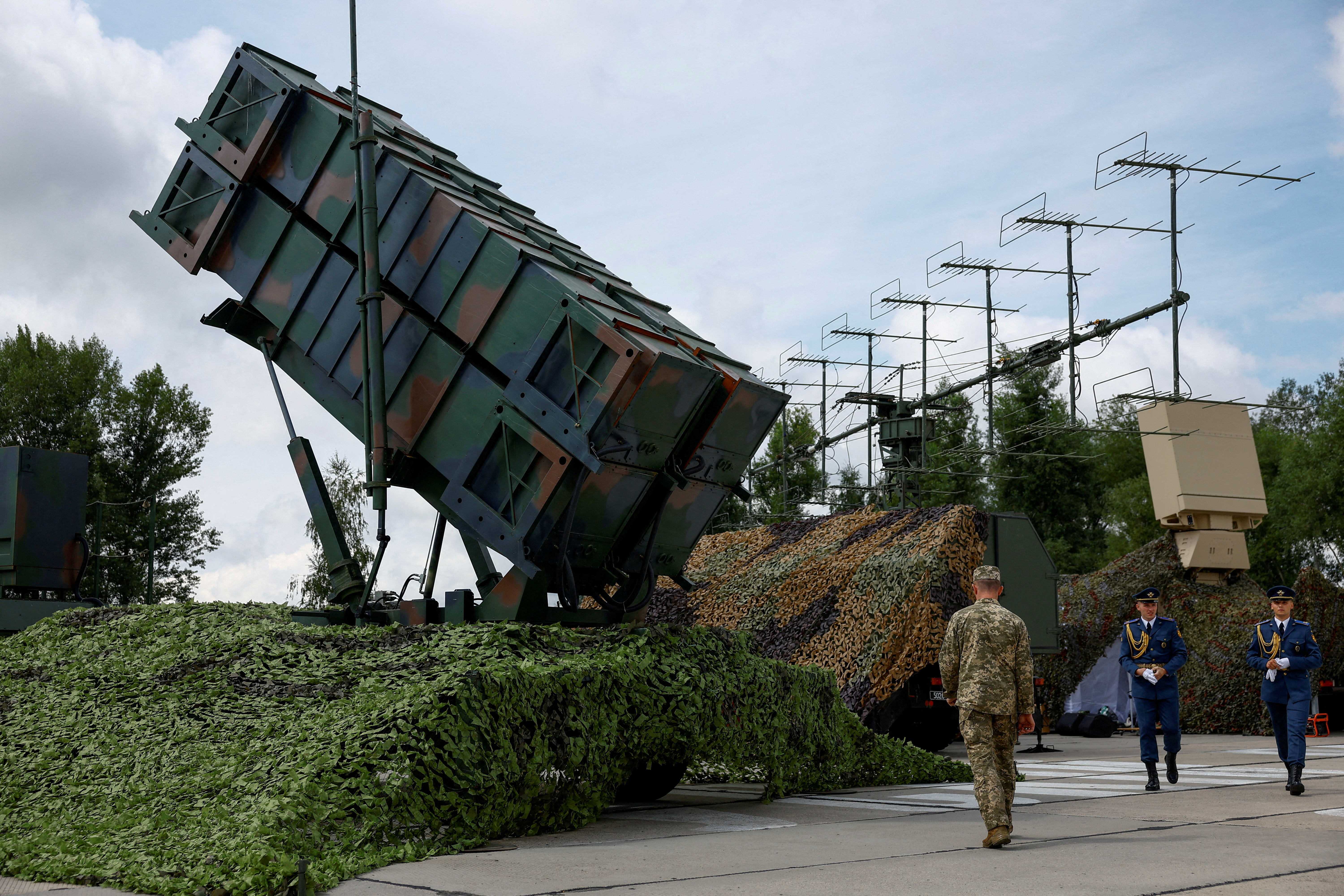
Both programs are crucial to Ukraine. Kyiv faces a growing shortage of Patriot interceptors, and the Pentagon is now scrambling to rebuild its own supplies. Ukraine also wants its own long-range missiles to hit targets deep inside Russia, especially ballistic missile launchers.
The lack of interceptors is allowing large numbers of Russian missiles to hit their targets, and Moscow’s attack capabilities are now being boosted by its North Korean allies .
Fire Point’s timeline was backed up by Ukrainian President Volodymyr Zelenskyy last week, although he said deploying the FP-7 will require significant international cooperation. “As for mass application, I cannot say, because there are things that do not depend on Ukraine… there are some elements from other countries.”
The FP-7 is a key part of Europe’s first common anti-ballistic system, called Freyja . Fire Point will provide the missiles and launchers, while Ukraine’s allies will work on components and surveillance and tracking radars.
“I can’t share the details because it’s a matter for the partners whether they want to talk about it. But everything is going quite quickly. All the partners work in the rhythm of Ukrainian defense companies,” said Terekh.
She also underlined the complexity of shifting from a simple ground-to-ground missile to adapting the FP-7 to missile defense systems.
“Their aerodynamic form and production principles are similar, but their functions are different. One has to fly from point A to B and hit the target; another one has a more sophisticated assignment to find and intercept the target,” she said.
A Patriot PAC-3 interceptor is pictured in Tokyo in August 2017. | Kazuhiro Nogi/AFP via Getty Images
The future Freyja interceptor will be produced in two iterations. The first will be similar to the PAC-2s used by Patriots, which explode next to their targets; the other has the more complex task of finding and intercepting a missile, something done by Patriot’s PAC-3 interceptors.
“It is way faster to produce a PAC-2-like missile,” said Terekh, adding: “We don’t have the luxury of spending decades to invent our own hit-to-kill [interceptors], so we decided to go in iterations … and in the future, we will learn how to make our own hit-to-kill similar to the PAC-3.”
Building Ukraine’s own missiles
While working to develop its own capabilities, Ukraine is also pushing to get a licensing agreement from the U.S. to make its own PAC-3s. U.S. President Donald Trump told Zelenskyy last month that such a deal would be possible, but he has since walked that back and is now pressing for the Pentagon to rebuild its own stocks after reports that the U.S. burned through huge numbers of missiles in the first days of the war against Iran.
Terekh stressed that even if the will was there, getting a Patriot PAC-3 production deal still involves “bottlenecks” in component production. She would prefer a separate agreement allowing Ukraine to produce homing heads — the autonomous guidance system housed in the nose of a missile that directs it to its target — calling it the “critical and most hard-to-produce component.”
Terekh also said that the long-range FP-9 will be ready this fall “if no one interferes with our work.” That would make Ukraine one of only about a dozen countries with such a capability.
Ukraine largely relies on long-range drones — including Fire Point’s FP-1, with a range of up to 2,300 kilometers, and the FP-2, with a 700-kilometer range — to conduct its ongoing campaign to destroy Russia’s oil refining industry and logistics giant Wildberries .
“This year, we attacked Russia with twice as many drones as it attacked us,” said Terekh. “This is something we could not dream of back in 2022. And we all did it together, the Ukrainian army, politicians and producers. And it’s our ability, independent from others, no more asking permission to hit targets.”
Ukraine is now developing its capability to hit Russia with much more lethal missiles.
Fire Point already has its FP-5 Flamingo cruise missiles, carrying a 1-metric-ton warhead up to 3,000 kilometers, but it has only been used sporadically. A ballistic missile like the FP-9 would be more difficult for Russia to intercept and could hit Russian launch sites, which is far more efficient than trying to knock down incoming Russian missiles.
While Fire Point develops new missiles and puts them into production, Russia is trying to hit Ukraine’s labs and factories.
Russia sees Ukrainian ballistics and its growing long-range and mid-strike drone production as serious threats and has been conducting reconnaissance, said Maj. Gen. Vadym Skibitskyi, deputy head of the Main Intelligence Directorate of Ukraine’s defense ministry.
“They are trying to prevent us from entering mass production of these weapons,” he said.
Terekh confirmed the Russian threat.
“No one but our partners want Ukraine to be armed with its own ballistics. That is why we work under such tremendous pressure,” she said.

 Ukraine's Freyja missile defence system integrates tech from 13 European defence firms
Defense News · 8d ago
Ukrainian drone startup Fire Point powers Ukraine's deep-strike campaign
CNBC · 4d ago
Ukraine's Freyja missile defence system integrates tech from 13 European defence firms
Defense News · 8d ago
Ukrainian drone startup Fire Point powers Ukraine's deep-strike campaign
CNBC · 4d ago
Comments
No comments yet — be the first to weigh in 👇
No comments yet. Be the first!