Full text
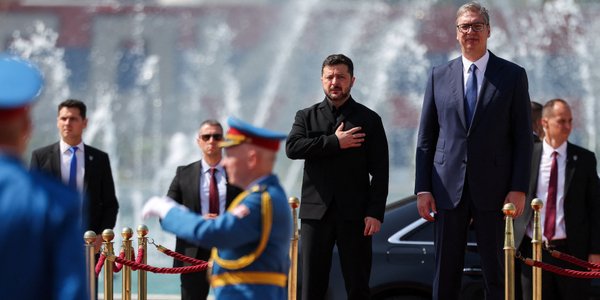
PRISTINA — Volodymyr Zelenskyy’s weekend trip to Serbia triggered reverberations in the Balkans long after the Ukrainian president jetted back to Kyiv.
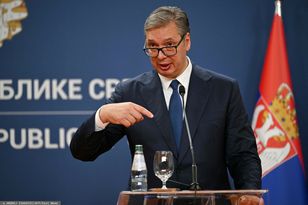
Zelenskyy visited Serbian President Aleksandar Vučić — who has refused to join the EU’s sanctions regime against Russia and maintains a cozy relationship with the Kremlin — for the first time on Saturday. He then waded into the thorniest regional dispute by declaring Ukraine would continue not to recognize the independence of Kosovo, a former province of Serbia.
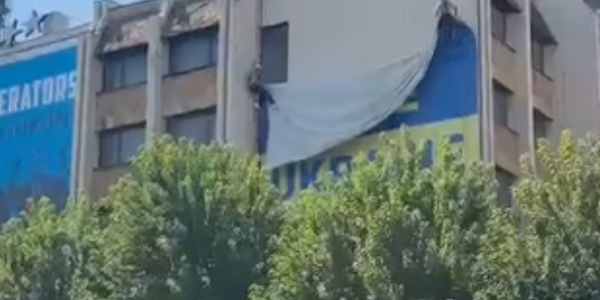
Kosovo’s response was swift. A building-sized blue-and-yellow “Free Ukraine” banner that has been up on Pristina’s main thoroughfare since 2022 came down immediately, with Mayor Përparim Rama declaring that while his sympathies remain with “peoples facing war, violence and persecution … respect must be mutual.”
Since Zelenskyy’s visit, Vučić threatened to physically redirect the Iber River that runs from Serbia to Kosovo in retaliation for Kosovo demolishing Serb-owned houses along the reservoir’s shore. Doing so would move that would drain the reservoir supplying much of Kosovo’s water and crucial cooling capacity to its largest power plant.
In addition, Serbian Foreign Minister Marko Djurić and Albanian Prime Minister Edi Rama exchanged barbs on X, with the latter accusing Serbia of being in “a political bubble” and being in denial over the fact that “Serbia lost Kosova” long ago.
Kosovo was an Albanian-majority southern province of Serbia for most of the 20th century. Its people held broad political rights under socialist Yugoslavia until a decade-long Serb crackdown on dissent led to the armed conflict of 1998-99. A three-month NATO bombing campaign drove Serbian forces out and made the province a U.N. protectorate.
Kosovo declared independence in 2008 and, to date, it is recognized by over 100 nations, including the U.S., U.K. and 22 of the 27 EU member countries. It is also a potential EU candidate country, submitting its application in December 2022.
The country’s status has long been a favorite talking point for Russian President Vladimir Putin, who has used it to justify invading Georgia in 2008 and annexing Crimea in 2014. Kosovo’s Foreign Minister Glauk Konjufca said he took note of Zelenskyy’s views “with regret” and that such rhetoric echoes “Russia’s attempts to invoke Kosova as a precedent.”
As for why Ukraine’s leader would wade into the intractable Balkan issue at all, it likely comes down to weaponry.
Serbia still produces considerable quantities of ammunition in the Soviet-standard calibers which would be impossible to acquire from Kyiv’s Western allies, who use the NATO standard instead. Ukraine retains Soviet-era heavy howitzers and tanks that remain key to the fight in the Donbas and beyond. And despite his pro-Russian stance, Vučić is happy to provide them to Kyiv quietly.
“Ukraine is in a position where it cannot care about things beyond the more immediate needs for Ukraine, and Vučić matters to him more,” explained Florian Bieber, who directs the Centre for Southeast European Studies at the University of Graz.
Vučić’s overtures towards Zelenskyy could be in part an effort to placate criticism from Brussels . EU leaders have condemned the “explosion of violence” during the ongoing anti-government protest movement and the “collapse in democratic standards” in Serbia.
“He’s hoping that he will get less critical remarks in the coming months because of his close, at least symbolically closer, ties with Zelenskyy. Vučić is doing this for leverage with the EU ahead of possible elections in the country,” Bieber continued.
Kosovo’s supporters have long cast its independence as a one-off, not a template. But the circumstances of its journey away from Serbia remains divisive, particularly for EU members like Spain and Cyprus, who have their own separatist headaches and still refuse to recognize Kosovo’s independence.
“Depending on which side of this argument you’re coming down on, you will have a different view over what Kosovo’s independence means for other conflicts and other territorial disputes around the world,” said Bieber.

Comments
No comments yet — be the first to weigh in 👇
No comments yet. Be the first!