Full text
🌘
Subscribe to 404 Media to get The Abstract , our newsletter about the most exciting and mind-boggling science news and studies of the week.
Ancient people of Colombia used collective labor to build a massive canal network that spans 2,000 square miles, a discovery that challenges the assumption that colossal works require top-down hierarchical social organization, reports a study published on Monday in Communications Sustainability.
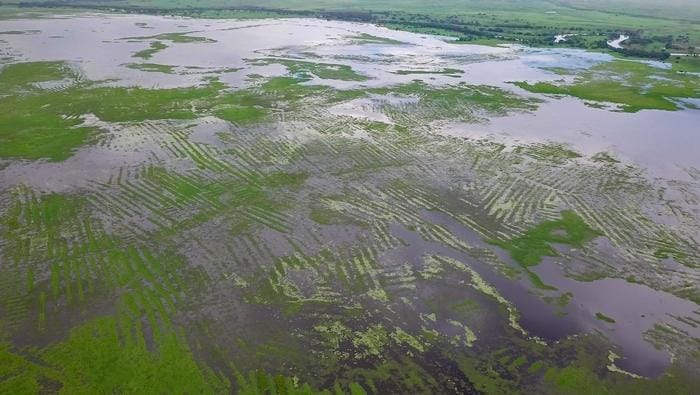
From the first century BC to the 11th century, Colombian peoples living in the La Mojana lowlands sculpted their wetland environment by building raised fields, ridges, and canals, which are today referred to as the Zenú hydraulic systems after the culture that built them. These multipurpose structures absorbed water during heavy rains and released it during dry seasons, creating a water management system that prevented both flooding and droughts. The vast network also provided water to communities for plant cultivation and access to fish.
For years, researchers have debated whether the immense work was built through top-down social organization at the direction of elite leaders, or if people could have collectively labored to construct it through bottom-up organization.
Now, a team of scientists has used satellite imagery to map a 1,200-acre patch of the system in unprecedented detail. With that sample, they built a model to estimate the population and labor costs of construction in that area. Assuming that about 1,600 people inhabited this area and half of them were part of the workforce, the structures could have been built in under six weeks, about half the dry season, which is a low labor cost that would not have required top-down organization.
“La Mojana is a special case study, in that it is the first to demonstrate in concrete, quantitative terms that these massive works are compatible with bottom-up, community-driven organisation,” said Jasmine Vieri, a research associate at the McDonald Institute of Archaeological Research at the University of Cambridge who led the study, in an email with 404 Media. “But it is also part of a much broader paradigm shift in how archaeology interprets evidence for hierarchy or top-down power.”
“As human beings, we tend to understand the world through our own lens, and many of us now live in hierarchical societies, where large-scale infrastructure, monumental architecture, or luxury goods are often commissioned by, or concentrated in the hands of a few,” she continued.
“Archaeological evidence from other regions and periods keeps revealing cases where people came together to achieve ambitious, collective goals through cooperation rather than coercion.”
The team’s sample included roughly 1,600 ridges and 63 housing platforms, most of which were about 4.5-feet tall when they were initially constructed. Though the exact dates of construction are unclear, these systems were constructed before the emergence of metal tools, such as shovels, though they may have used wood tools.
Based on this level of technology and workforce numbers, the team estimated that the largest raised ridge in the sample, which stretches for a third of a mile, would have taken a family of five months to complete, whereas a workforce of 800 could have built it in a matter of hours. But some of the smaller ridge structures could have been built by a single family over the course of a few days. The results suggest that the whole system in this sample could have been renewed once a generation, with just a few days of annual work.
“We entered the project with an open mind, although we did consider collective labour one feasible model from the start,” Vieri said. “However, when we did obtain the estimates, even we were surprised at how low they were, running through them several times just to confirm they were correct.”
The study was co-authored by Fernando Montejo Gaitán of the Colombian Institute of Anthropology and History, who has spent decades researching these ancient waterways and is part of REVERSEACTION , a project funded by the European Research Council focused on complex technologies in stateless societies.
Understanding how these people built such massive works is not just a matter of reconstructing the past, it’s also an adaptation strategy for the future, according to the study.
“Instead of focusing on futile attempts at blocking water, policymakers should consider borrowing the pre-Hispanic solution of working with the inundation rather than against it,” Vieri said. “Modern dikes built by the Colombian government are intended to prevent seasonal flooding, but are often breached by high-volume currents, destroying human lives and livelihoods.”
“In contrast, the pre-Hispanic raised fields functioned to redistribute the flow of water, enabling human settlement and cultivation above the water level throughout the wet season,” she continued. “Raised fields simultaneously buffer against severe droughts by storing and gradually releasing water during the drier months.”
For more than a millennium, people in this region used this strategy to go with the flow, without the need for top-down direction. Hopefully, future work might uncover more insights about the role of social organization in massive works, and the possibility that large structures might have emerged from small collectives.
“Answering these questions would contribute much to broader archaeological debates on the relationship between infrastructural scales and political organisation,” Vieri said. “In fact, a key outcome of our research is an open-source pipeline that can be readily be applied to the study of agricultural systems in other regions, enabling cross-comparative research into testing the strength of the evidence for bottom-up, multi-scalar, or top-down social organisation across different time periods or communities.”
🌘
Subscribe to 404 Media to get The Abstract , our newsletter about the most exciting and mind-boggling science news and studies of the week.

Comments
No comments yet — be the first to weigh in 👇
No comments yet. Be the first!