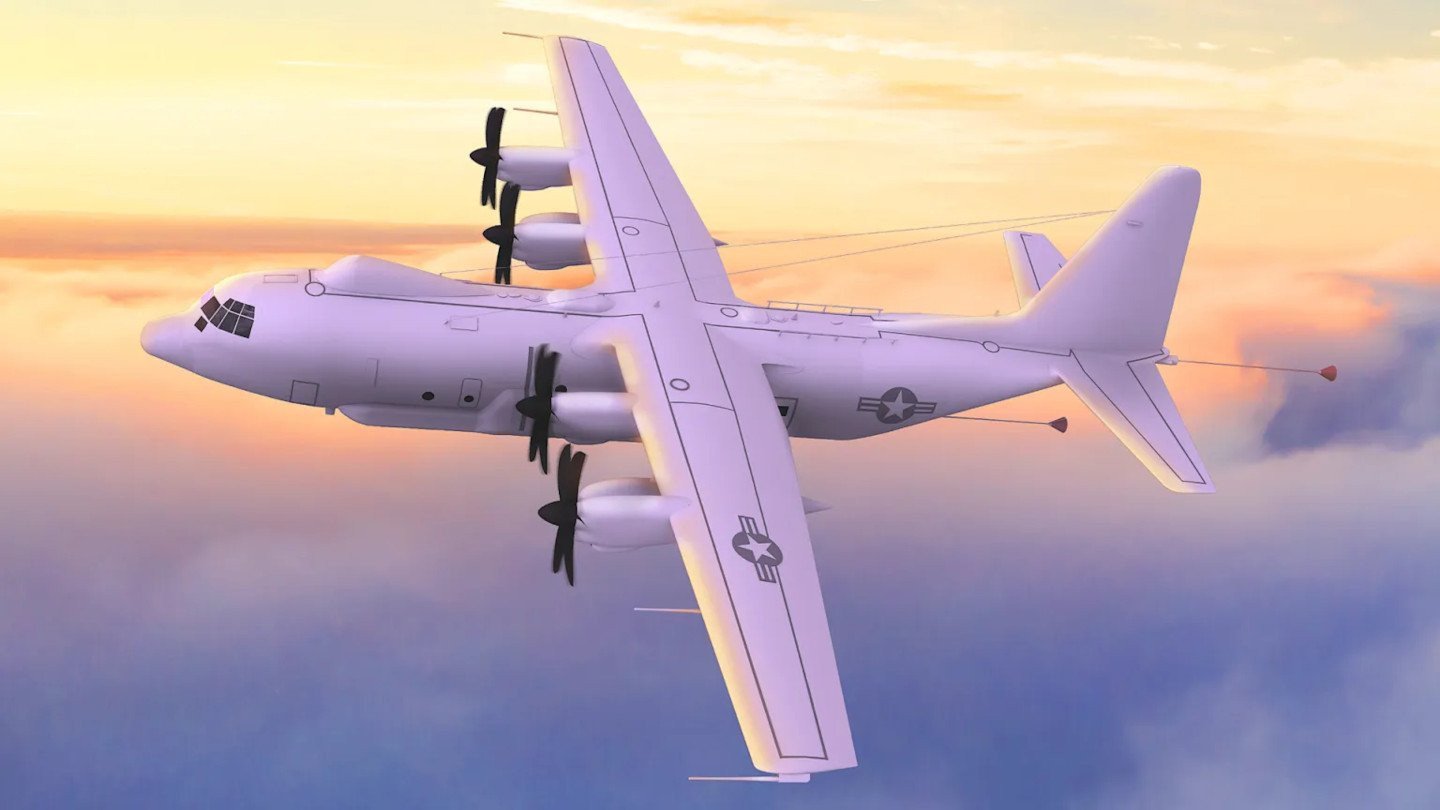
US Navy to nearly double its 'doomsday plane' fleet with 31 new E-130J Phoenix II aircraft
The US Navy plans to acquire 31 E-130J Phoenix II aircraft to replace its 16 ageing E-6B Mercury planes, nearly doubling the size of its TACAMO fleet. TACAMO aircraft provide airborne command and control for nuclear ballistic missile submarines, including the ability to order a submerged launch. The plans were included in a Pentagon Modernized Selected Acquisition Report dated April 21, 2026, produced as part of the proposed Fiscal Year 2027 budget.
Full text
The U.S. Navy is planning to acquire 31 E-130J Phoenix II aircraft to replace 16 E-6B Mercury planes now in service. This will nearly double the number of planes the service has configured to perform the Take Charge And Move Out (TACAMO) mission. TACAMO involves providing aerial command and control support for nuclear ballistic missile submarines , including the ability to send them orders to launch strikes while they are submerged . Platforms assigned nuclear support missions like this are commonly called ‘doomsday planes.’
The total planned E-130J fleet size was included in a recently released Pentagon report. The so-called Modernized Selected Acquisition Report (MSAR) was produced as part of work on the U.S. military’s proposed Fiscal Year 2027 budget and is dated April 21, 2026. The report also acknowledges risks to the program associated with operational availability, which the Government Accountability Office (GAO) has previously highlighted publicly . Aviation Week was first to report on the new E-130J MSAR.
One of the E-6B Mercury jets that the E-130Js Phoenix IIs are slated to replace. USAF
In terms of the acquisition plan, the Navy currently expects to acquire six pre-production E-130Js to support the type’s ongoing development, as well as 25 production examples. The service had only previously disclosed that it would be buying six aircraft as part of the development phase and that the initial low-rate production run would comprise three to six additional planes. Whether some or all of the pre-production Phoenix IIs might ultimately be used operationally is unknown.
The MSAR says the estimated Program Acquisition Unit Cost (PAUC), which factors in research and development costs, for all 31 E-130Js, was $732.8 million apiece as of April. The Average Procurement Unit Cost (APUC) for just the 25 production examples, which also does not include research and development costs, was pegged at $360.9 million each. The report also says that these PAUC and the APUC figures are both lower – by 3.29 and 2.64 percent, respectively – than the baseline estimates as of December 2024.
As noted, the E-130Js, which are being converted from four-engine turboprop C-130J-30 Hercules cargo planes , are set to replace the existing fleet of E-6Bs. The Mercury aircraft are based on the larger, jet-engined Boeing 707 airliner . The E-6Bs first began entering service in an earlier E-6A configuration in 1989, and were some of the last 707-based planes ever produced. They were subsequently brought up to the current standard in the late 1990s and early 2000s, and have received additional upgrades since then. The Mercury fleet currently also supports a U.S. Air Force nuclear mission set called the Airborne Command Post (ABNCP), and more commonly known by the nickname Looking Glass . That mission entails providing aerial command and control support to nuclear-capable bombers and silo-based Minuteman III intercontinental ballistic missiles . As part of this role, E-6Bs are equipped to initiate the launch of Minuteman IIIs while in flight. We will come back to this later on, as the stated plan now is for the Phoenix II planes to be capable of supporting the TACAMO mission only.
The first C-130J-30 Hercules airframe destined to be converted into a pre-production E-130J is rolled out in 2025. USN
Overall, the April MSAR for the E-130J says the “program is on track and executing to the APB [Acquisition Program Baseline].”
“An Integrated Baseline Review (IBR) was conducted September 23-26, 2025 and formally closed on February 24, 2026. All actions resulting from IBR Findings have been successfully resolved,” the report adds. “Preliminary Design Review (PDR) for the first test aircraft configuration (AV1) was conducted March 31-April 1, 2026 with the full system PDR planned for July 2026.”
However, the report also lists a risk associated with “Operational Availability,” but says that “additional details can be found at the classified
level.”
This is in line with concerns raised publicly by GAO, a Congressional watchdog, starting last year.
“The C-130J aircraft – selected 4 years before E-130J’s development start – may not meet operational availability requirements. The E-130J’s technical risk assessment highlighted the complexity associated with integrating E-130J systems onto this aircraft,” GAO warned in a report published in June 2025. “The Navy’s technical risk assessment team expects the integration risks to translate to manufacturing issues given the potential deviation from standard components and the security environment required.”
A rendering of an E-130J Phoenix II. Northrop Grumman
“As we reported in last year’s assessment, the Navy awarded its contract despite significant technical risks it acknowledged the E-130J program faced. A September 2024 independent technical risk assessment highlighted the complexity associated with the program’s planned integration effort, which officials acknowledged could increase as they integrate additional technologies,” per another GAO report released just last month. “Since our 2024 report, the program has delayed its low-rate production decision by approximately a year as these system integration risks have morphed into realities.”
“For example, program officials said that contractors are now focused on modifying already-existing mission systems to reduce their weight, which the independent assessment anticipated would be necessary to accommodate them on the C-130J-30 airframe,” the July 2026 GAO report added.
GAO also said in that report that the Navy “acknowledges technical risk,” but also that the service had highlighted “risk reduction contracts with subcontractors to address obsolescence and size, weight, and power-cooling risks.”
Generally speaking, aircraft assigned the TACAMO mission require a highly specialized and extremely reliable communications suite to ensure they can perform under what could be extremely challenging conditions. Each E-6B notably has the ability to reel out a five-mile-long antenna to communicate with submerged submarines. The E-130J will have a very similar, if not identical, antenna system. Hardening against electro-magnetic pulses (EMP), which would be produced during the detonation of nuclear warheads , is another key requirement for these planes.
Brandon Williams, Under Secretary of Energy for Nuclear Security and Administrator of the National Nuclear Security Administration (NNSA), at left, stands with Navy personnel next to an E-6B Mercury. This picture offers a good look at the red-and-white-colored drogue attached to the end of one of the plane’s five-mile-long communications antennas. NNSA
“Due to the highly sensitive and distinct strategic command and communications missions, the E-130J programs are managed with a zero-tolerance posture for foreign exploitation,” the April MSAR also highlights. “Program Protection is governed by stringent, continuously enforced plans addressing all Technology Security and Foreign Disclosure (TS&FD) elements, including Supply Chain Assurance and robust Information Assurance. Additional details are available in a classified environment.”
In the past, TWZ has discussed the potential operational readiness and other tradeoffs that could come from selecting a C-130-based platform to replace the 707-based E-6B in the TACAMO role. As we wrote previously :
“It’s certainly worth pointing out that the E-6Bs, conversions of what were some of the last and most modern 707 airliners built, were larger and higher performance platforms than the EC-130Qs. The C-130J-30 is certainly a more capable aircraft than the C-130H on which the EC-130Q was based, but it won’t have the base speed and altitude capabilities of an airliner-sized multi-engine jet. Compared to the Mercuries, any TACAMO-configured C-130J-30 would not be able to get on station as quickly, or fly as high, limiting its ability to get above bad weather or establish a better line of sight for its communications systems.”
“At the same time, as the Navy itself has noted, the C-130J-30 platform does immediately open up the ability to use a larger number of air bases, airports, and airfields, including austere ones that the E-6B cannot operate from. This could be very useful in a contingency scenario where an opponent may have destroyed or otherwise rendered unusable many well-established bases, as well as larger secondary dispersal sites, which include large commercial airports. Being able to fly from smaller, tertiary locations could help to ensure that the TACAMO mission continues without significant disruption under such circumstances. This is also true during peacetime as targeting the TACAMOs on the ground would be much harder if they could easily operate from and sit alert at a much larger number of airports.”
“A C-130J-30 configured for the TACAMO mission would certainly have a mid-air refueling capability and the Hercules is already a platform that has demonstrated the ability to loiter over particular areas for long periods of time. Unlike the Boeing 707, the C-130J is still in production, as well, meaning that TACAMO aircraft based on this plane would be inherently easier to maintain and support logistically, and may also be easier to convert to this specialized configuration begin with. As time goes on, the J looks set to increasingly become the default base C-130 model across the U.S. military, as well. Compared to the long out of production 707-based E-6, support for the C-130J is already distributed across the U.S., and beyond. Training C-130J crews is even an easier proposition.”
How exactly operational considerations factored into the decision regarding the E-130J fleet size is unknown. There are additional tradeoffs to having a larger total fleet, but it should offer strategic readiness benefits based on available airframes alone. It is worth noting here that the Navy did operate TACAMO aircraft based on older C-130 variants before the E-6A entered service.
The US Navy operated a fleet of EC-130Q TACAMO aircraft like the one seen here before the arrival of the E-6As. USN
There is no debate that the aging E-6Bs are becoming increasingly more challenging to operate and sustain. The Mercury fleet has been further strained over the years given the need to use operational aircraft to support training demands. The Navy is now utilizing a contractor-owned, but government-operated (COGO) Boeing 737NG airliner to support pilot training requirements. This follows an abortive plan to convert an ex-Royal Air Force E-3D Sentry airborne early warning and control aircraft, another Boeing 707-based type, into a dedicated TE-6B crew trainer, which came to a halt last year, as TWZ was first to report .
The ex-Royal Air Force E-3D seen in the process of being converted into the TE-6B trainer before that effort was abandoned. USN
To avoid any gaps in TACAMO coverage, the Navy has also said it will phase out the E-6Bs only as the new E-130Js enter service, which means that Mercury aircraft will have to keep flying until the transition is deemed complete. The initial operational capability timeline for the Phoenix II is currently classified, but the April MSAR says initial operational test and evaluation (IOT&E) is not set to start until June 2033, at the earliest. Completion of IOT&E is not automatically required for an IOC declaration.
As mentioned, despite the fleet size target, the E-130J is not set to take on the ABNCP/Looking Glass mission, at least currently. The Air Force is still in the very early stages of acquiring what it is currently calling Looking Glass-Next (LG-N) to assume this role. Among the questions still to be answered, at least that we know, is how many total planes the service will need to meet those mission requirements. Leveraging the forthcoming Boeing 747-based E-4C Survivable Airborne Operations Center (SAOC) jets has been raised as a possibility. However, the SAOC aircraft are set to have much broader ‘doomsday plane’ roles, just like the four E-4B Nightwatch types they are set to replace, as you can read more about here . The Air Force is also in the midst of a much larger modernization of its nuclear command and control architectures, work that is tied heavily to the much-delayed LGM-35A Sentinel intercontinental ballistic missile program, as we have detailed in the past . Nuclear command and control functions could increasingly move to space-based assets as part of these developments.
“I have full confidence in our ability to sustain existing capability and bridge to the next generation of capability,” Navy Adm. Richard Correll, head of U.S. Strategic Command, told TWZ and others at a media roundtable last week, when asked for an update on TACAMO and LG-N. Correll deferred to the Navy and the Air Force on more specific questions about those programs.
When it comes to TACAMO modernization, the Navy is pressing ahead with its plans, which are set to result in a major increase in at least the total number of aircraft configured for this critical mission.
Contact the author: joe@twz.com
The post Navy ‘Doomsday Plane’ Fleet To Almost Double In Size With New E-130Js appeared first on TWZ .
Similar stories
 🌍 World
Pentagon: US is 'digging in' to Asia, but allies must shoulder more of their own defence
Defense News · 3h ago
🌍 World
Pentagon: US is 'digging in' to Asia, but allies must shoulder more of their own defence
Defense News · 3h ago
 🪖 Military
Sila secures $1.4B Pentagon loan to scale battery production
TechCrunch · 4h ago
🪖 Military
Sila secures $1.4B Pentagon loan to scale battery production
TechCrunch · 4h ago
 🪖 Military
Pentagon urges arms industry to ramp up production amid post-Iran war shortages
Defence24 · 4h ago
🪖 Military
Pentagon urges arms industry to ramp up production amid post-Iran war shortages
Defence24 · 4h ago
Similar stories
🌍 World
Pentagon: US is 'digging in' to Asia, but allies must shoulder more of their own defence
Defense News · 3h ago
🪖 Military
Sila secures $1.4B Pentagon loan to scale battery production
TechCrunch · 4h ago
🪖 Military
Pentagon urges arms industry to ramp up production amid post-Iran war shortages
Defence24 · 4h ago
Should the US expand its fleet of nuclear command aircraft?
Comments
No comments yet
Comments
No comments yet — be the first to weigh in 👇
No comments yet. Be the first!