
DKIST telescope captures plasma waves "breaking" on the Sun in record resolution
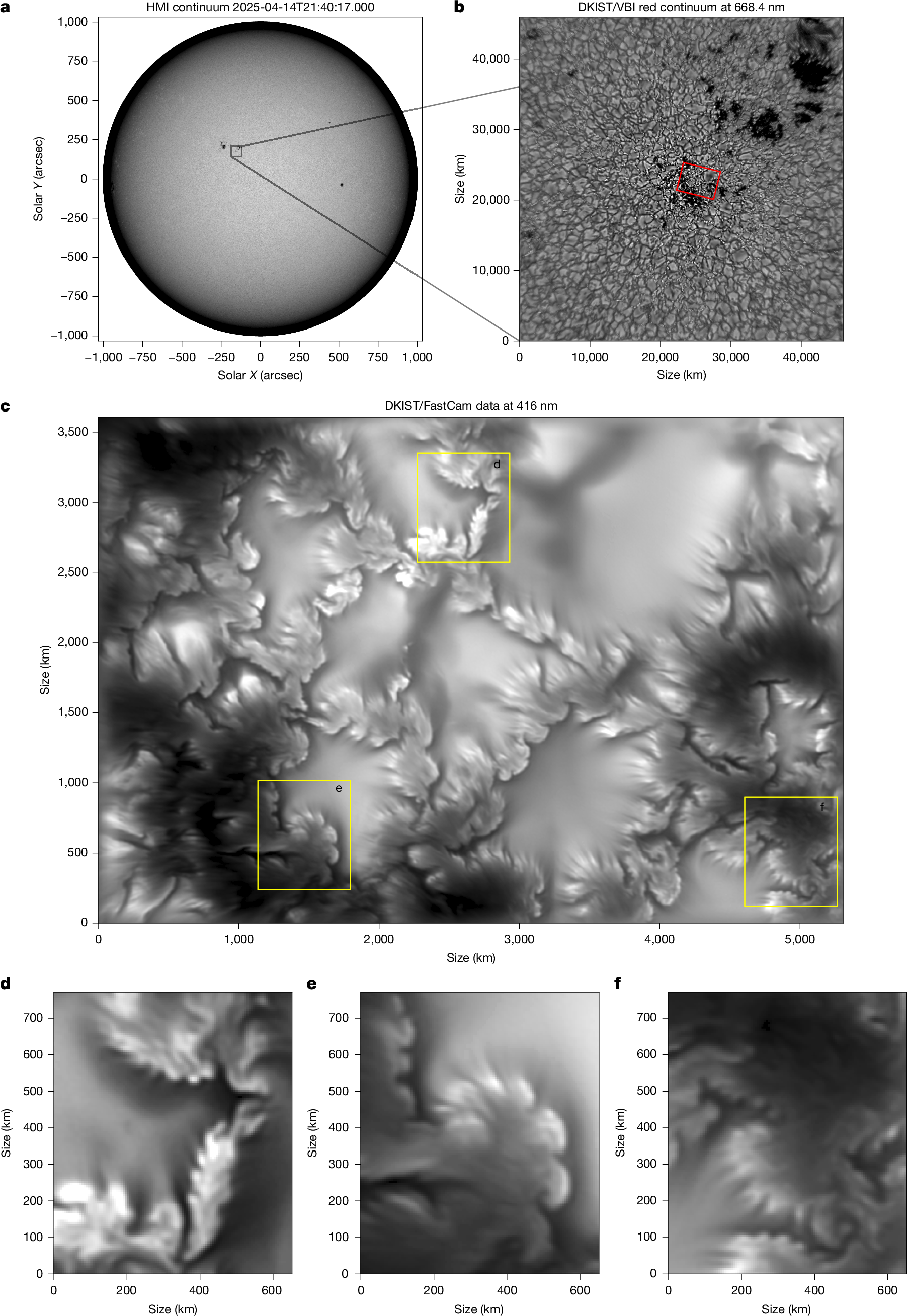
The National Science Foundation's Daniel K. Inouye Solar Telescope (DKIST) has captured the highest-resolution image ever taken of the Sun's photosphere, at a wavelength of 416 nanometres. The image reveals the Kelvin-Helmholtz instability — a fluid-flow phenomenon that occurs when two fluids move at different speeds, creating complex vortex-rich turbulence. The same instability is thought to be visible in Van Gogh's painting "The Starry Night."
Full text
The Sun is so much more than a shining ball of energetic plasma.
This incredible still image from the National Science Foundation’s Daniel K. Inouye Solar Telescope (DKIST) is the highest-resolution image of the Sun’s surface (i.e., photosphere) ever acquired. The image is taken at a wavelength of 416 nanometers, and showcases several features known to arise in fluid flow, such as the Kelvin-Helmholtz instability.
Credit : NSF/NSO/AURA/MPS
Its fluid surface is ocean-like: with plasma currents flowing, cooling, and colliding.
This animation shows the growth of complex, turbulent, vortex-rich structure from an initially small set of imperfections between two flowing fluids interacting while moving at different speeds: the classic scenario of the Kelvin-Helmholtz instability. This particular form of turbulence is thought to be at play in the famed Vincent Van Gogh painting “The Starry Night.”
Credit : Empetrisor/Wikimedia Commons
In physics, whenever two fluids flow past or through each other, instabilities arise.
This image of a portion of the planet Jupiter, taken by NASA’s Juno mission’s JunoCam, showcases multiple layers of Jupiter’s atmosphere passing by one another at different speeds, with many turbulent features arising, including from the Kelvin-Helmholtz instability where the white and red swirling features appear.
Credit : NASA/JPL-Caltech/SwRI/MSSS/Gerald Eichstad/Sean Doran
Shear forces create turbulent fluid flows, eddy currents, and vortices.
Incredibly, this image shows the phenomenon of the Kelvin-Helmholtz instability in a ring of a pure antimatter plasma. As antiprotons are held in a particle trap, electric and magnetic fields keep them quasi-stable, but cannot stop Kelvin-Helmholtz instabilities from creating vortices and causing the antiparticles to annihilate when they encounter the matter-containing apparatuses surrounding them.
Credit : Rcaravit/Wikimedia Commons
The underlying mechanism — the Kelvin-Helmholtz instability — arises in ocean waves,
A simulated video of waves created in a methane ocean on Titan (left) versus terrestrial waves generated in Earth’s water oceans (right). The flowing fluid of air (top) against the moving fluid of water (bottom) at different speeds creates ripples and waves on the liquid’s surface through the Kelvin-Helmholtz instability mechanism.
Credit : Massachusetts Institute of Technology
terrestrial clouds ,
These wave-like clouds, seen forming over Mount Duval in New South Wales, Australia, are an example of the Kelvin-Helmholtz instability occurring in Earth’s atmosphere: where two fluids or gases, moving at different speeds, grow small initial instabilities into large, chaotic, turbulent vortices.
Credit : GRAHAMUK/English language Wikipedia
and in the atmospheres of gas giant worlds.
Over a period of 8 months, the largest storm in the Solar System raged, encircling the entire gas giant world of Saturn. The storm itself was large enough that it was capable of fitting as many as 10-to-12 Earths inside. Cassini, although it wasn’t expecting this to occur, was equipped with instrument technology that was more than sufficient to discover and study this unprecedented feature, where the differing speeds of the flowing fluids in Saturn’s atmosphere create myriad features associated with the Kelvin-Helmholtz instability.
Credit : NASA/JPL-Caltech/Space Science Institute
These long-predicted instabilities have previously been detected within solar outflows .
This view of the Sun showcases Kelvin-Helmholtz instabilities and related features arising in the Sun’s atmosphere, due to outflows of material, in 2010 as observed with NASA’s Solar Dynamics Observatory.
Credit : NASA/L. Ofman & B.J. Thompson, Astrophysical Journal Letters, 2011
However, simulations predict such instabilities should arise within the Sun itself.
This still from a high-resolution simulation of the Sun’s photosphere showcase a region where two fluid currents on the photosphere flow against one another, creating instabilities, vortices, and other detailed figures. The simulation is visualized at a wavelength of 416 nanometers: to match the observing capabilities of the DKIST observatory.
Credit : NSF/NSO/AURA/HAO
If true, they’d help explain the high observed temperature of the Sun’s outer corona.
This image, of the Sun’s inner corona and prominences on the Sun, was taken during the April 20, 2023 total solar eclipse. Exquisite views of what’s occurring just off of the Sun’s disk are best captured during a total solar eclipse. While the solar corona is many times hotter, in terms of temperature, than the Sun’s photosphere, a complete understanding of the energy transport that leads to those high temperature properties remains elusive.
Credit : Phil Hart
They’d also provide a mechanism for building and transporting magnetic energy across the Sun.
Solar coronal loops, such as those observed by NASA’s Solar Dynamics Observatory (SDO) satellite here in 2014, follow the path of the magnetic field on the Sun. When these loops ‘break’ in just the right way, they can emit coronal mass ejections, which have the potential to impact Earth. With the ground-based power of DKIST, we can gain information about the Sun’s magnetic field, as well as the transport of energy, on the solar photosphere itself.
Credit : NASA/SDO
Only DKIST — the Daniel K. Inouye Solar Telescope — has sufficient resolution to find out.
This photograph shows the flagship heliophysics facility, built and managed by the National Science Foundation, known as the Daniel K. Inouye Solar Telescope, or DKIST. After completing construction in 2020 and commissioning in 2022, it has given us our highest-resolution views of the Sun’s photosphere ever since.
Credit : NSF/NSO/AURA
Since its 2020-2022 commissioning , it reveals the smallest-scale features ever seen on the solar photosphere.
While we’re used to seeing the disk of the Sun as a uniform surface with only the occasional sunspot, DKIST is capable of resolving the millions of individual convective cells across the Sun’s photosphere, as well as individual, changing details within those cells over time.
Credit : NSF/NSO/AURA/MPS
Its time-lapse imagery and videos showcase small-scale, dynamically changing swirls .
This animation showcases DKIST’s actual views of the Sun at its maximum resolution (top), with blown up, zoomed-in views of three different regions in the lower panels. The deformed boundaries of magnetic elements and the ultra-fine scale stripes, as well as the vortices in motion, are all associated with the Kelvin-Helmholtz instability mechanism.
Credit : NSF/NSO/AURA/MPS
The deformed, changing boundaries of magnetic elements within the Sun are apparent.
A close-up view from the Inouye Solar Telescope image highlighting a region of the solar photosphere. The enlarged inset reveals the fine-scale magnetic structures and dark striations associated with the Kelvin-Helmholtz instability at a scale of tens of kilometers. The animated switchover shows the size of the Hawaiian islands, where DKIST (the observing telescope) is located on the summit of Maui, for comparison.
Credit : NSF/NSO/AURA/MPS
The ultra-fine scale stripes, at those boundaries, also arise from Kelvin-Helmholtz instabilities.
This high-resolution simulation of two fluids moving at different speeds, interacting, across the surface of the Sun generates many classic features associated with the Kelvin-Helmholtz instability. The match between these state-of-the-art simulations and DKIST’s observations of the solar photosphere are a striking confirmation of the theory.
Credit : NSF/NSO/AURA/MPS
These views match exquisitely with physics-based simulations.
A side-by-side comparison of a real observation from the Inouye Solar Telescope (top left) and a synthetic image generated by state-of-the-art, physics-based computer simulations (top right). The blown up details in both cases (bottom left and bottom center) shows remarkable agreement, indicating the role of the Kelvin-Helmholtz instability in the photosphere of the Sun. The simulated magnetic field map (bottom right) confirms the deformation of the magnetic elements from a physics perspective.
Credit : NSF/NSO/AURA/HAO
DKIST’s scientific importance, as Earth’s only ground-based flagship heliophysics observatory, cannot be overstated.
This still image of a small region of the Sun’s photosphere, along with three zoomed-in closeups, clearly show a variety of features associated with classic Kelvin-Helmholtz instabilities. This provides a potential mechanism for explaining the Sun’s magnetism and its intensely hot corona: the strongest such evidence to date of such a theoretical connection.
Credit : NSF/NSO/AURA/MPS
Mostly Mute Monday tells an astronomical story in images, visuals, and no more than 200 words.
This article We caught an ocean of plasma waves “breaking” on the Sun is featured on Big Think .
Similar stories
 🔬 Science
Kelvin–Helmholtz instabilities found to be widespread drivers of plasma mixing on the Sun
Nature · 4d ago
🔬 Science
Kelvin–Helmholtz instabilities found to be widespread drivers of plasma mixing on the Sun
Nature · 4d ago
 🔬 Science
Sharpest-ever solar images reveal mysterious plasma vortices never seen before
Rzeczpospolita · 4d ago
🔬 Science
Sharpest-ever solar images reveal mysterious plasma vortices never seen before
Rzeczpospolita · 4d ago
Similar stories
🔬 Science
Kelvin–Helmholtz instabilities found to be widespread drivers of plasma mixing on the Sun
Nature · 4d ago
🔬 Science
Sharpest-ever solar images reveal mysterious plasma vortices never seen before
Rzeczpospolita · 4d ago
Should solar surface research be a top priority for science funding?
Comments
No comments yet
Comments
No comments yet — be the first to weigh in 👇
No comments yet. Be the first!