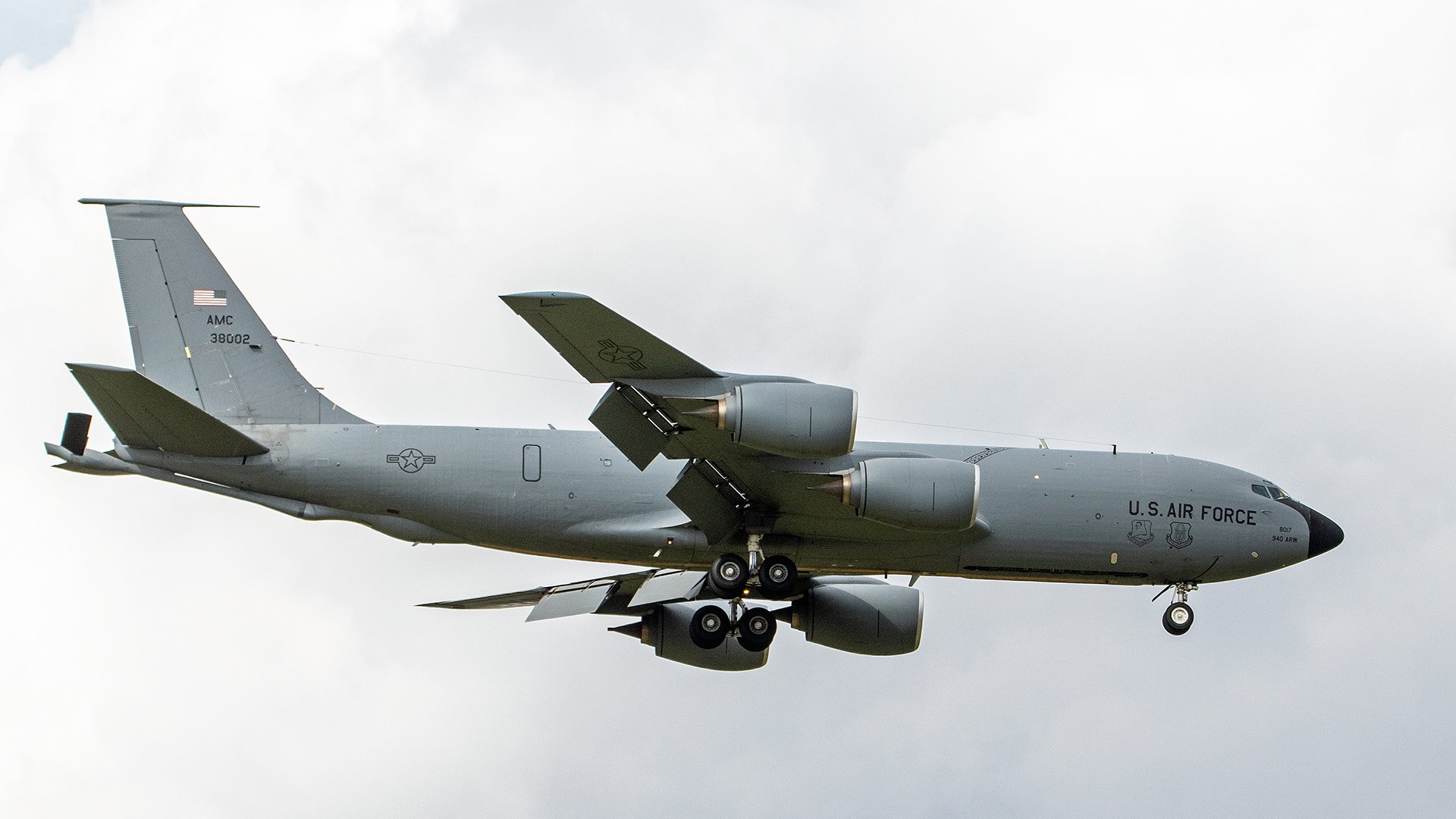
KC-135 that lost its tail in deadly Iraq midair collision now under repair at Tinker AFB
The KC-135 Stratotanker (serial 63-8017) that survived a deadly March 12 midair collision over Iraq is now undergoing full repairs at Tinker Air Force Base, Oklahoma — the only USAF unit specialising in battle-damage repair for aerial refuellers and bombers. The collision killed all six crew members of the other tanker, call sign Zeus 95, from MacDill AFB and Rickenbacker Air National Guard Base. Photos showed the surviving jet had lost roughly half its tail before making an emergency landing at Ben Gurion Airport in Israel.
Full text
The KC-135 Stratotanker aerial refueling jet involved in a deadly midair collision with another tanker over Iraq in March is now undergoing full repairs at Tinker Air Force Base. The Oklahoma installation hosts the only unit specifically designed to repair battle damage to the Air Force’s fleet of aerial refuelers and strategic bombers.
The collision on March 12 killed the entire crew of the tanker , which had the call sign Zeus 95 . Maj. John A. Klinner, Capt. Ariana G. Savino and Tech. Sgt. Ashley B. Pruitt were assigned to the 6th Air Refueling Wing, MacDill Air Force Base, Fla. Capt. Seth R. Koval, Capt. Curtis J. Angst and Tech. Sgt. Tyler H. Simmons were assigned to the 121st Air Refueling Wing at Rickenbacker Air National Guard Base, Columbus, Ohio.
After the incident, the surviving jet, serial 63-8017, landed at Israel’s Ben Gurion Airport. Images emerged showing that half its tail was sheared off.
תיעוד: אחד ממטוסי התדלוק האמריקניים, שהיה מעורב אתמול בתאונה בשמי עיראק, צולם בנתב"ג ללא חלק משמעותי ממיצב הכיוון בזנב המטוס. תיעוד המטוס הגיע אלינו הבוקר, ומלמד משהו על התאונה החריגה במהלך התקיפות באיראן
המטוס השני שהיה מעורב בתאונה התרסק בעיראק, גורל ששת אנשי הצוות לא ידוע pic.twitter.com/igBPfEOZjf
— איתי בלומנטל Itay Blumental (@ItayBlumental) March 13, 2026
Little more was known publicly about the jet – assigned to the 314th Air Refueling Squadron at Beale Air Force Base, California – until it arrived at RAF Mildenhall in the United Kingdom on Aug. 2 with a replacement tail. Local aviation photographer Andrew McKelvey was kind enough to share images he took of the aircraft, one of which you can see below.
KC-135, damaged in a midair collision over Iraq that killed all six crew members of the other jet, arrived at RAF Mildenhall on Aug. 2 with a donor tail. (Andrew McKelvey photo)
Serial 63-8017 left Mildenhall and finally arrived at Tinker on Aug. 3.
Rare arrival today at Tinker. 63-8017 completed its transit from the Middle East as RCH564.
This was the KC-135R involved in a tragic mid-air collision back in March with ZEUS95. Wild to see the 8002 tail on. (it was in pdm when the crash happened) Same jet, 2 different numbers. pic.twitter.com/kweSOarcTy
— MAGPhoto (@MAGPhotoOK) August 3, 2026
After McKelvey sent us the pictures, we reached out to the Air Force to find out how the aircraft was repaired and what would happen to it next. In addition, Mildenhall, as we have previously reported , was also a pit stop for at least two KC-135 tankers that returned from the Middle East full of patch mark repairs from shrapnel damage incurred during Iranian attacks.
“The aircraft are being inducted for programmed depot maintenance, where any damage patched by an Expeditionary Depot Maintenance (EDMX) unit will be fully repaired in conjunction with regularly scheduled 5-year maintenance,” an Air Force spokesperson told us Thursday afternoon. Located at Tinker, the EDMX is “responsible for maintaining the Air Force’s sole source for Aircraft Battle Damage Repair (ABDR) rapid repair capabilities for the entire tanker and bomber fleets,” according to the Air Force .
“Timelines for when the aircraft will fully return to the fleet ultimately depends on the extent of any additional defects or engineering issues identified during the inspection portion of the programmed depot maintenance,” the Air Force spokesperson added. “The current average for this regularly scheduled maintenance is 155 days, but it is reasonable to assume the timeline may be extended based on findings.”
A KC-135 Stratotanker undergoes programmed depot maintenance at the Oklahoma City Air Logistics Complex at Tinker Air Force Base, Oklahoma, Nov. 23, 2019. During PDM, each KC-135 undergoes a series of inspections, upgrades to the aircraft, and a flight test to ensure proper functionality. (U.S. Air Force photo by Airman Kiaundra Miller) Senior Airman Kiaundra Miller
The repair process to keep these aircraft able to maintain full mission capability can be much quicker, the Air Force spokesperson explained.
“Several damaged KC-135 Stratotankers were repaired by members of the 76th Aircraft Maintenance Group’s Expeditionary Depot Maintenance Flight [EDMX], allowing the aircraft to maintain full mission capability to complete deployed missions,” the Air Force added. The EDMX “completed more than 200 repairs over the course of three weeks; effective patches that also allowed the aircraft to return to Tinker Air Force Base for comprehensive repairs.”
The Air Force declined to provide details about the number of aircraft that arrived at Tinker to be repaired after being damaged in the war on Iran and did not immediately provide additional information about the work done on 63-8017 in Israel to enable it to fly again in the first place.
Whether coincidental or not, a few weeks after the mishap in March over Iraq, the Air Force pulled a Stratotanker out of storage and brought it to Tinker.
“At the request of the KC-135 System Program Office, the 309th Aerospace Maintenance and Regeneration Group regenerated KC-135R, tail number 58-011, to support operational requirements,” the Air Force told us back in April. “The aircraft departed on April 2, 2026, en route to the Oklahoma Air Logistics Complex at Tinker AFB, Oklahoma City, Oklahoma.”
The Air Force at the time declined to say if 58-011 was being used specifically to repair jets damaged during Epic Fury.
KC-135 Stratotanker serial number 58-0011 seen in a hangar at McConnell Air Force Base in Kansas on Sept. 1, 2015. (USAF)
In addition to the tanker involved in the midair collision, an Iranian attack on Prince Sultan Air Base (PSAB) in Saudi Arabia is said to have damaged five tankers . However, the full destruction inflicted by it and subsequent strikes on PSAB remains murky, as do potential impacts to facilities and aircraft located across the region. The lack of regular satellite imagery from U.S. providers of the Middle East has made it harder to understand what has occurred, but as we state repeatedly, satellite images would not show more minor damage to aircraft, such as the shrapnel holes in images of two KC-135s that made a temporary stop at Mildenhall before heading to Tinker.
As we noted earlier in this story, on April 12, a KC-135, serial 59-1444, belonging to the Ohio Air National Guard’s 121st Air Refueling Wing, arrived at the air base in England covered in patches installed over shrapnel damage. You can see that jet’s arrival in the following photograph.
(Andrew McKelvey)
A little more than a month later, another Stratotanker, serial 63-8028, assigned to the Alaska Air National Guard’s 168th Wing, arrived at Mildenhall also peppered with temporary shrapnel damage repairs. The following photograph shows the aircraft at the base.
(Andrew McKelvey)
The damaged tankers are among at least 40 aircraft damaged or destroyed during the U.S. conflict with Iran. Our last tabulation is from April 10. There have been several other Iranian attacks on air bases in the region housing U.S. aircraft since then, but U.S. Central Command (CENTCOM) has declined to discuss battle damage. So it is possible, if not likely, that there have been additional assets destroyed or damaged.
The Air Force is seeking money to replace some of these aircraft.
“We hope to be able to address this in a supplemental for the aircraft that we’ve lost,” Air Force Chief of Staff Kenneth S. Wilsbach told Congress in April . “And the procurement going forward is meant to increase the number of tails we have, especially in the fighter force, but it will also include bombers and tankers as well. So both the supplemental and the ’27 budget is supposed to address those losses.”
You can get an idea of the extent of U.S. aircraft losses from our graphic linked here.
Operation Epic Fury U.S. Aircraft Losses Visualized
Here are all the known American aircraft losses during the nearly six week-long war with Iran. https://t.co/5tzH2gks1l
— TWZ (@thewarzonewire) April 10, 2026
The fact that these tankers, which have all been in service for more than 60 years, were able to return to flight is a testament to the crews that fixed them. How much repair work they still have to undergo remains unclear.
Tankers are critical assets in high demand, and in this case of these jets, there may be at least one positive side effect from the damage. Executing a battle damage repair plan in the field to get a KC-135 back in the air is a good real-life exercise, one that could prove vital if a future conflict in the Pacific were to erupt. Lessons will certainly be learned on many levels from the war on Iran. And some of these lessons unfortunately, and perhaps needlessly , came the hard way.
Contact the author: howard@twz.com
The post KC-135 That Lost Its Tail In Deadly Collision Over Iraq Now At Tinker AFB Repair Shop appeared first on TWZ .
Similar stories
 🌍 World
Iraq faces financial crisis as salary costs hit $8.2bn a month
Al Jazeera · 1d ago
🌍 World
Iraq crisis: Shia militias defy disarmament deadline of September 30
Al Jazeera · 2d ago
🌍 World
Iraq faces financial crisis as salary costs hit $8.2bn a month
Al Jazeera · 1d ago
🌍 World
Iraq crisis: Shia militias defy disarmament deadline of September 30
Al Jazeera · 2d ago
Similar stories
🌍 World
Iraq faces financial crisis as salary costs hit $8.2bn a month
Al Jazeera · 1d ago
🌍 World
Iraq crisis: Shia militias defy disarmament deadline of September 30
Al Jazeera · 2d ago
Should the US Air Force accelerate the replacement of its ageing KC-135 fleet?
Comments
No comments yet
Comments
No comments yet — be the first to weigh in 👇
No comments yet. Be the first!