Full text
3 Min Read
NASA’s Lunar Development and Test Facility Prepares Artemis Hardware for Moon
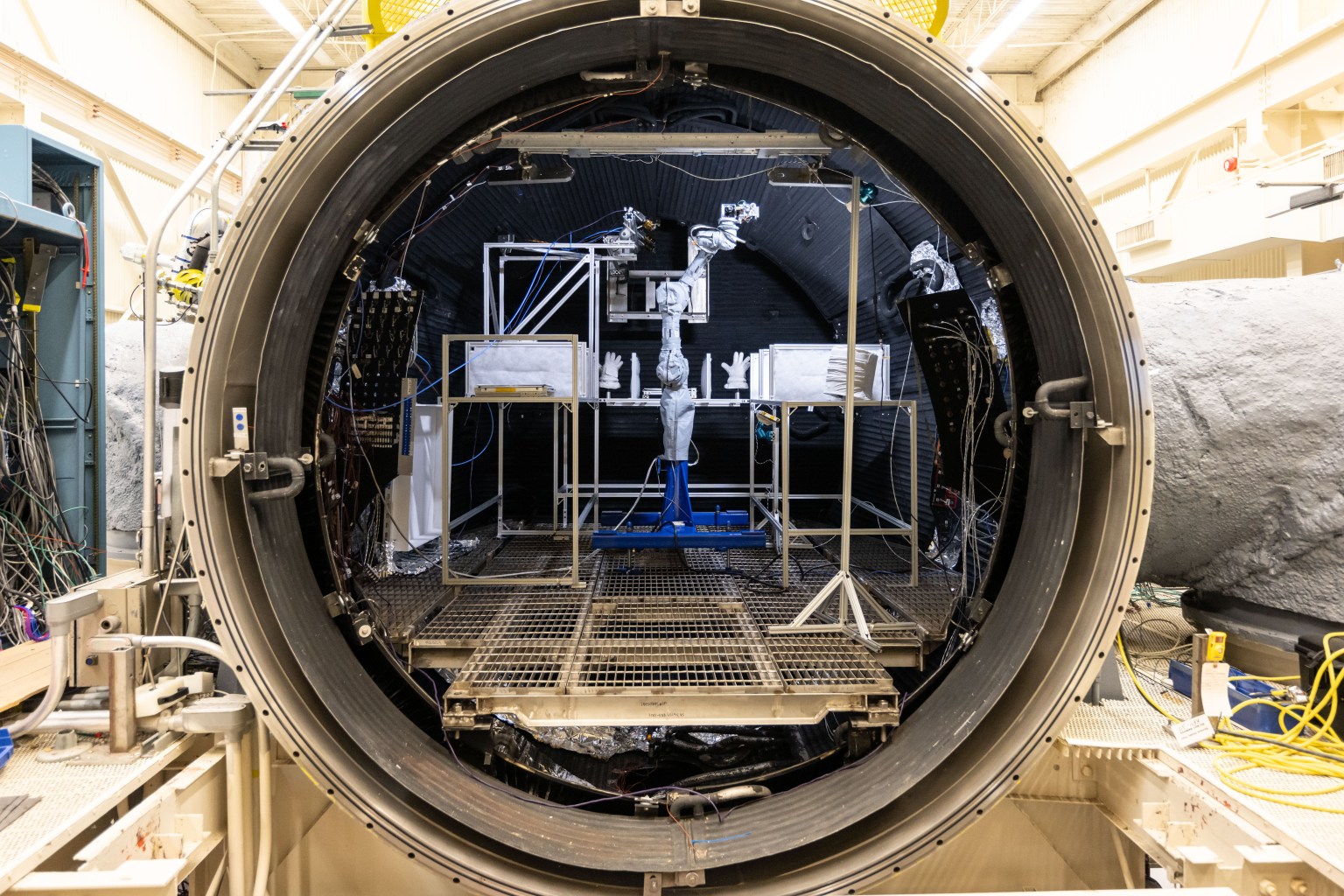
The Handheld Lunar Electrostatic Dust Mitigation (LEDM) tool is tested inside the Lunar Development and Test Facility at NASA’s Johnson Space Center in Houston.
Credits:
NASA/Josh Valcarcel
Before astronauts return to the Moon’s surface through NASA’s Artemis program , the hardware they depend on must first prove it can survive the unforgiving lunar environment. At NASA’s Johnson Space Center in Houston, engineers at the Lunar Development and Test Facility are tackling one of exploration’s biggest challenges: Moon dust.
Unlike sand on Earth, lunar dust is sharp, abrasive, and clings to nearly everything. Without mitigation, lunar dust could damage equipment and spacesuits while posing health risks to astronauts. Understanding and mitigating the effects of lunar dust is essential as astronauts prepare to live and work on the surface of the Moon.
The Handheld Lunar Electrostatic Dust Mitigation tool is tested inside the Lunar Development and Test Facility at NASA’s Johnson Space Center in Houston.
NASA/Josh Valcarcel
Located within the Energy Systems Test Area and managed by NASA engineers, the Lunar Development and Test Facility supports the development and testing of hardware in simulated lunar conditions. Engineers evaluate systems and subsystems inside vacuum chambers using lunar regolith simulant to better understand how spacesuits, spacecraft components, and mechanisms with moving parts and joints will perform during future Artemis missions.
Lunar spacewalking tools undergo a dust mitigation test inside Johnson’s thermal vacuum chamber.
NASA/Bill Stafford
NASA Johnson’s Propulsion and Power Division developed specialized systems that make the facility’s lunar simulations possible. The facility includes a dust containment and preparation laboratory for ambient testing, a 3-foot cube vacuum chamber, and a 15-foot thermal vacuum chamber.
Inside the chamber, engineers test hardware under realistic lunar conditions using lunar regolith simulant. The chamber uses a closed-loop nitrogen system to recreate the harsh lunar environment.
“The facility helps develop and test technologies needed for long-duration lunar exploration,” said Mike Salinas, Propulsion and Power Division branch deputy chief. “Engineers are advancing techniques to extract resources from lunar regolith, which can be turned into oxygen for astronauts and liquid oxygen for rocket propellant.”
The spirit of exploration extends beyond the facility’s walls. Its exterior features a large-scale mural depicting astronauts exploring the lunar surface beneath a view of the cosmos. Completed in 2024 by artist Sebastian Boileau, the artwork celebrates the innovation, ingenuity, and discovery happening inside the building every day.
Artist Sebastien Boileau, left, and Margaret Braun pose in front of Johnson’s Lunar Development and Test Facility after the mural’s completion on Feb. 7, 2024.
NASA/Josh Valcarcel
Now, anyone can step inside the facility from anywhere. Explore NASA’s new 3D virtual tour of the Lunar Development and Test Facility to see where engineers are helping prepare the technologies that support this Golden Age of exploration and innovation.
About the Author
Sumer Loggins
Share
Details
Last Updated
Aug 07, 2026
Related Terms
Johnson Space Center
General
Explore More
2 min read
Ames Science Stars of the Month – August 2026
Article
3 days ago
6 min read
NASA Provides Updates on Moon Base Cargo Landers, Tech Demonstrations
Article
3 days ago
5 min read
Ike Theriot Helps Prepare Astronauts to Work on the Moon
Article
4 days ago
Keep Exploring
Discover More Topics From NASA
Missions
Humans in Space
Climate Change
Solar System
Comments
No comments yet — be the first to weigh in 👇
No comments yet. Be the first!