Full text
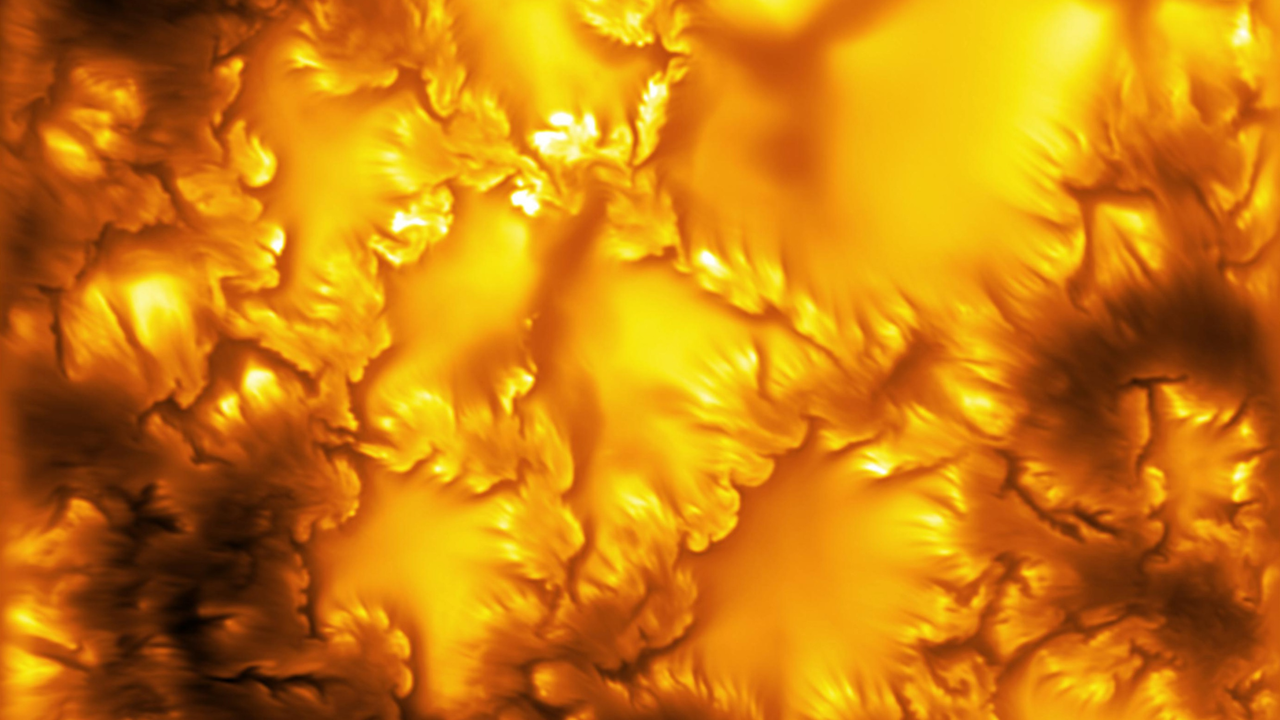
New images captured by the world's most powerful solar telescope have revealed something that was hiding in plain sight on the sun for 150 years: thousands of tiny whirlpools twisting across our star's surface. The ultra-detailed observations could help to explain some of the sun's most violent behavior as well as hint at the answer to a long-standing solar mystery.
The new time-lapse footage offers the first direct proof of a long-predicted phenomenon called Kelvin-Helmholtz instability . The effect itself isn't new to science; it's named for physicists Lord Kelvin and Hermann von Helmholtz, who described it in the 19th century . The physicists found that whenever two fluids slide past each other at different speeds, the friction between them, or shear, rolls into spiraling patterns. However, this is the first time this effect has been seen on the sun, where that shear plays out between neighboring streams of solar plasma.
Researchers captured the swirls using the U.S. National Science Foundation's Daniel K. Inouye Solar Telescope in Hawaii and then compared the images against computer simulations of the sun's visible surface, called the photosphere. The findings were published Aug. 5 in the journal Nature .
A time-lapse view of the Inouye telescope's obseravtions of the sun. (Image credit: NSF/NSO/AURA/MPS ) The resulting time-lapse footage from the telescope is unlike anything solar physicists have captured before. It shows dozens of tiny vortices clustering along the edges of magnetic regions, some accompanied by delicate, dark stripes known as striations, according to a statement from the National Science Foundation. The telescope's resolution is sharp enough to pick out structures just tens of miles across — a scale so fine that the vortices had gone completely undetected until now.
When the researchers lined the images up against their simulations, the match was close enough — down to the average spacing between vortices — to confirm that they'd finally caught the instability in action.
Beyond the impressive visuals, researchers think these swirls may serve an important function. By constantly twisting and mixing the sun's magnetic-field lines, these vortices may play a part in building up the energy behind solar flares and coronal mass ejections .
RELATED STORIES
'The fate of Earth depends on a delicate balance': Our planet may survive the death of the sun after all, new models hint
Scientists discover the possible origin of the sun's magnetic field, and it's not where they thought it was
How long does it take the sun to rotate?
The effect also might help to explain the long-standing mystery of why the sun's outer atmosphere, or corona, reaches temperatures of around 2 million degrees Fahrenheit (around 1 million degrees Celsius) while its surface remains hundreds of thousands of degrees cooler , Thomas Rimmele , chief technologist at the National Solar Observatory, said in the statement.
The team now plans to use computer programs to automatically track these vortices across future observations. This will help them measure exactly how much these swirls contribute to heating the corona and driving the explosive space weather that can disrupt satellites , communications and power grids on Earth.
See how much you know about the sun with our sun quiz!
 UK cuts funding for physics and astronomy, threatening Lovell Telescope and CERN project
Nature · 6h ago
UK cuts funding for physics and astronomy, threatening Lovell Telescope and CERN project
Nature · 6h ago
 Total solar eclipse on August 12 visible across northern Spain — first in 20 years
France 24 · 6h ago
Total solar eclipse on August 12 visible across northern Spain — first in 20 years
France 24 · 6h ago
Comments
No comments yet — be the first to weigh in 👇
No comments yet. Be the first!