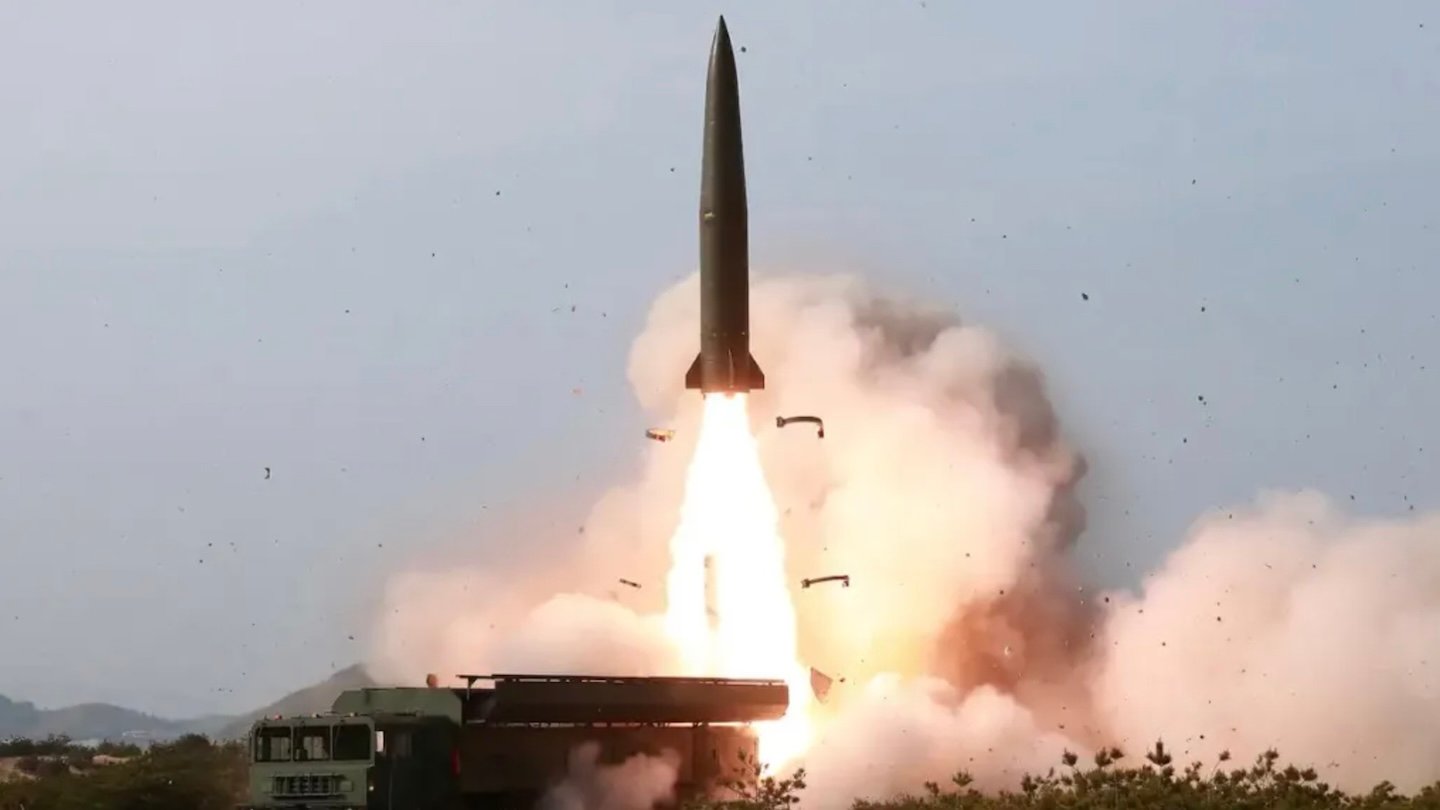
North Korea preparing missile unit deployment to Russia near Ukraine border
Ukraine's Main Directorate of Intelligence (GUR) says North Korea is preparing to deploy roughly 90 personnel to Russia's Voronezh region, which borders Ukraine, alongside the Russian military's 112th Guards Missile Brigade. The unit could field six launchers and up to 120 KN-23 and KN-24 short-range ballistic missiles, with the final composition to be confirmed at senior-level talks next month. Kyiv warns its dwindling ballistic missile defences are already costing civilian lives.
Full text
Ukraine’s military intelligence says North Korea is preparing to deploy a missile unit to western Russia, which would mark another major expansion of military cooperation between Moscow and Pyongyang . The report comes as Kyiv warns its dwindling ballistic missile defenses are costing civilian lives.
Andrii Cherniak of Ukraine’s Main Directorate of Intelligence (GUR) told Reuters that the deployment will involve approximately 90 North Korean personnel stationed in Russia’s Voronezh region — which borders Ukraine — alongside the Russian military’s 112th Guards Missile Brigade. Ukrainian intelligence assesses the unit could ultimately field six launchers and as many as 120 KN-23 and KN-24 short-range ballistic missiles (SRBMs), although the final composition is expected to be determined during senior-level talks next month.
A North Korean KN-24 short-range ballistic missile. North Korean State Media
The Ukrainian intelligence assessment has not been independently verified.
If confirmed, the deployment would represent a further deepening of North Korean support for Russia, after supplying Russia with ammunition , smaller numbers of ballistic missiles , and troops .
The Ukrainian Air Force today said Russia launched another major overnight strike combining drones with ballistic missiles. Preliminary figures showed Ukrainian air defenses shot down 98 of the 115 drones launched, but failed to intercept a single ballistic missile. As well as the inherent difficulty of intercepting these threats , this statistic also points to the exhaustion of its Patriot interceptor stockpiles .
Overnight, Russia attacked Kyiv and the surrounding region with more than two dozen ballistic missiles, killing at least 17 people and injuring more than four dozens.
Russian strikes take no summer vacation; support for Ukraine and pressure on the aggressor must not pause… pic.twitter.com/GLc0YUgUgG
— Andrii Sybiha (@andrii_sybiha) August 5, 2026
The attack killed at least 17 people and injured dozens more after strikes hit multiple locations across Kyiv.
President Volodymyr Zelensky directly linked the casualties to continued shortages of advanced air-defense systems.
“Ballistic missile interceptors could have saved the lives of those killed today,” Zelensky wrote on social media. “It is very important that our partners understand that delays in supplying them, or an unwillingness to provide anti-ballistic systems, lead directly to such horrific casualties and destruction.”
As of now, 44 people have been reported injured in the massive Russian strike on Kyiv and the Kyiv region. Another 17 people, tragically, were killed. My condolences to their families and loved ones. It was a heavy strike – 24 ballistic missiles, 4 Zircon/Oniks missiles, and… pic.twitter.com/4LoHXXkt8R
— Volodymyr Zelenskyy / Володимир Зеленський (@ZelenskyyUa) August 5, 2026
Ukraine has spent months urging Western partners to provide additional Patriot batteries and interceptor missiles, which remain among the few systems capable of defeating ballistic missile threats such as Russia’s Iskander and North Korea’s KN-23 and KN-24. While Ukrainian forces routinely claim to intercept the majority of incoming drones and many cruise missiles, ballistic missiles continue to present one of the most difficult threats to defend against.
Last month, U.S. President Donald Trump suggested Washington might grant Ukraine a license to manufacture Patriot interceptors domestically before later appearing to back away from the proposal, saying the technology was “a hard thing to give away.”
Trump on Ukraine and Patriots:
We have to be very careful about letting somebody build our advanced weapons.
It's a hard thing to give away that kind of technology.
Those people whom you give technology can also turn on you. That's possible.
We have to be very careful. pic.twitter.com/5QaUnkDsrN
— Clash Report (@clashreport) July 31, 2026
According to Ukraine’s military administration, seven sites across Kyiv were struck during the latest attack, which began shortly after midnight. Zelensky said the primary targets included civilian industrial facilities, among them a brewing company and warehouses storing construction materials.
“Partners who are not yet ready to play a more active role in supplying interceptors can help by implementing new sanctions. A significant share of Russia’s ballistic missile production is still not under sanctions,” Zelensky wrote on X. “Even now. New steps are needed — from the G7, the European Union, and everyone who supports the protection of life. Thank you to those who are willing to help in this way.”
Kyiv Mayor Vitali Klitschko said rescue operations continued throughout the day.
“There may still be people under the rubble,” he said.
Apocalyptic scenes in Kyiv following Russian missiles strikes on Tuesday night. https://t.co/AoChQIPqCQ pic.twitter.com/Ew8LyaECae
— Status-6 (War & Military News) (@Archer83Able) August 4, 2026
Emergency crews rescued two survivors from a destroyed warehouse near the city center. Klitschko said 24 people were injured, including an ambulance driver, while four remained in critical condition. The strikes also ignited multiple fires at warehouses and industrial sites, while Ukrainian authorities reported an ammonia leak triggered by one of the impacts.
The latest attack coincides with what Ukrainian intelligence says was Russia’s first use of North Korean ballistic missiles since August 2025.
Cherniak told Reuters that Pyongyang recently delivered another batch of 40 KN-23 and KN-24 missiles to Russia, along with additional personnel. He said Russia ultimately expects to receive 120 North Korean ballistic missiles and six launchers.
A North Korean KN-23 short-range ballistic missile. North Korean State Media
According to Ukrainian authorities, one of the newly delivered North Korean missiles struck the central Ukrainian village of Radushne last week, flattening a residential home and killing at least five members of the same family.
In the strike on Radushne, for the first time in a while, the Russians used a North Korean missile, according to preliminary data. Of course, more examinations will follow, and everything will be verified, but as of now – it is a North Korean ballistic missile. The alliance… pic.twitter.com/UtTTNGwBUb
— Volodymyr Zelenskyy / Володимир Зеленський (@ZelenskyyUa) July 30, 2026
Clearly, any increase in Russia’s ballistic missile inventory poses a serious challenge for Ukraine’s already strained air defenses. The situation is likely to become more difficult heading into the coming winter, when Russia normally steps up its strikes against Ukraine’s electrical grid.
The KN-23, known in North Korea as the Hwasong-11A, is a traditional SRBM that can reach out to around 800 kilometers (497 miles) and has a 500-kilogram (1,102-pound) class unitary high-explosive warhead. It offers greater range than Russia’s 9M723 Iskander SRBM, which carries a similarly sized warhead but has a range of 500 kilometers (311 miles). This weapon has also been fired from adapted railcars, a concept you can read more about here .
A North Korean KN-23 test. North Korean State Media
As for the KN-24, or Hwasong-11B, this has a range of approximately 410 kilometers (255 miles), making it more of a battlefield support SRBM, but still sufficient for Russia to strike many targets within Ukraine. It is often considered a North Korean analog of the U.S.-made Army Tactical Missile System (ATACMS) .
KN-24 being test-launched. North Korean State Media
However, the North Korean SRBMs are considered less accurate than their Russian-made counterparts and have been associated with strikes causing significant civilian casualties.
According to a report from Ukrainian state prosecutors, around half of the KN-23s that had been launched by Russia between late December 2023 and late February 2024 not only deviated from their trajectory but also exploded in midair.
Interesting Ukrainian MoD assessment of North Korea's KN-23 and KN-24 missiles. https://t.co/PxgyjMCog9
— Fabian Hinz (@fab_hinz) April 18, 2026
An investigation by Conflict Armament Research (CAR) into the wreckage of a KN-23/KN-24 missile used by Russia in Ukraine found that the missile contained more than 290 foreign-made electronic components, with approximately 75 percent linked to U.S. companies, 16 percent to European firms, and the remainder to Asian manufacturers. This suggests that North Korea continues to obtain critical Western technology despite longstanding international sanctions and points to continued limitations in Pyongyang’s high-technology production capabilities.
Analysis of the debris from one of the North Korean ballistic missiles fired by Russia at Ukraine found it was constructed with more than 290 non-domestic electronic components. Many of them were produced by US companies in the last 3 years.
This analysis was conducted… pic.twitter.com/YHwwAZG0Wo
— Colby Badhwar (@ColbyBadhwar) February 20, 2024
North Korea first began supplying KN-23 and KN-24 missiles to Russia in late 2023. Cherniak said Pyongyang delivered approximately 150 ballistic missiles between late 2023 and August 2025. Ukraine also says North Korea has supplied millions of much-needed artillery projectiles and deployed around 14,000 troops to Russia’s Kursk region under the countries’ 2024 mutual defense agreement.
A graphic shown at a White House press conference in January 2024 provides details about Russian use of North Korean ballistic missiles. NSC/White House
Cherniak said roughly 9,500 North Korean troops remain in Kursk but are not currently engaged in combat operations against Ukraine. Zelensky said last month that Russia is seeking an additional 30,000 North Korean troops and is preparing facilities in the Voronezh region to receive them.
Overall, North Korean-supplied missiles make up only a very small fraction of the weapons used in Russian strikes on Ukraine, but there has long been concern about the direction the burgeoning military relationship between Moscow and Pyongyang could take. There have been particular concerns that Russian expertise in the development of ballistic missiles and nuclear weapons — as well as other weapons and technologies — could be provided to North Korea.
The reported new deployment comes as Russia appears to be increasing its reliance on ballistic missiles to exploit one of Ukraine’s most significant military vulnerabilities. With few signs that Russia has been able to further ramp up production of its own Iskander missiles, an increased supply of North Korean ballistic missiles would take advantage of a gap in Ukrainian air defenses and further threaten its cities, energy infrastructure , and other targets. The bigger concern is not simply another shipment of missiles, but the prospect of Russia tapping into an expanding North Korean production base financed by Moscow, allowing it to sustain high-volume ballistic missile attacks for far longer than it otherwise could.
Ukraine’s ability to defeat ballistic missiles of any origin has become increasingly constrained by the availability of interceptor missiles. Patriot remains the primary system capable of reliably engaging Iskander, KN-23, and KN-24 ballistic missiles, but the U.S.-made interceptors are expensive, produced in relatively modest numbers, and are also needed to meet U.S. and allied needs around the world. European-supplied SAMP/T batteries also provide a limited anti-ballistic capability, but have been provided in only limited numbers so far .
Ukrainian personnel remove camouflage netting from a Patriot launcher. Ukrainian Air Force
Global demand for Patriot interceptors has surged amid conflicts in Europe and the Middle East , straining U.S. and allied inventories and production capacity. Those constraints have become significant enough that Congress has questioned whether the Pentagon can sustain higher transfer rates to Ukraine even as Kyiv presses for more interceptors. Meanwhile, although the United States continues discussing licensed Patriot production with Ukraine , any domestic manufacturing effort would take many months—if not years—to produce missiles in meaningful numbers, leaving Kyiv dependent on allied deliveries for the foreseeable future.
Whether or not the reported North Korean missile unit deployment materializes, the operational trend is becoming increasingly clear. Russia is continuing to expand the scale and complexity of its long-range strike campaigns, pairing mass drone attacks with growing numbers of ballistic missiles specifically intended to exploit one of Ukraine’s most difficult defensive challenges. As Kyiv’s leadership continues to press for additional Patriot batteries and interceptor missiles, the consequences of those shortages are becoming increasingly evident with every large-scale strike.
Contact the author: thomas@thewarzone.com
The post North Korea Upping Ballistic Missile Supplies To Russia Would Be Bad News For Ukraine At The Worst Time appeared first on TWZ .
Similar stories
 🪖 Military
North Korea deploys ballistic missile unit to Russia for strikes on Ukraine
Wirtualna Polska · 11h ago
🪖 Military
Ukrainian intel: North Korea deploys 120 ballistic missiles to western Russia
Defence24 · 15h ago
🪖 Military
North Korea deploys ballistic missile unit to Russia for strikes on Ukraine
Wirtualna Polska · 11h ago
🪖 Military
Ukrainian intel: North Korea deploys 120 ballistic missiles to western Russia
Defence24 · 15h ago
 🪖 Military
Zelensky warns Russia may take in 30,000 more North Korean troops
Bankier.pl · 9d ago
🪖 Military
Zelensky warns Russia may take in 30,000 more North Korean troops
Bankier.pl · 9d ago
Similar stories
🪖 Military
North Korea deploys ballistic missile unit to Russia for strikes on Ukraine
Wirtualna Polska · 11h ago
🪖 Military
Ukrainian intel: North Korea deploys 120 ballistic missiles to western Russia
Defence24 · 15h ago
🪖 Military
Zelensky warns Russia may take in 30,000 more North Korean troops
Bankier.pl · 9d ago
Should NATO countries urgently supply Ukraine with more missile defence systems?
Comments
No comments yet
Comments
No comments yet — be the first to weigh in 👇
No comments yet. Be the first!