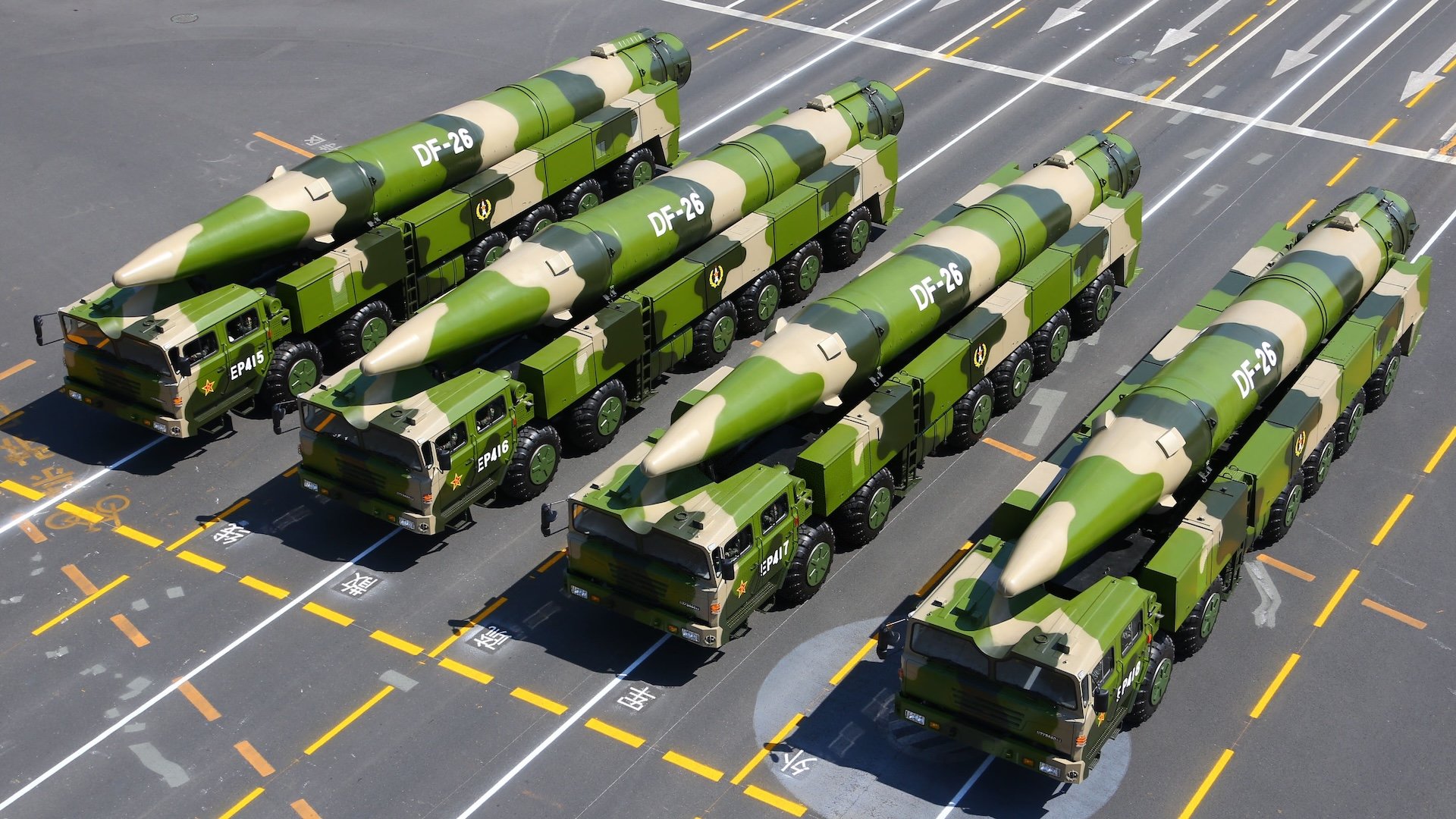
China builds world's largest regional ballistic missile arsenal
China's People's Liberation Army Rocket Force now fields the world's largest and one of the most diverse ballistic missile arsenals, having dramatically expanded from a small nuclear deterrent over the past two decades. Both conventional and nuclear-capable missiles form the backbone of Beijing's anti-access/area-denial (A2/AD) strategy. Short-range systems are optimised for a Taiwan contingency, while intermediate-range weapons can strike Guam and threaten U.S. naval forces deep into the Western Pacific.
Full text
China’s ballistic missile arsenal has undergone a dramatic transformation over the past two decades. Once centered on a relatively small force of nuclear missiles designed primarily for deterrence, which we discussed in the first part of this series , the People’s Liberation Army Rocket Force (PLARF) now fields the world’s largest — and one of the most diverse — conventional and nuclear-armed ballistic missile forces. Among its increasingly advanced regional ballistic missiles are several types that are capable of carrying either conventional or nuclear warheads, further complicating crisis stability.
Ranging from short-range systems optimized for a Taiwan contingency to intermediate-range weapons capable of striking Guam and threatening U.S. naval forces deep into the Western Pacific, these regional missiles have become the backbone of Beijing’s anti-access/area-denial (A2/AD) strategy. The land-based examples are road-mobile, solid-fueled, and increasingly precise. Some are fitted with hypersonic or maneuvering warheads to further complicate the work of an adversary’s air defenses. As of last year, the Pentagon assessed that China fielded 600 missiles in the ‘boosted hypersonic’ category, which includes systems carrying hypersonic glide vehicles (HGVs) as well as air-launched ballistic missiles , also covered in this article.
DF-21 missiles on parade on October 1, 2009, in Beijing, China. Since then, Chinese ballistic missile development has moved swiftly. Getty Images
This guide examines China’s principal short-, medium-, and intermediate-range ballistic missile systems, how they evolved, and the roles they are expected to play in any future conflict in the Indo-Pacific.
In this context, a short-range ballistic missile (SRBM) refers to a ballistic missile with a range of up to 1,000 kilometers (621 miles), typically intended for battlefield or nearby regional targets; a medium-range ballistic missile (MRBM) covers ranges of 1,000-3,000 kilometers (621-1,864 miles) and is designed to strike targets across a broader region; and an intermediate-range ballistic missile (IRBM) has a range of 3,000-5,500 kilometers (1,864-3,418 miles), enabling it to reach distant regional targets.
This article also discusses multiple missiles that carry either a hypersonic glide vehicle (HGV) or a maneuverable reentry vehicle (MaRV). These weapon types can potentially be adapted to hit moving vessels. A MaRV follows a roughly ballistic path to its impact point, maneuvering to improve terminal accuracy and defeat missile defenses. If paired with a seeker, among other alterations, they can potentially be used to strike ships. Meanwhile, unlike a traditional ballistic reentry vehicle, an HGV is designed to be boosted to high speed and released before proceeding along a relatively shallow, atmospheric flight path to its target. It remains maneuverable throughout much of its flight, allowing it to change course and vary its altitude. That combination of sustained hypersonic speed and unpredictable flight profile makes it far more difficult to successfully engage, while also reducing the time air defenses have to defend against it — provided they even have weapons that can successfully do so.
Short-range ballistic missiles
The PLARF fields multiple variants of the DF-11, DF-15, and DF-16 SRBM families. Among their most important roles is to hold Taiwan and the southern reaches of the Japanese archipelago at risk. Ongoing modernization efforts to improve accuracy, survivability, and operational flexibility underscore the continued importance of these systems, particularly for a cross-Strait campaign . Just as significant is their sheer quantity, which would enable sustained strikes against the many military and infrastructure targets that would need to be engaged in a major conflict.
DF-11A (CSS-7 Mod 2)
The origins of the DF-11 can be traced back to 1985, and work on a new single-stage solid-fuel ballistic missile. The initial requirement called for a 300-kilometer (186-mile) range, matching that of the widely used Soviet Scud-B , using a similar road-mobile transporter-erector-launcher (TEL). However, development trailed the DF-15, culminating in a successful flight test in mid-1990.
The DF-11 entered PLARF service in 1992, but work on an improved version reportedly began almost immediately. Development of the DF-11A started as early as 1993 and focused primarily on extending the missile’s reach to approximately 600 kilometers (373 miles), effectively doubling the range of the original design. Following its maiden flight in 1997, the program was publicly acknowledged the following year, and the DF-11A formally entered Chinese service in 1999.
China also developed a specialized bunker-busting variant known as the DF-11AZT, reportedly entering service in 2013. Believed to use the DF-11A airframe, the missile replaces the standard high-explosive payload with a penetrator warhead optimized for attacking hardened and fortified targets. Images of the system surfaced in Chinese media in 2016, followed by the release of footage showing a 2013 test launch the following year.
A lineup of DF-11 variants, with a DF-11AZT reportedly on the far right. via Chinese internet
Although rumors have periodically claimed the DF-11 family can carry a nuclear warhead, the available evidence does not support that assessment. Today, it appears that only one brigade still operates the system.
A PLARF DF-11A combat launch drill from a highway in the Eastern Theater Command. via Chinese internet
DF-15 (CSS-6)
China began developing a new generation of conventionally armed, mobile SRBMs during the 1980s, mainly with export customers in mind. The DF-15 has evolved through several iterations, although publicly available information on the missile family remains fragmented and, in some cases, contradictory. The first major upgrade, the DF-15A, reportedly entered service in 1996 and has occasionally been described as being capable of carrying a nuclear payload. However, the only PLARF brigade still believed to operate the variant is consistently identified in open-source assessments as a conventional missile unit. Estimates of its maximum range are equally inconsistent, with figures ranging from the original 600 kilometers (373 miles) to as much as 900 kilometers (559 miles).
A more substantial redesign followed with the DF-15B (CSS-6 Mod 3), which reportedly entered operational service around 2006 before making its public debut during China’s military parade in 2009. The most obvious external change is its triconic reentry vehicle fitted with control fins, a configuration widely interpreted as incorporating a MaRV warhead.
CCTV Military's Weibo account posted footage of what looks like a DF-15 short-range ballistic missile. pic.twitter.com/mG7NqhqIM9
— Duan Dang (@duandang) August 4, 2022
Around 2013, another variant, the DF-15C (CSS-6 Mod 2), reportedly entered service. Based on the shape of its warhead, the missile is widely believed to be optimized for attacks against hardened and deeply buried targets, much like the previous DF-11AZT.
The DF-15 remains in service with only a small number of PLARF brigades and appears to be steadily giving way to the newer, longer-ranged, and more capable DF-16.
A screencap from an official PLA video showing the launch of a DF-15 missile, purportedly from the Taiwan-focused exercise in August 2022. PLA
In 2022, the PLARF fired multiple DF-15s into the waters around Taiwan during live-fire drills following then-U.S. House Speaker Nancy Pelosi’s visit to Taiwan. This reflects the fact that missiles in this category remain central to any contingency involving the island.
DF-16 (CSS-11)
Another conventionally armed mobile SRBM, the DF-16 has steadily replaced the DF-15. Although it made its public debut during China’s 2015 military parade, the missile is widely believed to have entered PLARF service several years earlier, around 2011 or 2012. Nevertheless, Much about the DF-16 remains unclear.
The DF-16 closely resembles the older DF-15, but lacks the prominent aerodynamic fins found on its predecessor. This suggests the missile relies on a more advanced guidance and flight-control system capable of maintaining stability without the need for large external control surfaces. There is also some uncertainty about its range: this could potentially surpass 1,000 kilometers (621 miles), a threshold that would place it in the MRBM category.
Stills from a video showing a test of a DF-16 with a submunitions warhead:
DF-16 from mid 2010s, with a submunition warhead.
Employment of submunition warheads against land based targets is well established, but for the PLA, their use for large and medium naval targets from AShBMs are more interesting especially from a mission kill pov. pic.twitter.com/m6S4QFAgDS
— Rick Joe (@RickJoe_PLA) March 8, 2026
A version equipped with what appears to be a MaRV, commonly identified as the DF-16A (CSS-11 Mod 2), was spotted in footage of a Chinese military exercise released in early 2017, indicating it was already operational by that point. Chinese state media later revealed another DF-16 warhead configuration in 2018, widely interpreted as evidence of a further variant, the DF-16B (CSS-11 Mod 3?). Despite the emergence of multiple versions, open-source reporting consistently indicates that the DF-16 family is intended exclusively for conventional strike missions.
PLARF crews training with the DF-16. via Chinese internet
Medium-range ballistic missiles
Over the past decade, Beijing has invested heavily in modernizing both the quality and quantity of its medium-range ballistic missile forces. Today, it fields a diverse mix of MRBMs, backed up by long-range land-attack cruise missiles, capable of executing both conventional and nuclear missions across the Indo-Pacific. All of these MRBMs are road-mobile, carried on wheeled TELs, and powered by solid-fuel rocket motors, allowing them to disperse rapidly, launch with minimal preparation, and complicate efforts to destroy them either before or after firing.
DF-17 (CSS-22)
One of the PLARF’s most significant recent additions is the DF-17, the world’s first operational ballistic missile designed from the outset to deliver an HGV. Publicly unveiled during China’s 70th anniversary military parade in 2019, the system is estimated to have entered service shortly beforehand.
With an estimated range of 1,800-2,200 kilometers (1,118-1,367 miles), the DF-17 can reach targets across Taiwan, South Korea, and most of Japan, as well as U.S. military facilities throughout the First Island Chain . Traveling at speeds reportedly approaching Mach 10, the DF-17 could cover its maximum range in roughly a dozen minutes, representing a far more difficult target for existing air and missile defense systems.
A closer look at the (here mocked-up) hypersonic glide vehicle that sits on the top of the DF-17. CCTV capture
The PLARF would likely employ the DF-17 during the opening stages of a conflict to neutralize high-value assets, including integrated air and missile defense sites, long-range radars, command-and-control nodes, and other time-sensitive targets, thereby improving the effectiveness of follow-on strikes by less advanced missile systems.
Although Beijing maintains that the DF-17 is conventionally armed, Chinese media and senior U.S. military officials have suggested the missile may also possess a nuclear capability. If confirmed, it would join several other PLARF missile systems believed to be dual-capable, further complicating an adversary’s ability to distinguish between conventional and nuclear strikes during a crisis, and potentially increasing the risk of miscalculation.
Reports have also periodically pointed to the development of an anti-ship variant, which would further expand the DF-17’s role within China’s growing long-range precision strike arsenal.
DF-17 missiles are reviewed during the V-Day military parade on September 3, 2025, in Beijing, China. Photo by VCG/VCG via Getty Images
DF-21
The origins of the DF-21 can be traced back to the late 1970s, when China began working in earnest on solid-fuel ballistic missiles. Following successful tests of a large-diameter solid rocket motor in 1978, development of the road-mobile DF-21 accelerated (as did work on a larger solid-fueled missile that would eventually evolve into the DF-31 intercontinental ballistic missile and its submarine-launched counterpart, the JL-2, both described in the first part of this feature ).
The DF-21 completed its maiden successful test in 1985 and rapidly entered operational service with the PLA. The original DF-21 carried a single nuclear warhead and formed the backbone of China’s first generation of solid-fuel strategic missile forces. Its range is estimated at more than 1,750 kilometers (1,087 miles).
Even before the original DF-21 entered widespread service, work had begun on an improved version. Approved in 1986, the DF-21A (CSS-5 Mod 2) focused on reducing structural weight while increasing propellant capacity, extending the missile’s range and improving overall performance. Flight testing began in 1991, and by the mid-1990s the PLA had begun replacing the original DF-21 with the upgraded variant.
A rare view of a DF-21A with its missile canister cap removed for launch. via Chinese internet
The DF-21 subsequently evolved from a purely nuclear deterrent into a remarkably versatile missile family. Around 2004, the PLA fielded the DF-21C (CSS-5 Mod 4), widely believed to be the first conventionally armed member of the series. Designed for precision land attack, the missile introduced an entirely new mission for the DF-21 but also highlighted a growing escalation risk. The DF-21C appears to have been retired, with surviving units reportedly having transitioned to newer missile systems.
Public information on a supposed DF-21B remains sparse. The designation may have referred to an intermediate development fitted with a MaRV before that technology matured into the much better-known DF-21D.
It was the DF-21D (CSS-5 Mod 5) that really brought the missile family into the spotlight, as one of China’s most closely watched strategic weapons. Public attention surged in 2010 after a senior U.S. Navy officer stated that the missile had reached initial operational capability. Equipped with a MaRV and designed specifically to attack moving warships, the conventionally armed DF-21D became the world’s first operational anti-ship ballistic missile (ASBM) and quickly earned the nickname “carrier killer” (since applied to several other weapon systems). Western sources attribute the DF-21D with a range of more than 1,500 kilometers (932 miles).
The concept reflected Beijing’s broader A2/AD strategy, which seeks to hold U.S. carrier strike groups at risk and complicate U.S. military intervention inside the First Island Chain. U.S. defense reports had been tracking the program since the mid-2000s, and subsequent reports indicate the DF-21D has been tested against both land-based carrier mockups and actual targets at sea , underscoring China’s continued investment in long-range precision strike capabilities.
DF-21D missile TELs drive past the Tiananmen Gate during a military parade to mark the 70th anniversary of the end of World War Two on September 3, 2015 in Beijing, China. Photo by Andy Wong – Pool /Getty Images
While both the DF-21C and DF-21D are conventionally armed, there is also a more modern nuclear-armed addition to the family. First reported in 2016, information about this missile is scarce. Some sources refer to this variant as the DF-21E, though this designation has not been seen in an authoritative context in China, and the Western reporting name CSS-5 Mod 6 has meanwhile been applied.
Intermediate-range ballistic missiles
For years, the medium-range DF-21 formed the backbone of China’s regional ballistic missile force, with different variants providing conventional land-attack, anti-ship, and nuclear strike capabilities. That role is increasingly being assumed by the longer-ranged DF-26 IRBM, which significantly expands the PLARF’s reach by bringing Guam, and its concentration of critical U.S. military facilities, within range. The in-development DF-27 looks set to push that range even further, blurring the boundary between an IRBM and an ICBM.
DF-26 (CSS-18)
Increasingly the centerpiece of the PLARF’s regional strike force is the DF-26, which appears to be a substantially enlarged and more capable evolution of the DF-21. Development is believed to have begun before 2010, with the first images emerging from Chinese sources around 2012 before U.S. intelligence publicly acknowledged the missile’s existence in 2014. Mounted on a highly mobile six-axle TEL, the two-stage, solid-fueled DF-26 made its public debut during China’s 2015 military parade and entered operational service the following year.
The DF-26 combines significantly greater range with exceptional mission flexibility. Unlike many earlier PLARF missiles, it is believed to be genuinely dual-capable, able to carry either conventional or nuclear warheads that can reportedly be exchanged relatively quickly depending on operational requirements.
A DF-26 prepared for launch. via Chinese internet
In addition to land-attack missions, China has also fielded an anti-ship variant , equipped with a MaRV, and effectively extending the DF-21D’s “carrier killer” concept many hundreds of miles farther out to sea .
The DF-26 is thought to have a range of more than 3,000 kilometers (1,864 miles).
Just as significant as the DF-26’s capabilities is the pace at which it has been fielded. The missile has become one of the fastest-growing elements of the PLARF’s inventory, reflecting Beijing’s increasing emphasis on longer-range conventional strike options. The U.S. Department of Defense estimated that China possessed more than 200 DF-26 launchers by 2020, a figure that had grown to around 250 just two years later. Combined with its ability to strike targets as far away as Guam while performing both conventional and nuclear missions, the DF-26 is poised to remain one of the PLARF’s most important regional strike weapons for the foreseeable future.
DF-26D missiles attend the military parade in Beijing, capital of China, September 3, 2015. Photo by VCG/VCG via Getty Images
DF-27 (CSS-X-24)
A next-generation system, the DF-27, represents the PLARF’s continued modernization. The Pentagon’s 2023 assessment described the DF-27 as still being under development, but a tranche of leaked U.S. intelligence documents earlier that year suggested at least a limited number had already entered service. If accurate, the DF-27 would represent another significant leap in China’s long-range precision strike capabilities. The Pentagon has stated that the missile could have a range of 5,000-8,000 kilometers (3,107-4,971 miles), pushing into the intercontinental-range category . Even at the lower end of this assessment, it could strike targets far beyond the Second Island Chain , including parts of Alaska and Australia, depending on launch location. At the higher end, it would be sufficient to reach Hawaii and potentially parts of the U.S. West Coast from some launch locations.
One missile I was hoping to see in yesterday's PLA parade was the DF-27—a new long-range hypersonic missile that's been discussed in the annual DoD China Military Power Report for the last few years.
However, it was missing from the parade…or was it??? pic.twitter.com/GPIGwkMgUG
— Tom Shugart (@tshugart3) September 3, 2025
Available reports indicate the missile is designed to carry an HGV and will likely be fielded in both land-attack and anti-ship variants. That combination could substantially expand the PLARF’s ability to threaten high-value targets across the Western Pacific, extending the reach of China’s A2/AD network farther into areas where U.S. carrier strike groups have traditionally operated under reduced threat.
The missile’s payload remains undisclosed, but given the PLARF’s growing inventory of dual-capable ballistic missiles, it would not be surprising if the DF-27 were ultimately able to carry either conventional or nuclear warheads.
Air-launched ballistic missiles
Falling into an interesting category is the air-launched ballistic missile (ALBM). The ALBM concept is far from new , with designs dating back to the Cold War , although they are currently seeing something of a comeback, with multiple nations around the globe now pursuing their capabilities . China is among them, and the best-known of these weapons, the JL-1, is today considered to constitute the airborne arm of the Chinese nuclear triad.
JL-1
The JL-1 ALBM can be launched by the modernized H-6N missile carrier aircraft of the People’s Liberation Army Air Force (PLAAF). These aircraft feature a modified fuselage that allows for the external carriage of these large weapons, as well as an in-flight refueling probe, extending their range.
One of the past images showing an H-6N carrying a missile that looks very similar to the JL-1. via Chinese internet
The JL-1 ALBM is assumed to be the same missile that has been referred to in the past in the West as the CH-AS-X-13, and which is understood to have been in development since at least the mid-2010s. This missile is reported to be an adapted, air-launched version of the DF-21 MRBM and similarly equipped with a MaRV. The possible relationship with the DF-21, and the DF-21D specifically, has prompted previous speculation about the H-6N having an anti-ship role, particularly against U.S. carrier strike groups , as well as being able to hit land targets.
China released first in-flight footage of an H-6N bomber carrying the JL-1 nuclear-capable air-launched ballistic missile, escorted by two J-20 stealth fighters.
JL-1: Nuclear-capable ALBM, ~8,000 km range, hypersonic reentry, also usable for anti-ship/land-attack. pic.twitter.com/e9uokWFnvz
— Clash Report (@clashreport) August 4, 2026
China has said the JL-1 (presumably coupled with the H-6N) has a range of approximately 8,000 kilometers (4,971 miles), although this is very much unconfirmed.
JL-1 missiles during the military parade marking the 80th anniversary of victory over Japan and the end of World War II, in Beijing’s Tiananmen Square on September 3, 2025. Photo by Pedro Pardo / AFP PEDRO PARDO
The latest Pentagon report on Chinese military capabilities refers to the H-6N as a “nuclear weapons-capable bomber,” and that its JL-1 ALBM is a “highly precise theater weapon that would be well suited for delivering a low-yield nuclear weapon.” However, it may also have the option of a conventional warhead.
Imagery has also emerged in the past, as seen below, which has contributed to discussions about the possibility of a second variation on the Chinese ALBM concept, with what may be a wedge-shaped unpowered HGV on top. As with the JL-1, this weapon could also be anti-ship capable.
The possible second variation on the CH-AS-X-13, or another different missile, with an apparent HGV on top. via Chinese internet
KD-21
Finally, the H-6K variant can carry the smaller KD-21 ALBM on its center-wing pylons. This designation indicates an anti-ship missile, but it may well have the capability to strike ground targets, too.
An inert KD-21 missile under the right wing of an H-6K at Zhuhai in 2022. via Chinese internet
In terms of its appearance, the weapon is very similar to the Russian Kinzhal (known in the West as the AS-24 Killjoy), a missile that is launched from adapted MiG-31 Foxhound interceptors and which has been employed in the war in Ukraine, apparently with only mixed success . Like the Kinzhal, which is an air-launched development of the Iskander SRBM, the KD-21 may be derived from a land-based weapon. In particular, the Chinese missile bears a close resemblance to the CM-401 land-based anti-ship ballistic missile (ASBM), a weapon offered for export. The truck- or ship-launched CM-401 is also capable of hitting static land targets and is said to have a terminal speed of between Mach 4 and 6 and a range of up to 290 kilometers (180 miles).
A mockup of a CM-401 on display at the Zhuhai Airshow in 2018. In the background is the truck-based launcher. via Chinese internet
Missile numbers
Estimating the size of the PLARF’s missile arsenal remains challenging, and, understandably, publicly available figures differ depending on whether they refer to launchers or missiles.
Recent Pentagon assessments estimate the PLARF operates roughly 200 SRBM launchers backed by around 1,000 missiles, approximately 300 MRBM launchers with some 1,300 missiles, and another 300 IRBM launchers fielding roughly 550 DF-26-class missiles.
While the number of Chinese SRBM launchers used for the DF-15 and DF-16 missiles, both of which are conventionally armed, has remained static in recent years according to Western estimates, Beijing has prioritized the development and deployment of land-based MRBMs and IRBMs, such as the dual-capable DF-21 and DF-26. From 2018 to 2019, for example, the Pentagon noted that the number of Chinese IRBM launchers and missiles had at least roughly tripled from roughly 30 to 80. In its 2020 report, the Pentagon noted that the PLARF had further increased this number to approximately 200 launchers.
Models of the DF-17 and DF-21C medium-range ballistic missiles, DF-26 intermediate-range ballistic missile, DF-41 intercontinental ballistic nuclear missile, and other missiles, exhibited at Beihang University in Hangzhou, Zhejiang Province, China. CFOTO/Future Publishing via Getty Images CFOTO
These figures are informed estimates, and they vary noticeably across successive Pentagon reports as intelligence assessments evolve. Even so, they underscore the extraordinary scale of China’s regional strike force and, perhaps more importantly, its substantial magazine depth. This would allow the PLARF to conduct repeated waves of missile strikes in a high-intensity campaign. Current conflicts, especially between Iran and the United States/Israel , as well as in Ukraine , have shown just how critical these weapons are, and underscore that they can be a deterrent just by existing in huge numbers. The cost of air defense is also very high for the one being targeted. These lessons learned will likely accelerate China’s acquisition of more missiles and improved designs.
Taken together, the missile families detailed here illustrate how dramatically the PLARF has evolved from a relatively small strategic force into one of the world’s most capable missile services. Older systems such as the DF-11, DF-15, and DF-21 continue to provide valuable magazine depth, while newer designs including the DF-16, DF-17, DF-26, and emerging DF-27 emphasize greater range, improved accuracy, enhanced survivability, and increased operational flexibility.
Just as importantly, Beijing has increasingly blurred the line between conventional and nuclear deterrence by fielding a growing number of dual-capable missile systems, complicating an adversary’s ability to determine China’s intentions during a crisis.
Coupled with expanding production, continued technological refinement, and the proliferation of hypersonic and anti-ship capabilities, the PLARF’s regional missile arsenal has become a central pillar of China’s military modernization and one of the most consequential strike forces in the Indo-Pacific. Any future conflict involving Taiwan, the First Island Chain, or U.S. forces in the Western Pacific is certain to feature these missiles prominently from its opening hours.
Contact the author: thomas@thewarzone.com
The post China’s Growing Regional Ballistic Missile Arsenal: A Guide appeared first on TWZ .
Similar stories
 🪖 Military
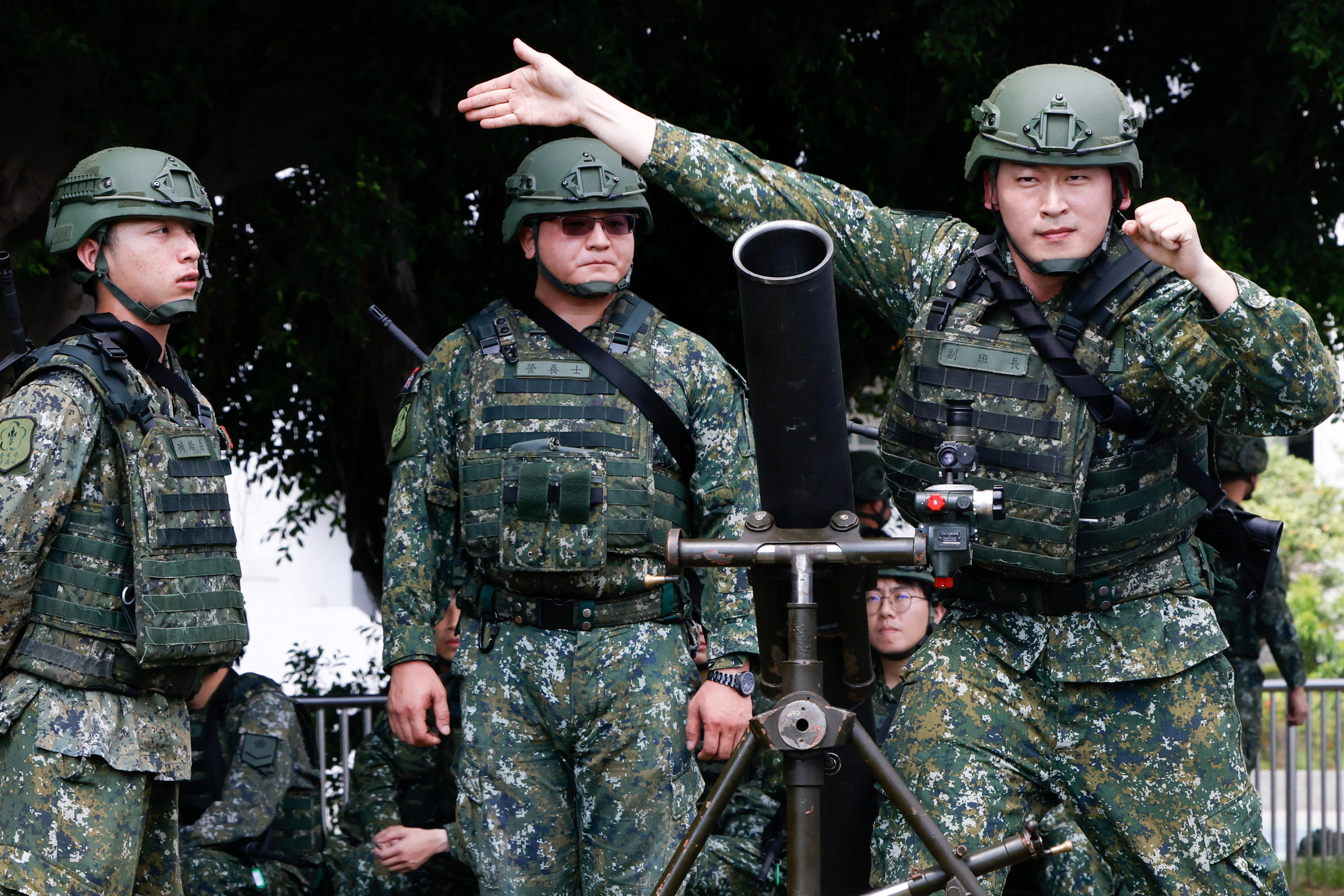
Taiwan drills defence against Chinese invasion in Han Kuang military exercises
Interia Fakty · 5h ago
🪖 Military
Taiwan drills defence against Chinese invasion in Han Kuang military exercises
Interia Fakty · 5h ago
 🪖 Military
Taiwan launches 10-day Han Kuang war games to test battlefield command flexibility
Defense News · 6h ago
🪖 Military
Taiwan launches 10-day Han Kuang war games to test battlefield command flexibility
Defense News · 6h ago
Similar stories
🪖 Military
Taiwan drills defence against Chinese invasion in Han Kuang military exercises
Interia Fakty · 5h ago
🪖 Military
Taiwan launches 10-day Han Kuang war games to test battlefield command flexibility
Defense News · 6h ago
Does China's expanding ballistic missile arsenal threaten global security?
Comments
No comments yet
Comments
No comments yet — be the first to weigh in 👇
No comments yet. Be the first!