Full text
Planting boots on Mars is hard enough. But getting "breathing room" on the Red Planet without inhaling toxic dust is yet another issue.
Given NASA's plans to eventually put astronauts on the Red Planet , the agency assembled a Martian Dust Limit Working Group earlier this year to review what's known and unknown about the toxicological hazard to human crews from exposure to Mars dust. The ultimate goal was to establish a permissible exposure limit for humans on the Red Planet by compiling a comprehensive set of expert perspectives regarding Martian dust toxicology, exposure pathways and mitigation strategies.
The working group's conclusions reinforced the view that an initial Martian dust standard "must balance conservatism with operational feasibility while accommodating architectural and scientific uncertainty," the report states. Furthermore, the report explains, "as additional Martian data and toxicological research become available, this standard should be periodically revisited to ensure continued protection of crew health during human exploration of Mars."
Unique study
A panel member for that study was Brian Hynek professor in the Department of Earth Science and a research associate at the Laboratory for Atmospheric and Space Physics, both at the University of Colorado, Boulder.
"It was a unique study," Hynek told Space.com, conducted by NASA specialists, space medicine experts, habitat designers, including toxicologists, volcanologists and geologists. "The task was to help gauge health hazards to humans, both for short and long-term stays," he said.
Just highlighting the differences between the moon and Mars played a role, said Hynek. "The moon is worse in some ways and Mars is worse in other ways."
Disneyland of dust
To be sure, one outcome from Apollo moonwalkers – the "dusty dozen" – is that dealing with lunar dust proved to be troublesome, much more than expected. The aged moon is a Disneyland of dust and crews that went there attested to that fact.
Once out and about, moonwalkers coped with very fine, tiny particles composed of sharp, glassy material. Lunar dust stuck to everything it came in contact with; dust eroded their spacesuits, caused overheating on equipment and instrumentation, compromised seals on their spacesuits, even irritated the eyes and lungs of moonwalkers.
"On Mars, dust particles are a little more rounded, not as jagged and cutting into you. But then you have all the extra chemical components and minerals that you don't have on the moon, like really unhealthy perchlorates," Hynek said. "We can use the lunar knowledge, but Mars is a totally different place," he added.
At the conclusion of Apollo 17's mission in December 1972, moonwalking suits and space helmets are covered by lunar dust. (Image credit: NASA) Heavy metals
Hynek noted that Martian dust is known to contain various carcinogens, such as silica and numerous heavy metals. He co-authored a recent paper on "Potential Health Impacts, Treatments, and Countermeasures of Martian Dust on Future Human Space Exploration."
"There's talk about growing crops on Mars," Hynek observed. "The martian soil is full of all these nasty chemicals. So the astronauts might get more exposure from what they are growing on Mars than the actual airborne dust," said Hynek.
Then there's the dust that will assuredly find its way into the habitat, Hynek said, so engineers are looking at filtering systems and just how much time will be required to clean the inside of the habitat.
"It's good to have the forethought and to start considering the Martian dust and its hazards. It poses a lot more health hazards than the lunar dust," Hynek concluded.
Learned our lesson
Joel Levine, a research professor in applied science at William and Mary in Williamsburg, Virginia, is a leading expert on lunar dust, engineering and safety concerns. He was not a panel member of the NASA report.
Levine cited earlier thinking from a recent National Academy of Sciences report on human exploration of Mars. Two goals noted in that 2026 report are Mars dust-related:
Determine what controls the onset and evolution of major dust storms, which dominate present-day atmospheric variability.
Characterize the effects of Martian dust on human physiology and hardware lifetime.
"This indicates that Mars dust is on the minds of mission planners! This is good news based on our experience with lunar dust on the Apollo landings," said Levine. "It looks like we learned our lesson about dust at future human landing sites."
Levine stated that Mars sample returns would be very helpful to characterize Martian dust samples for chemical composition and other qualities. "Unfortunately, it does not look like the Mars samples already collected will ever be returned to the Earth for analysis," he said.
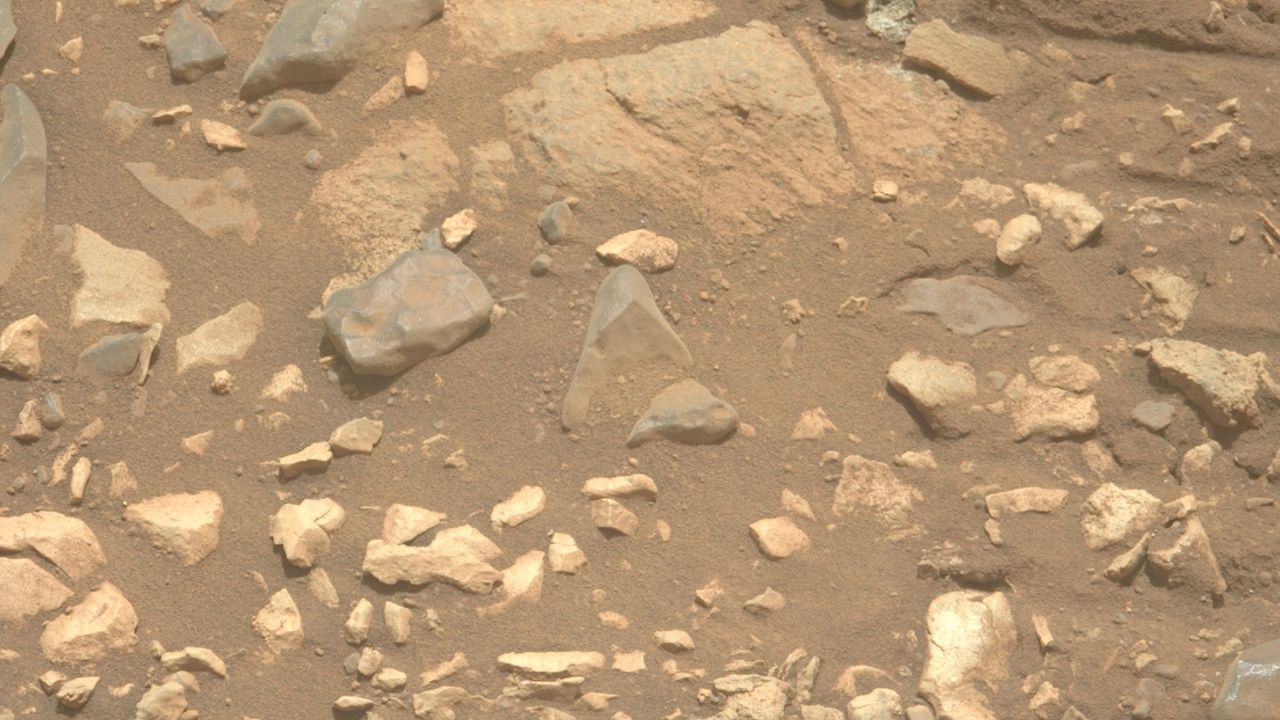
Martian dust seen on NASA's Perseverance rover on July 27, 2026 (Sol 1932) by the rover's Right Mastcam-Z camera. (Image credit: NASA/JPL-Caltech/ASU) Major takeaways
Shaunna Morrison, an associate professor in the Department of Earth and Planetary Sciences at Rutgers University in New Jersey, served as a panel member on the Martian Dust Limit Working Group.
"One of the major takeaways from the Mars dust working group is that martian dust is a real crew-health and engineering issue, but it is also a tractable one if it is treated as a design requirement from the beginning," Morrison emphasized.
The worry is not that Mars dust is uniquely or catastrophically toxic based on what we know now, Morrison told Space.com.
"The concern is that future crews will be living and working in a closed habitat, repeatedly going outside, bringing dust back in on suits and equipment, in a low-humidity environment," said Morrison. That's a condition in which small particles are more prone to becoming airborne and potentially inhaled, she said, and potentially crew members being exposed to fine respirable particles over many days.
A region-wide seasonal dust storm obscures the Jezero Crater in this image from NASA's Mars Perseverance rover, acquired using its Left Mastcam-Z camera on Aug. 20, 2024 (Sol 1244, or Martian day 1,244 of the rover's mission). (Image credit: NASA/JPL-Caltech/ASU) Prevention first
Morrison said that a key point is that we do not have as yet returned samples of authentic airborne martian dust. So NASA has to build a conservative standard using the best available evidence: lunar dust toxicology, Mars simulant studies, and the very extensive chemical and mineralogical datasets from Mars rovers and landers, she pointed out.
"The best strategy is prevention first," Morrison said. "Keep as much dust as possible outside the habitat, remove it quickly when it gets in, monitor airborne particles, and design the system so crews are not relying on medical countermeasures after exposure," she advised.
Comments
No comments yet — be the first to weigh in 👇
No comments yet. Be the first!