Full text
Beijing trimmed its car subsidy by roughly a third this year.
BYD and Geely leaned on exports to soften the home slump.
Analysts expect China’s whole car market to shrink in 2026.
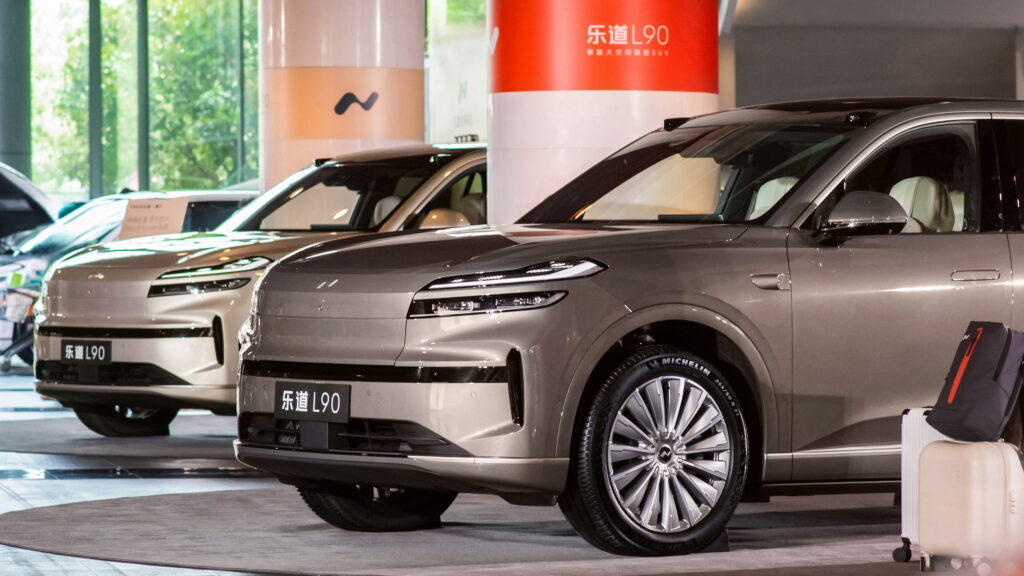
After years of what looked like unstoppable growth, sales of new electric vehicles in China are down 14 percent year on year, dragged lower in part by a slowing local economy and the government pulling some incentives.
var adpushup = window.adpushup = window.adpushup || {que:[]};
adpushup.que.push(function() {
if (adpushup.config.platform !== "DESKTOP"){
adpushup.triggerAd("0f7e3106-c4d6-4db4-8135-c508879a76f8");
} else {
adpushup.triggerAd("82503191-e1d1-435a-874f-9c78a2a54a2f");
}
});
Figures released by the China Passenger Car Association show that 4.7 million new EVs have been delivered in China this year. July treated some brands more kindly than June did, though major players like BYD and Geely are still feeling the downturn, as are smaller local firms including Xpeng and Nio.
Read: China’s Electrified Car Sales Sank 13%, And The World Is About To Feel It
In July, BYD sold 239,370 vehicles locally, down 9 percent from the same month in 2025 but up 4.9 percent from June. Geely followed a similar pattern, with July sales up 4 percent on June yet down 29.1 percent against last July, the South China Morning Post reports . What’s helping both automakers cushion the home-market slump is a surge in overseas exports.
var adpushup = window.adpushup = window.adpushup || {que:[]};
adpushup.que.push(function() {
if (adpushup.config.platform !== "DESKTOP"){
adpushup.triggerAd("89c65a14-4682-4807-a4bb-5436c5361bee");
} else{
adpushup.triggerAd("f25825bd-1260-4574-84ce-2b26e315fad8");
}
});
Brands like Xpeng , Nio, and Li Auto all have some footprint abroad, but their home nation still accounts for the vast majority of sales. Xpeng’s July deliveries slipped 5.2 percent to 38,027 vehicles versus June, Nio’s fell 11.5 percent to 35,934, and Li Auto’s dipped 1.4 percent to 30,468.
AlixPartners expects that by the end of this year, new car sales in China will have dropped by 10 percent to 24.6 million vehicles. The wider economy isn’t doing EV sellers any favors either. GDP grew just 4.3 percent year on year in the second quarter, China’s slowest pace since late 2022.
Incentive Pain
The government’s decision to trim incentives has had an immediate impact on sales . Earlier this year, any new car purchase came with a 15,000-yuan ($2,220) subsidy. That figure was recently cut by 33 percent, and the subsidy now equals 10 percent of a new vehicle’s purchase price, capped at 10,000 yuan ($1,480). For some of the nation’s most affordable EVs, the payout is now 5,000 yuan ($740) lower than before.
var adpushup = window.adpushup = window.adpushup || {que:[]};
adpushup.que.push(function() {
if (adpushup.config.platform !== "DESKTOP"){
adpushup.triggerAd("bb7964e9-07de-4b06-a83e-ead35079d53c");
} else {
adpushup.triggerAd("9b1169d9-7a89-4971-a77f-1397f7588751");
}
});
var adpushup = window.adpushup = window.adpushup || {que:[]};
adpushup.que.push(function() {
if (adpushup.config.platform !== "DESKTOP"){
adpushup.triggerAd("bb7964e9-07de-4b06-a83e-ead35079d53c");
} else {
adpushup.triggerAd("9b1169d9-7a89-4971-a77f-1397f7588751");
}
});

Comments
No comments yet — be the first to weigh in 👇
No comments yet. Be the first!