US Army revives giant cannon from cancelled SLRC program for hypersonic warhead tests
The US Army successfully conducted a live-fire test of a hypersonic warhead using a cannon-based launch system at Yuma Proving Ground in Arizona. The gun used is the Heavy Artillery Test System (HATS), derived from the cancelled Strategic Long Range Cannon (SLRC) programme, which was designed to strike targets at over 1,000 miles. The cannon approach offers a cheaper and faster method for evaluating future hypersonic weapons.
Full text
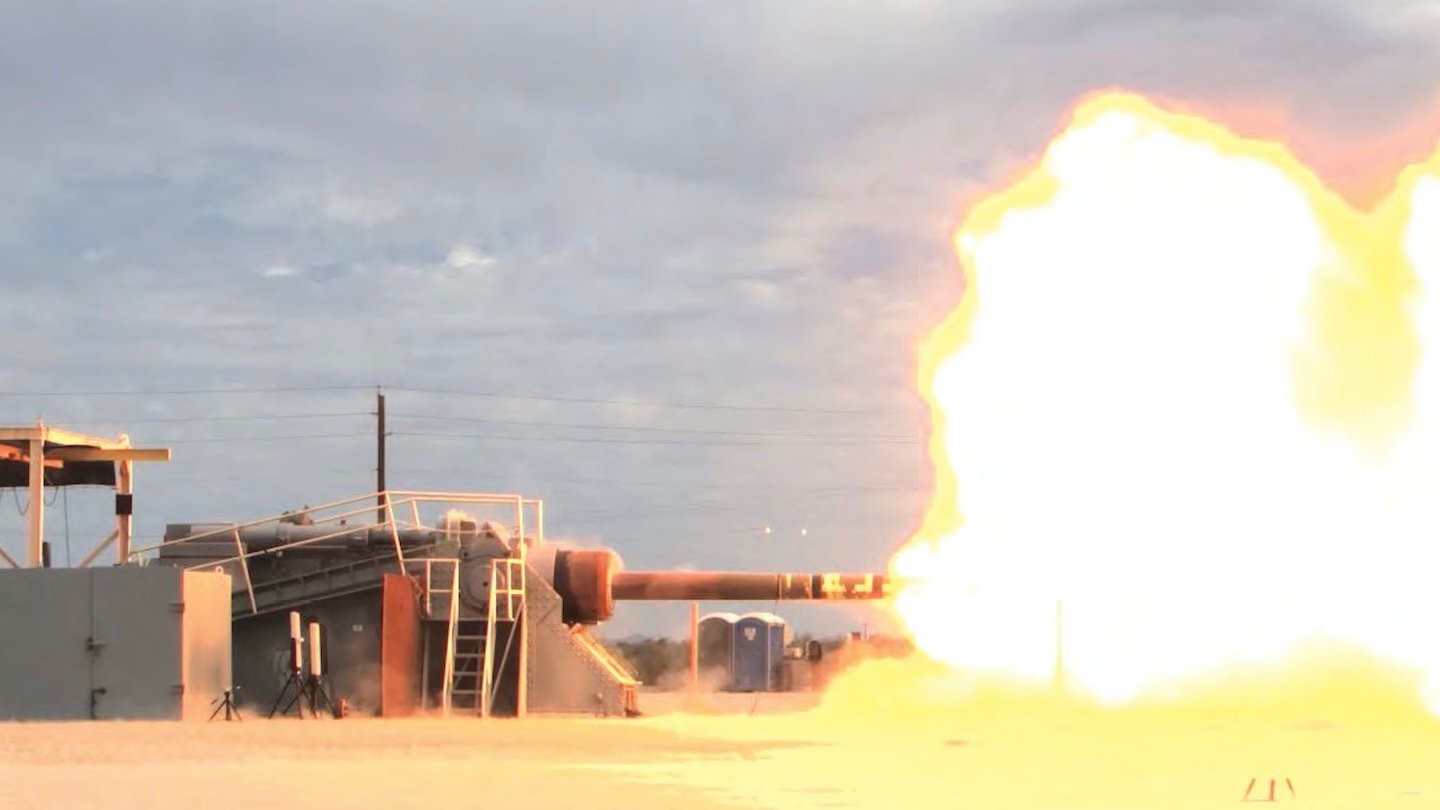
The U.S. Army says it has successfully completed a live-fire test of a hypersonic warhead using a cannon-based launch system at Yuma Proving Ground, Arizona, a demonstration that could provide a cheaper and faster way to evaluate the terminal performance of future hypersonic weapons . The gun in question is the Heavy Artillery Test System (HATS), or a modification of it, from the canceled Strategic Long Range Cannon (SLRC), a huge artillery piece intended to be able to hit targets out to a range of 1,000 miles or more. This suggests that the program could still provide value, this time in the test world.
Yuma Proving Ground (YPG) has successfully supported a full-scale, live-fire hypersonic warhead test fired from a cannon-based test https://t.co/aPueeqhM7M appears the test leveraged the Heavy Artillery Test System (HATS) from the canceled Strategic Long-Range Cannon (SLRC)… https://t.co/niKK7fZxZD pic.twitter.com/OboY13kD0a
— 笑脸男人 (@lfx160219) August 4, 2026
According to the latest issue of The Outpost , the in-house news organ of the Army’s Yuma Proving Ground, the test marks the first successful live-fire demonstration of a full-scale hypersonic warhead launched from what it describes as a “cannon base test system.” Rather than relying on an expensive flight test of an operational hypersonic missile, the approach uses a gun to accelerate the warhead to high speed before impact, allowing engineers to study its lethality under controlled conditions. Hypersonic velocity means speeds of Mach 5 and above.
The concept has been under development for roughly two years as a way to create what the Army calls “a high throughput, alternative method for assessing terminal effects at velocity and scale.” While the release does not disclose the velocity achieved during the test, or exactly when it occurred, the underlying idea is straightforward. Hypersonic weapons derive some of their destructive effect from the enormous kinetic energy they carry into a target, as well as, at least in some cases, a relatively small warhead. A large-caliber gun offers a comparatively inexpensive way to reproduce at least part of a hypersonic weapon’s terminal conditions without expending an entire missile or firing from an airborne launch platform, costing millions of dollars.
A full view of the live-fire test of a hypersonic warhead using the Heavy Artillery Test System (HATS) at Yuma Proving Ground, Arizona. U.S. Army
The effort brought together researchers from Lawrence Livermore National Laboratory and the Army Combat Capabilities Development Command Armaments Center (DEVCOM-AC), which developed a specialized launch package capable of surviving the extreme acceleration generated inside the gun barrel. Engineers also incorporated a DEVCOM-AC electronic safe-and-arm fuze while analyzing the internal ballistic forces the warhead would experience during launch. The extreme acceleration of being fired out a cannon is one major difference a warhead or test article would have to endure compared to being mounted on an actual missile and that must be accounted for.
Before the live-fire event, the team conducted an inert proof-of-concept firing that validated the overall approach. Army officials said those results led to a series of design refinements before progressing to a live warhead.
A model of a Strategic Long Range Cannon concept, in black, situated between models of more traditional tracked self-propelled howitzers. The SLRC, or a modification of it, was used for hypersonic warhead testing at Yuma. U.S. Army
The service offered a detailed description of the final firing sequence.
After instrumentation checks and target preparation were completed, crews positioned the launch package, armed the fuze, and loaded the warhead and propelling charge. Personnel then withdrew to protective bunkers while test officials monitored telemetry.
As the article describes it, the test director issued the command to fire, followed by “a massive boom” that echoed across Yuma Proving Ground. Once the dust settled, engineers reviewed high-speed camera footage before confirming the shot had achieved all of its objectives. According to the Army, the silence was “quickly broken by loud cheers confirming a complete success.”
Beyond the immediate test, the Army reckons the capability could significantly increase the pace of hypersonic weapons development. Instead of relying exclusively on limited and expensive missile flight tests, engineers could use cannon-launched surrogates to generate impact data earlier and more frequently during development. The release says the demonstration has already attracted interest from multiple hypersonic programs that are considering incorporating the methodology into future test campaigns.
Although not mentioned in the article, the “cannon base test system” seen in the accompanying photo is the Heavy Artillery Test System (HATS) that was developed under the Strategic Long Range Cannon (SLRC) program before that was axed, when Congress directed the Army to stop funding the weapon in its fiscal 2022 appropriations act.
The section on the Strategic Long Range Cannon in the Army’s 2022 Fiscal Year budget proposal. U.S. Army
At the time, the service said it wanted to move funds into a more general account that it could use to help mature various advanced technologies.
The Army also said that it planned to complete various research and development and testing of SLRC components in the 2021 fiscal year. This included work on the very large rocket-assisted projectile that was supposed to give the cannon its 1,000-mile-plus range, as well as “system integration and technology maturation for SLRC to include designs for long lead prototypes to be used in upcoming major system level demonstrations.”
A graphic showing a notional SLRC design that emerged in 2021, with the gun on a “platform” style mount attached at the front to an 8×8 Oshkosh M1070 Heavy Equipment Transporter System (HETS) tractor and at the rear to a three-axle trailing section. The Yuma test involved a static gun mounting. U.S. Army
Returning to hypersonic testing, other alternatives to end-to-end missile flights include rocket sleds, which have long been used to replicate high speeds to test different technologies.
Back in 2022, as you can read about here , the U.S. Air Force successfully recovered a reusable rocket sled after traveling at a recorded speed of 6,400 feet per second, or just about Mach 5.8, beyond the hypersonic threshold, at Holloman Air Force Base, New Mexico.
This was the first time the Air Force successfully recovered a reusable rocket sled after traveling at such a speed. Being able to recover reusable sleds after traveling at hypersonic speeds allows for the collection of critical post-testing data, which is particularly important for hypersonic weapons testing.
Roughly 10 miles long, the Holloman High-Speed Test Track (HHSTT) is the only track capable of recovering sleds that hit hypersonic velocity via high-speed braking.
The Air Force also began the Hypersonic Readiness program (HSR) in 2020, which focused principally on fielding a hypersonic nine-inch monorail sled test with high-speed braking capability.
A reusable rocket sled travels at 6,400 feet per second on a monorail before being recovered as part of the Hypersonic Sled Recovery effort at the High-Speed Test Track at Holloman Air Force Base, New Mexico, in 2022. U.S. Air Force
In general, hypersonic testing, a major priority across the U.S. military , is intended to push weapons and their components to the limits of what they can withstand. Test articles are subjected to the extreme heat, pressure, and mechanical loads associated with sustained flight at speeds above Mach 5 to determine whether materials, structures, and subsystems can survive the operational environment.
If the new gun-based approach proves broadly applicable, it could offer one answer to a persistent challenge in hypersonic development: generating meaningful terminal-effects data without consuming scarce and costly prototype missiles.
Exactly how closely the cannon-launched tests replicate the conditions experienced during an actual hypersonic weapon’s flight, and what velocity envelope the Army has achieved, remain unclear. Those details may ultimately determine how valuable the new test capability becomes across the Pentagon’s growing portfolio of hypersonic weapons. At the same time, any help in accelerating hypersonic weapons development would likely be of high value as China, in particular, has gained a clear lead in this critical new capability set.
Special thanks to X user @lfx160219 for alerting us to this story.
Contact the author: thomas@thewarzone.com
The post Army Revives Giant Cannon to Advance Hypersonic Testing appeared first on TWZ .
Similar stories
 💻 Technology
Startup Antares raises $470M to build nuclear reactors for the US military
TechRadar · 4d ago
💻 Technology
Startup Antares raises $470M to build nuclear reactors for the US military
TechRadar · 4d ago
 🪖 Military
US soldiers' phone photos helping Iran assess effectiveness of strikes
Rzeczpospolita · 6d ago
🪖 Military
US soldiers' phone photos helping Iran assess effectiveness of strikes
Rzeczpospolita · 6d ago
 🪖 Military
US military stocks thinning as Trump seeks Iran deal
Onet Wiadomości · 7d ago
🪖 Military
US military stocks thinning as Trump seeks Iran deal
Onet Wiadomości · 7d ago
Similar stories
💻 Technology
Startup Antares raises $470M to build nuclear reactors for the US military
TechRadar · 4d ago
🪖 Military
US soldiers' phone photos helping Iran assess effectiveness of strikes
Rzeczpospolita · 6d ago
🪖 Military
US military stocks thinning as Trump seeks Iran deal
Onet Wiadomości · 7d ago
Is a cannon-based launch system an effective alternative for testing hypersonic warheads?
Comments
No comments yet
Comments
No comments yet — be the first to weigh in 👇
No comments yet. Be the first!