Full text
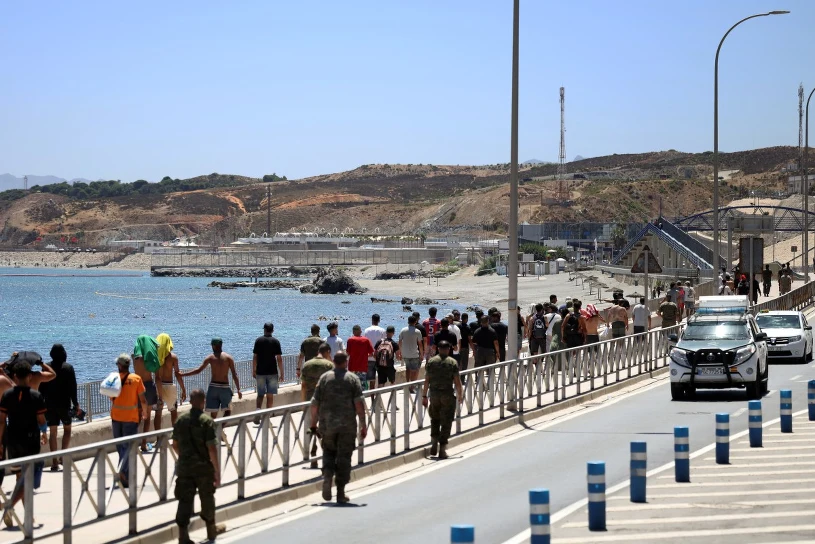
BRUSSELS — EU interior ministers sought to draw a line under five days of bitter recriminations over the arrival of 72,000 migrants in Ceuta, closing ranks behind Spain and accusing smugglers and foreign actors of exploiting the crisis to divide the bloc.
The show of solidarity marked a sharp shift after EU leaders publicly blamed Madrid’s migration policies for creating a crisis they warned could spill across Europe, prompting Italy to suspend air and sea links with Spain.
Following a three-hour emergency meeting in Brussels on Tuesday, ministers praised Spain’s response, stressed that the passport-free Schengen zone had never been at risk and called for tighter coordination among capitals during future migration emergencies.
The meeting followed days of unusually public anger at Prime Minister Pedro Sánchez. In a letter signed by 22 EU leaders, governments demanded tougher action to stop irregular arrivals, while Italy suspended air and sea transit with Spain over fears that migrants could move onward through the Schengen area. Sánchez hit back by urging his counterparts to show “understanding” rather than turn Spain into a scapegoat for a crisis on the EU’s external border.
By Tuesday, ministers were keen to close ranks. The EU’s Migration Commissioner Magnus Brunner said the influx had been “instrumentalized” by smugglers and human traffickers, while French Interior Minister Laurent Nuñez said ministers had condemned efforts to use images of the crossings to divide the bloc.
“The divisions that we have heard over the weekend were not welcome and they were exploited by foreign countries,” Nuñez told reporters. “But what I heard this morning reassured me.”
Brunner declined to speculate about whether Morocco had played a role in the influx. The question is sensitive because Spain relies heavily on Rabat to police departures toward Ceuta, and the episode revived memories of 2021, when thousands entered the exclave after Moroccan forces relaxed controls during a diplomatic dispute with Madrid.
Spanish Interior Minister Fernando Grande-Marlaska instead praised Morocco’s cooperation in bringing the latest crisis under control and described Tuesday’s meeting as “entirely constructive.”
He said 70,000 of the 72,000 people who entered Ceuta had since returned to Morocco and insisted the Schengen area had never been at risk. Ceuta has special arrangements requiring travelers to show documentation before continuing to mainland Europe.
Grande-Marlaska also called Italy’s transport restrictions unjustified and said he expected them to be lifted. He rejected suggestions that the crisis had made Spain look weak.
“Spain has come out looking like a strong, reliable partner,” he said. “This isn’t a matter that depends on testosterone.”
Ministers also called for better early-warning systems, closer coordination between capitals and stronger cooperation with non-EU countries to prevent departures.
Several pressed for faster work on so-called return hubs outside the bloc. Greece proposed an EU mechanism allowing asylum procedures to be suspended and migrants returned immediately in extreme circumstances, according to a Greek government official.
“The EU’s external borders are our shared responsibility, and migration requires a united European response,” said Ireland’s Justice Minister Jim O’Callaghan, who chaired the meeting.
The Commission is expected to consider further measures in September after examining what caused the influx and whether social media helped organize or amplify it. Strengthening the role of the EU border agency Frontex is among the options under discussion.
Max Griera and Nektaria Stamouli contributed to this report.

 Sanchez in Ceuta: Morocco violated Spain's integrity, half of migrants turned back
Gazeta.pl · 4d ago
Sanchez in Ceuta: Morocco violated Spain's integrity, half of migrants turned back
Gazeta.pl · 4d ago
 EU offers Spain emergency funding to reinforce Ceuta border after migrant crisis
Interia Fakty · 1h ago
EU offers Spain emergency funding to reinforce Ceuta border after migrant crisis
Interia Fakty · 1h ago
Comments
No comments yet — be the first to weigh in 👇
No comments yet. Be the first!