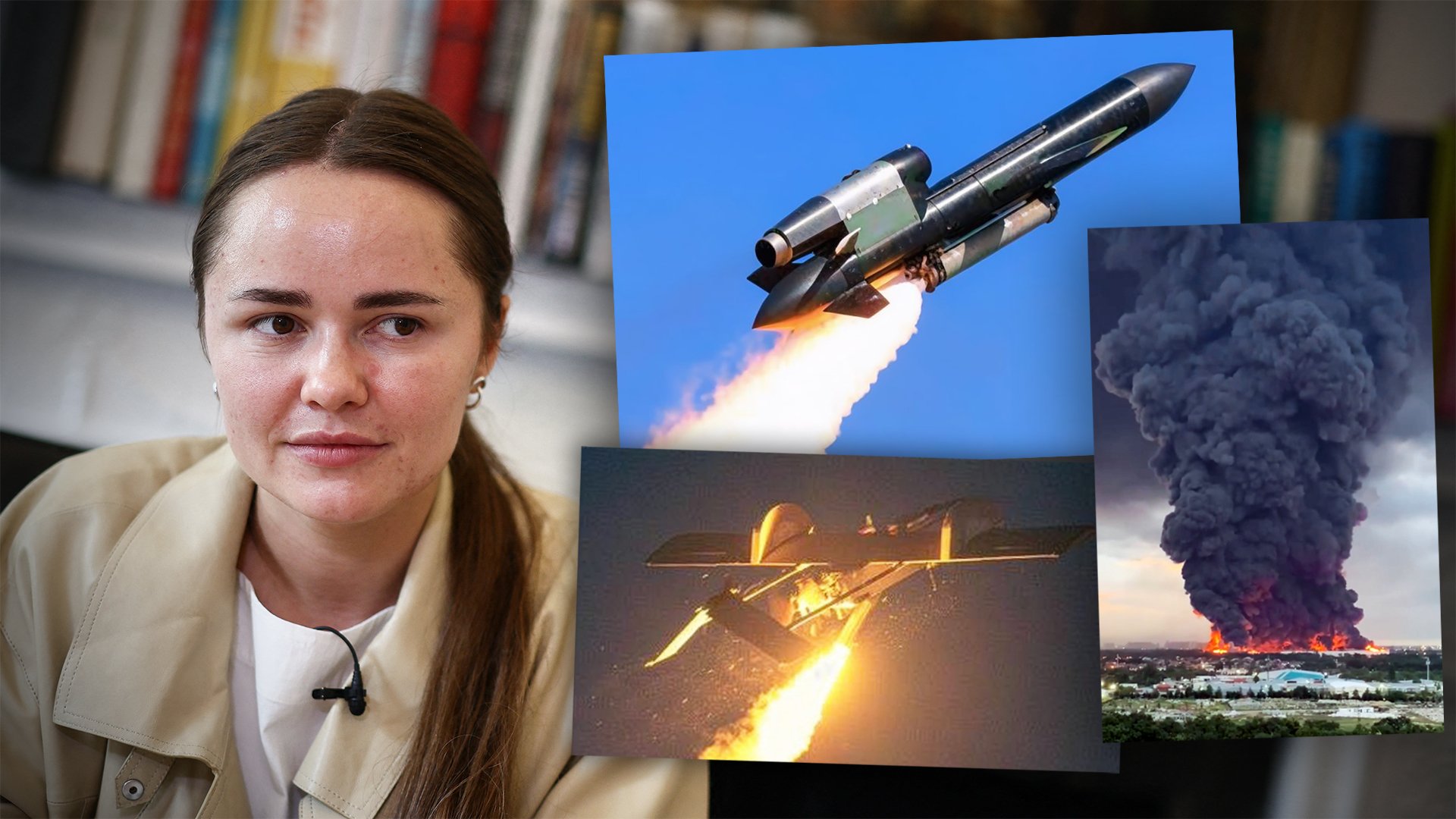
Ukraine's Fire Point builds long-range drones and ballistic missiles from garage start-up
Ukrainian company Fire Point, led by 35-year-old architect-turned-CEO Iryna Terekh, has grown from a garage weapons start-up into a leading producer of indigenous long-range strike drones and missiles. Its FP-1 and FP-2 drones have struck Russian targets to devastating effect, while Flamingo cruise missiles add a new long-range threat. The company is also developing the FP-9 ballistic missile with a range of around 500 miles and the FP-7.x interceptor as a cheaper Patriot alternative.
Full text
As a keen reminder of the threats Ukraine is facing, Fire Point CEO Iryna Terekh had to stop a recent interview with TWZ to scramble to a shelter as Russian ballistic missiles were approaching. A 35-year-old architect by training, Terekh helped turn Fire Point from a Ukrainian start-up making weapons in a garage into a leading producer of indigenously made long-range strike drones and missiles, and we were talking to her about the company’s weapons and future plans.
Fire Point’s FP-1 and FP-2 drones have been striking Russian targets to devastating effect and its heavy-hitting Flamingo cruise missiles are adding a new level of long-range threat.
Beyond these, Fire Point is developing the FP-9 ballistic missile to hit targets up to about 500 miles away and the FP-7.x ballistic missile interceptor , intended to provide a more plentiful and cheaper alternative to Patriot munitions.
Among the many topics discussed, Terekh talked about the status of the FP-9 ballistic missile program, roadblocks to fielding an indigenous Patriot interceptor alternative, how her firm is using AI, why the FP-2 drones were so successful against Russian ships in the Sea of Azov and the challenges of building complex weapons systems while under constant Russian fire. Some of the questions and answers have been slightly edited for clarity.
Iryna Terekh, the CEO of Fire Point, a Ukrainian drone and missile firm. (Photo by HENRY NICHOLLS / AFP) HENRY NICHOLLS
Q: Tell me how Fire Point came to build drones and missiles.
A: Well, we started with the intention to win the war and destroy the Russian Empire, some knowledge in engineering, physics, mathematics, and industrial production, and we started with the FP-1 drone , which was basically the idea behind this. There were two ideas. First is to make an analog of the Shahed drone by technical characteristics, and the second was to utilize a huge stock of Fab 50 bombs . It’s an old Soviet aviation bomb. There was a rumor that there were dozens of thousands of these in Ukrainian stocks, so we decided to build a platform to carry this huge stock.
When we finished designing the aircraft, it turned out that this rumor was just a rumor about the huge stocks of Fab 50s. But anyway, this was a start for FP-1. And when we started to really scale up the production and design a model that would be fitting to be scaled at volume, then we were forced to build a lot of satellite productions around the main production because very soon we met all the possible bottlenecks. And while developing this huge satellite network of productions of the spare parts of different components, we understood that probably we now have enough missiles to go into missile design. That’s the short story.
Q: The Flamingo ground-launched cruise missile , which broke cover last fall , has a claimed range of about 1,800 miles. It uses Ivchenko AI-25 turbofan engines that are commonly found on the L-39 Albatros jet trainer. How many of these engines still exist and how long can you sustain production with those surplus powerplants without switching to something that can be produced en masse cheaply today?
A: First of all, the AI-25 TL was the initial engine with which we started to fly, but this is just one of five different engines that we use on Flamingo. So it’s not the only engine, and Flamingo was initially designed to be flexible and to be able to work with different types of engines. So we can really widen up the stock of used engines.
But at the same time, we started to develop our own turbojet engine with the same design bureau that designed the 25 TL many years ago, and we built it specifically for the purpose of UAV, not for aviation. And it took quite some time, more than a year and a half. And now we are assembling our first 10 prototypes of the future turbojet fan engines of our production.
Q: And when will that be ready?
A: As soon as possible. Obviously it is harder to make a turbojet engine than it is to make a missile.
Q: What’s the timeline?
A: The goal is to finish testing all the samples and making all the improvements by the end of this year, and next year go into mass production.
Q: Fire Point has said that it aims to increase Flamingo production to a daily rate of at least seven missiles by October of this year. This would translate to 2,555 built annually. How can you make this happen?
A: We did not increase the production to these numbers. This is the maximum capacity of our production that we built. Unfortunately, since Ukraine was waiting for the funds coming from the European Union loan, the orders did not match the maximum capacity of the production, so the production was lowered to a lower percentage of what it could possibly provide. We expect to ramp it up to the named number. Probably by the end of this year or beginning next year. It depends on how the contracts will arrive.
Q: How does the Flamingo do its job? Can you run us through what mission preparation, launch, navigation, impact and after action activities look like?
A: I personally place Flamingo in the drone category, despite the fact that it’s a big missile, because the process looks almost the same.
Of course, there are nuances that we need to count on during mission planning, but the mission planning is on the side of Ukrainian armed forces. In terms of our company, as a manufacturer, we do a very detailed after-action review. After each mission, we understand how it reacted to electronic warfare. We were able to do a very effective countermeasure against on-ground air defense systems like Pantsir and Tor. So basically, there is just one threat that is really left for Flamingo, and this is aviation. Against this, we cannot really fight. Otherwise, it’s half of the technical perfection of the missile and half of the art of mission planning. So, to fly as low as possible to plan the mission correctly, to understand the altitudes, we cannot afford the luxury of doing the ramp up before the final attack, because then we would be visible to radars.
Local residents filmed an FP-5 Flamingo cruise missile flying almost directly overhead at extremely low altitude. pic.twitter.com/a4akIKLTag
— Special Kherson Cat (@bayraktar_1love) August 2, 2026
Therefore, when you plan the ramp up picket, it is much easier than to plan a very smooth, almost horizontal few degrees attack.
Anyway, our armed forces already mastered this as well, and from our side, it is important that we provide a navigation solution that is completely resistant towards electronic warfare, jamming, spoofing, any sort of interference, and this we did. So we see the improvements after each mission on both sides, both on our software part and on the mission planning part.
Ukraine’s domestically produced long-range Flamingo cruise missiles are being used in strikes deep inside Russia. (Photo by Murat Usubali/Anadolu via Getty Images) Anadolu
Q: What navigation and target package suites are available for Flamingo at this time? What about in the future?
A: I don’t want to name exact systems for obvious reasons, but it’s a combination of a [ Controlled Reception Pattern Antenna ] antenna, inertial navigation system, of specific software, of additional data sources, and sometimes it’s visual navigation as well.
Q: Olena Kryzhanivska, a defense fellow at the Canadian Global Affairs Institute, recently told the New York Times that the Flamingo missiles have shown “low effectiveness,” possibly because of accuracy problems and that the “results that we see are not the ones that Ukraine would like to have.” How do you respond?
A: Honestly, I don’t respond to such things at all because in the end, we are no magicians. If anybody could create a cruise missile in one year and then already pay back all of the money spent on this missile with the effect of the damage on the enemy’s territory, they can show better and more effective results.
Q: Let’s talk about the FP-9 . Ukraine getting its own ballistic missile is a big deal. What went into developing it and what can you tell us about its design?
A: The FP-9 is a missile that we planned would be able to reach Moscow with a range of 850 kilometers. It required building the whole new infrastructure specifically for casting solid rocket propellants in such a huge amount. The engine itself is 4.6 tons of solid rocket fuel, compared to FP-7, where it’s just one ton of solid rocket fuel, so a whole set of factories of preparation infrastructure.
Anyway, as we are speaking now, the engines are being cast. Therefore, we expect test launches soon, as soon as possible. The navigation solution, everything else on this missile is already ready. So basically, it’s the last touch on the engine, and we are ready to start.
Q: So when will it be operational? It hasn’t been used yet, right?
A: No, we are preparing for the first flight.
Q: When do you think that will be?
A: I understand the curiosity behind the question on when exactly this would happen, but we have our specific dates in mind where we are aiming. But I don’t like naming them because a lot of things could go wrong on the way, so my expectation is that this would be autumn. I would not specify better at this moment.
Q: For the FP-9 ballistic missile, Ukraine had to build a new solid-fuel engine casting facility. How difficult was that and what is the status of it?
A: Obviously, it was quite a challenge because we do have such a factory. Ukraine had such a factory in Pavlograd, but Pavlograd is under constant attack , and also they’re using a little bit different technology for that. We understand if we do not build an alternative to Pavlograd, then we will have no future for the missile program.
So we built multiple factories in Ukraine and one in Denmark for the sake of solving this task. Of course, it’s extremely challenging. It’s equipment. It’s mixers for casting. It’s a specific post-curing process, casting process. This is a dangerous production, and we had to reinvent in a way this whole technology almost from scratch. Therefore, it was quite a challenge, but I like how it went out. Since we are already casting a lot of solid rocket fuel for smaller rockets, I like how it’s developing and how it’s going.
Q: How difficult is it to put all this together from so many dispersed locations?
A: Well, the logistics are hell, to be frank (chuckles). But we do not have the luxury to have the factory in a classic way, with the walls and roof, we if when I say factory and we have 90 of them in the moment, when I say factory I mean this whole ecosystem with logistics, with warehouses, everything is hidden and dissolved in a way that the critical components are always duplicated, triplicated, quadruplicated. It’s a lot of additional investments and, of course, a lot of risks and a lot of additional time for logistics specifically, but again, we do not have any other choice. Therefore, the factory in this matter is a whole ecosystem.
A render of the FP-9 ballistic missile. (Fire Point)
Q: Fire Point claims that Ukraine can build missiles faster than Russia by building cheaper, less complex missiles. How would that work?
A: I personally believe that if you want to build something in volume, you need to think of this from day one of future product development, and this is probably a critical thing that we changed in this culture at Fire Point. So understanding how the production works is a very important thought to be established as a fundament of the future development. So in practice, how it looks when we start the R&D process, our chief designer has a lot of ideas. But I have the power to interrupt and to block any idea that will not be possible to mass produce later. Therefore, we are rethinking and rethinking until we get the solution that is possible to mass produce.
And when you think of this in the design stage, then of course it is easier to do it. In fact, and also technological sovereignty is very important for all the critical components and processes. We have our own capabilities inside Fire Point, all the critical, even the machine production. So we do cover lots of things. We rely at least on subcontractors and contractors, and we try to set up the maximum control over the supply chain.
Author’s note: At this point Terekh stops talking and looks at her phone.
Terekh: I am looking to see if this is a ballistic missile attack or not. Yeah, it’s ballistics. So, I would be glad to maybe talk more with you on this point, but I have to evacuate now to the shelter. The flight time is like two minutes.
The scene of a Russian missile strike just outside of Kyiv where six people were killed and dozens injured on July 24, 2026. Iryna Terekh had to seek shelter during this widespread attack. (Office of Ukrainian President Volodymyr Zelensky)
Author’s note: A week later, we continued the conversation.
Q: Can you talk about the arrangement with Diehl Defense to build Flamingos in Germany? How does this help Fire Point and Ukraine? Can you provide any details about the new seeker Diehl is working to outfit the weapon with and any other details about how Diehl will improve the munition?
A: I cannot provide many details yet because the negotiations are ongoing. But basically, in terms of Germany, we are in negotiations with Diehl Defense, they initiated this discussion. We, I’m sure, can be a mutually interested industrial partner for each other. There is something that Diehl can bring to the table in terms of technology. There is definitely something that we could bring to the table in terms of technology and industrial knowledge.
So I consider such types of negotiations and cooperations very useful. Because the way big primes rethink their future by learning from Ukrainian companies and at the same time using their legacy knowledge for future development – I think is very fruitful for both sides. And of course, it all started by an initiative of the German government because everybody wants to have long-range capabilities of domestic production.
Visitors walk at the stand of Ukrainian defense technology company Fire Point during the Eurosatory land and airland defence and security trade fair, at the Paris-Nord Villepinte Exhibition Centre in Villepinte, north of Paris on June 15, 2026. (Photo by Guillaume BAPTISTE / AFP) GUILLAUME BAPTISTE
Q: Let’s talk about the FP-1 drone. Created in 2023, it has been widely used in Ukrainian attacks on targets deep inside Russia. How did you ramp up production of this system and improve it to keep it effective against always adapting Russian defenses?
A: At the beginning, I thought that just constantly analyzing the feedback in a correct way, and then adapting and making changes would be enough. But from today’s point of view, I would say that’s definitely not enough. You have to be so deep in the context of what’s happening on the front line, and in general of the development of enemy tactics of electronic warfare. So you have to be able to make some sort of forecast and try to predict what will happen in the future, find a solution for this future problem, test it, validate it, and when the problem actually comes, you have to have something on your shelf already ready for solving this solution.
So we are trying to trick the timelines a little bit, even if in some cases, my forecasts are not correct. Eighty percent of the time, they are correct, and that’s definitely enough to always keep up in this technological race.
You can see video of an FP-1 drone being used in an attack below:
Impressive footage of the double strike by Ukrainian FP-1 kamikaze drones on the Moscow Oil Refinery and a lazily flying Pantsir-S1 SAM missile in the background. pic.twitter.com/sqiDEaPMBS
— MilitaryNewsUA (@front_ukrainian) June 18, 2026
Q: There are now two configurations of this drone, one for longer range and one for a larger warhead. Can you talk about them and how they were adapted to be useful over such a wide range of target sets?
A: You know, when we just made the FP-1, it was just 700 kilometers, and then we found a way to increase the distance and increase the accuracy as well. The same logic happened with FP-2. It started as a middle strike of 200 kilometers, and now it’s up to 500 kilometers. So these are gentle improvements, or as I call them, nuanceful improvements. You can work with an engine. You can work with engine consumption. You can work with reassembling some part of the aircraft in a way that is more aerodynamically effective. So when you make a product that you are satisfied with, there is always room for improvement, to be frank.
In the case of the longer-ranged version of FP-1, it is a little bit more complicated in production. So it’s not possible, at the moment, to make 300 of them per day, but it allows us to go such long distances. It has a different wing. This wing contains additional fuel tanks, and there are also some minor improvements here and there that provide this result.
An employee assembles a long-range drone in a workshop of the Fire Point company, which manufactures FP-1 deep-strike drones and FP-2 strike drones in an undisclosed location in Ukraine on January 29, 2026, amid the Russian invasion of Ukraine. (Photo by Serhii Okunev / AFP) SERHII OKUNEV
Q: And the FP-2?
A: The same logic. It could be different changes, but the same logic.
Q: Can you provide any insights into the ongoing Sea of Azov campaign against Russian shipping that relies heavily on the FP-2 drone? What makes this a good weapon for such attacks?
A: It is controlled manually. There is additional AI assistance on that control. So basically, that makes it the best option to fight dynamic moving targets. Especially, it has multiple options for content streamline. I would explain it like this. So, in case one type of connectivity does not work, there are other options for this as well, and it is very effective when you are controlling your aircraft in real time. Then the pilot can target the most vulnerable part of the ship, and unfortunately, as far as I can see, these are the only sanctions that our enemy really understands.
Q: What other options are there when one type of connectivity doesn’t work?
A: I don’t really want to share exactly what the setup we use is because the more detailed I will explain it, the faster the enemy will find the countermeasures for this.
The following video shows Fire Point drones being used to attack Russian ships in the Sea of Azov:
Magyar’s update: Another bad day to be a tanker.
28 shadow de-fleet vessels of the rf hunted down overnight on 11 July in the Sea of Azov by the Birds of the Unmanned Systems Forces.
A total of 76 vessels were struck over six days (06–11.07.26). The Molochka is doing its job.… pic.twitter.com/nhM9Di3DRg
— 414 Magyar's Birds (@414magyarbirds) July 11, 2026
Q: News reports state that you look to arm this drone with rockets to take on multiple ground targets at standoff ranges. Can you talk about this concept and how you aim to see it be used on the battlefield?
A: Actually, the FP-1 and FP-2 are pretty universal platforms. There are so many versions of this that we didn’t announce it publicly yet, however these airplanes can make a lot of different side quests, and one of these side quests is of course carrying uncontrolled short-range missiles. We do have a huge stockpile of this missile in the Ukrainian army that is not largely used, and it is the way to utilize them with the most possible sense. It helps to counterattack the mobile interceptor groups, and when the aircraft is done with letting the missiles out, it can go further for the initial mission. So it’s really like a side quest.
Q: What kind of rockets are you talking about?
A: Old Soviet 57mm S-5 rockets .
Q: How many S-5 rockets can it carry?
A: But it could be any, to be frank. But that does not matter much.
Q: But how many can the drone carry?
A: Eight.
You can see an FP-1 drone launching rockets in this video:
A Ukrainian FP-1/2 kamikaze drone launches an unguided aerial rocket at a Russian mobile air defense group during a raid on Crimea tonight. pic.twitter.com/3HwnJbe1La
— MilitaryNewsUA (@front_ukrainian) May 12, 2026
Q: How do you use AI in these drones and other weapons ? Where is this headed in the future?
A: Since we are using quite a big platform, our user experience with AI is slightly different from smaller FPV or reconnaissance drones. We use it for visual map-matching for final target corrections. But I do not say that it’s largely changing the narrative of how we’re using drones because I still believe there should be a person behind making a final decision. So we do use AI a lot in our daily work in software development, in technical consultancy, but in terms of directing the flight, it is still in the end a human who makes the final decision.
Q: Do you use man-in-the-loop or man-on-the-loop?
A: Both.
Q: Can you provide more details about how you use AI in the terminal phase of an attack?
A: There are multiple versions for this type of terminal work. At the moment, we are mostly at the point of collecting more precise data for more inertial platforms like ours. At the same time, it helps to correct and lead the aircraft if the connectivity is lost for quite some time because it has the target recognition possibility and the final targeting as well. But it should still be human-in-the-loop at this moment.
This photograph shows a long-range drone during its’ assembling in a workshop of the Fire Point company which manufactures FP-1 deep-strike drones and FP-2 strike drones in an undisclosed location in Ukraine on January 29, 2026, amid the Russian invasion of Ukraine. (Photo by Serhii Okunev / AFP) SERHII OKUNEV
Q: Where is this headed in the future?
A: You know, AI companies are now hiring philosophers to decide on where it’s heading in the future. My perfect scenario would be that we will use AI for finding alternative deterrence options. What I mean is, instead of just relying on nukes as a deterrent, it could be that we will build some sort of drone walls, or we will operate the kill zones where the decision-making would be solely on AI.
There are pros and cons to this as well. For example, we all knew of cases where Russians were infiltrating their agents in the governments of different countries, and when it came to making a fair response to barbarian actions, somebody sabotaged this fair response. So probably AI could be an instrument to provide an immediate response for aggressive actions in the future of whoever this could be, the aggressor. I don’t have a clear answer. Obviously, we are all thinking about this: to what point we can delegate the responsibility, and it’s still an open question.
Cool animated video by Ukrainian company Fire Point on the latest upgrades for their FP-2 and FP-2 strike UAVs.
The FP-1 can now fly up to 3400 km carrying a 60 kg warhead, while the FP-2 can reach 700 km with a 200 kg warhead. https://t.co/sFA9sLdXvB pic.twitter.com/fiu3dUw60z
— Roy (@GrandpaRoy2) July 29, 2026
Q: Satellite communications are also key to long-range strikes against dynamic targets like ships. How has the miniaturization of this technology changed how your products are used?
A: Miniaturization is crucial, but that is all the detail I can share at this stage.
Q: Let’s talk about Project Freya and the FP-7.x interceptor missile you are developing . Who is providing the seeker to make this work? What is the timeline and what are the expected costs per interceptor? And how will it compare to PAC-3 Patriot?
A: We are working with two European and one Ukrainian company on secret development, and I don’t know which of the options would be the fastest out of this. The final goal is to make the whole interceptor cheaper than 1 million euros. I think with the expected price range of the seekers that we discussed with our partners, this is doable. Probably not from the first iterations, but definitely in serial production.
Q: What seekers are you using, and from which companies?
A: I t is [imaging infrared] seekers . One deal is public, so one option is from Diehl Defense that we are currently integrating. The other is – I don’t know if they’re comfortable with public disclosure yet, so I have to talk with them first.
Q: What’s the timeline for this?
A: Nobody can answer at this point. So the deep technical integration is happening right now. We expect, of course, it to be in the nearest months, because the seekers aside, we are on a good level of readiness. But nobody can answer this point.
Q: What’s the major issue that still has to be overcome?
A: On technical integration?
Q: On being able to produce the interceptor at scale.
A: If we look at everything but the seeker, our production is already ready, even for mass production, and we finished all the tests on this matter. But the amount in which we will have seekers and their accuracy and the results of technical integration – it’s still something that we are cooking at the moment. Of course, we will be doing our best to maximize both the accuracy, the energy consumption, and the mass production in the future. But we have to understand that even the seeker manufacturers are doing this for the first time in such an integration. So it requires a lot of talent, a lot.
Держави програють війни на полі бою значно рідше, ніж вони програють їх у інститутах, лабораторіях та на виробництві за десять років до їх початку.
Коли країна роками недофінансовує інженерну освіту, скорочує дослідження, втрачає виробничі компетенції або звикає покладатися на… pic.twitter.com/Ti1Ayn4INf
— terekh (@iraterekh) June 3, 2026
Q: How will it compare to PAC-3 Patriot interceptor ?
A: The PAC-3 is a different missile designed for different consumption levels. I think FP-7.x is more comparable in the first iteration to the Patriot PAC-2 because we do not expect immediate success with hit-to-kill, and the first interception we expect to do with the blast interception. Hit-to-kill is the next iteration. So at the beginning we will have more the analog of the PAC-2, but more mass-produced and cheaper.
Q: How many do you think you will be able to make?
A: From our side, we are ready to make almost an infinite amount. So we are targeting to do at least 2,000 a year as a starter, and then develop the production. Right now, we are solving the bottlenecks again, especially on the seeker part of this. But everything that is dependent on Fire Point, we can scale these numbers up.
A rendering of the FP-7 surface-to-surface ballistic missile on which the FP-7.X missile is based. (Fire Point)
Q: What do you think about the Patriot interceptor licensing deal Presidents Trump and Zelensky discussed before the American leader backed away from that? Would this affect anything you are doing?
A: No, it could be a good addition to what we are already doing.
Q: Why?
A: Because, in my opinion, every industrial corporation is like the greatest university of all. And the more you cooperate with different companies – there are not that many companies in the world who can produce anti-ballistic capabilities, and we have to kind of stay together on solving massive threats.
President Trump said that the United States has not agreed to Ukraine building Patriot missiles but that talks are ongoing, adding that the US must be 'very careful about letting somebody build them' https://t.co/EoFTSuoM6I pic.twitter.com/Ba1wavxM7S
— Reuters (@Reuters) July 31, 2026
Q: On his last day as defense minister, Mykhalio Fedorov wrote that “a successful ballistics test was conducted, which was developed within the Ministry of Defense’s area of responsibility. We significantly changed the technical specifications and demonstrated maximum accuracy. We reduced the price by 30%. Ukraine will enter a new league.” Is this something you are working on or is it the government-run Sapsan program? What can you tell me about this?
A: I don’t know what exactly his words meant to be about because around the same time we were both testing our missiles and Pivdenne was testing theirs [the Sapsan], but from what I know, Sapsan also got a big improvement, and they had recently one of their first big successes with accuracy and technologically. So I think probably he meant both of us or just Sapsan. I don’t know.
Moscow has a new reason to worry. Ukraine has tested a new ballistic missile
In his farewell post, Mykhailo Fedorov revealed that successful tests of a Ukrainian ballistic missile took place on the very day the government stepped down. He did not specify which missile it was.… pic.twitter.com/PoprVjAUx8
— NEXTA (@nexta_tv) July 16, 2026
Q: A little more than six months after naming the tech-savvy Fedorov defense minister, Zelensky fired him , ultimately replacing him with Major General Yevhen Khmara , who now serves as acting defense minister. How has the change in command in the Ministry of Defense affected Fire Point and Ukrainian domestic weapons development in general?
A: I think in general, our president has a big vision on why he’s doing specific things. The team of Mykhailo Fedorov helped a lot to develop Ukrainian industry, specifically with removing a lot of bureaucracy from the process. I think this initiative alone was the reason why Ukrainian industry is looking like this today. It was back in 2023. But the new minister is a war person. He is deep in the knowledge of asymmetric actions. So we expect a positive future.
Q: Fire Point has talked about the need for a Medium-Altitude Long-Endurance (MALE) UAS armed with a 30mm cannon that can intercept glide bombs before they hit their targets. What details can you provide about that?
A: There is a version of this, like an interceptor. We have multiple versions for interceptors on the platform of FP-1. One is with a gun, the other with small interceptors, like the ones that are popular now, the [ General Cherry] Bullet interceptors . And there are also a few other options. As I mentioned at the beginning, it’s a pretty universal platform that can do a side quest.
Q: What kind of gun are you talking about?
A: Honestly, it was created to intercept Shaheds. I think for intercepting the glide bombs, it’s almost impossible to do so after the glide bomb has left the aircraft. It looks unrealistic to me, to be frank. Maybe, there would be a way, for example, to try and catch the aircraft before it launches. But the most effective way to fight glide bombs is to destroy Russian aviation, and I don’t know yet a more effective way to do this.
Russia may have brought back UMPB-5R jet-powered glide bombs. Recent strikes suggest the weapons can reach targets about 150 km away. https://t.co/xiZ6Nf0H1X
— Militarnyi (@militarnyi) August 2, 2026
Q: What else is on the horizon for Fire Point? What new capabilities and platforms are you looking at developing and what battlefield realities are driving those developments?
A: Aside from everything that is well known, we are also focusing on creating our own satellite constellation , so we have an independent connectivity for the drones. So this is one of the focuses, and of course we are working on improving the autonomous flight for the drones, so there are many small and big developments, but the biggest one is probably satcom.
Q: Tell me about this. Are you actually going to launch your own satellites? Are you building satellites for someone else to launch?
A: We are working together with a company that produces satellites, and we are also starting to develop our future possibility to deliver satellites. We are far from that yet, but we already have the equipment, and we already are experimenting with the bigger rocket engines. So this development had already started. It’s not the main focus at the moment, of course, because at the moment we have to win the war first. But this is something we are preparing for the future.
Q: What company are you working with?
A: Again, I have to talk with them whether or not they want to be public.
Q: Finally, what about Fire Point as a weapons exporter? Where do you see the company as a global arms provider in the near future and after the war hopefully ends?
A: We have a big interest from a majority of European countries to have Fire Point products in their armies, and we already started to work on that because they all saw the threat that may potentially come from Russia. Of course, we also have other negotiations, but now we have to be more careful how we ensure that our products do not wind up with the bad guys. So every export movement would be treated with the maximum cautiousness.
This photograph shows parts of long-range drones stored in a workshop of the Fire Point company which manufactures FP-1 deep-strike drones and FP-2 strike drones in an undisclosed location in Ukraine on January 29, 2026, amid the Russian invasion of Ukraine. (Photo by Serhii Okunev / AFP) SERHII OKUNEV
Q: How could your weapons land in the hands of the bad guys?
A: Ah, that’s a good question, how these deals could be possibly secured from being redirected to the wrong place? We have a huge level of trust with our partners, but those countries that are new to us, we do not yet have this relationship and this level of trust.
Q: Are you selling any weapons right now to either the U.S. or, say, some of the Gulf Arab nations, given what’s going on there?
A: Not at the moment.
Q: Are you in negotiations with the U.S. and/or Gulf Arab nations?
A: Yeah, we have a lot of negotiations and discussions going on in parallel. I will comment once the negotiations are successful.
Ukrainian workers use 3D printing and carbon fiber at a secret factory to build and fit wings, components, and fuselages of FP-2 drones, made by the Fire Point defense company, for deep-strike attacks inside Russia that have targeted Russia’s energy infrastructure and military logistics hubs. (Photo by Scott Peterson/Getty Images) Scott Peterson
Q: Are there any weapons or products that you’re developing that I haven’t asked about?
A: I think it is important to understand that we will soon consider all the weapons more in terms of security subscription rather than actual hardware product.
Q: What do you mean?
A: I mean the amount of updates that we make, even on the software side, is huge and happens so often. It kinda reminds me of how you update your smartphone. This does not mean that you have to buy each new smartphone every month, but the software updates quite fast, and also could be that in a year or two you will need a new smartphone. So Ukraine is rethinking the weaponry more in the possibility of how the company can ensure that the army will always have a capability, and how this capability is provided is now a headache of the company.
So in the old model, when a defense contractor delivers the contract, that’s it. Maybe after some time he will be called for maintenance. But our responsibility isn’t finished on the day that we deploy the weapon, but after I finally receive the post-flight analysis and I’m happy with this. So the whole logistic services, software updates, up-training, any changes that are happening on the way we do by ourselves. The end user can focus on launching and planning the missions, and of course we work shoulder to shoulder to ensure that we will use the battlefield data to a maximum level of usefulness.
The post-Cold War order was built on assumptions russia never shared.
Today’s queues at the Fire Point stand suggest Europe has understood the assignment.
Exceptional second day at Eurosatory. pic.twitter.com/hwMLEMcZXN
— terekh (@iraterekh) June 16, 2026
Q: What can the U.S. learn from Fire Point?
A: Make the market more transparent and attractive to younger startups. Remove bureaucracy as much as possible, share the risks with the contractors to make everybody more flexible, and probably that’s it.
Contact the author: howard@twz.com
The post Ukraine’s Fire Point CEO On How It’s Making Missiles And Drones To “Destroy The Russian Empire” appeared first on TWZ .
Similar stories


Similar stories
Can Ukraine's domestic weapons production change the course of the war?
Comments
No comments yet
Comments
No comments yet — be the first to weigh in 👇
No comments yet. Be the first!